Welcome to Boise’s newest suburb: Small-town charm. 45-minute commute. Is it affordable?
READ MORE
Affording Boise: Rental housing
Soaring rents. Skyrocketing home prices. The double-digit rates of increase in the costs of Boise-area housing create increasingly urgent problems for low-income, working-class and even moderate-income Idahoans who need places to live. Affording Boise is a series of Idaho Statesman special reports on housing. This collection focuses on rental homes, including apartments. A separate collection focuses on homeownership.
Expand All
Driving down Freezeout Hill during springtime, generations of motorists headed toward Emmett would breathe deeply to catch a whiff of the light fragrance of cherry blossoms in bloom on both sides of Highway 16.
Closer to town, the scent of freshly cut lumber wafted from a Boise Cascade mill. And during the heat of August, a less desirable smell floated through Emmett, that of rotting corn scraps from a Stokely-Van Camp cannery.
For decades, the lumber mill, built in 1916, provided the lifeblood of the community built along the Payette River 30 miles north of Boise. Boise Cascade once employed more than 1,300 people there, but a series of downturns in the wood products industry brought layoffs in the 1980s and led to the mill’s closure in 2001.
Some residents moved away. Empty storefronts lined Main Street where Noland Drug Store, Western Auto, Harrison’s Variety and Alma’s Cafe once thrived.
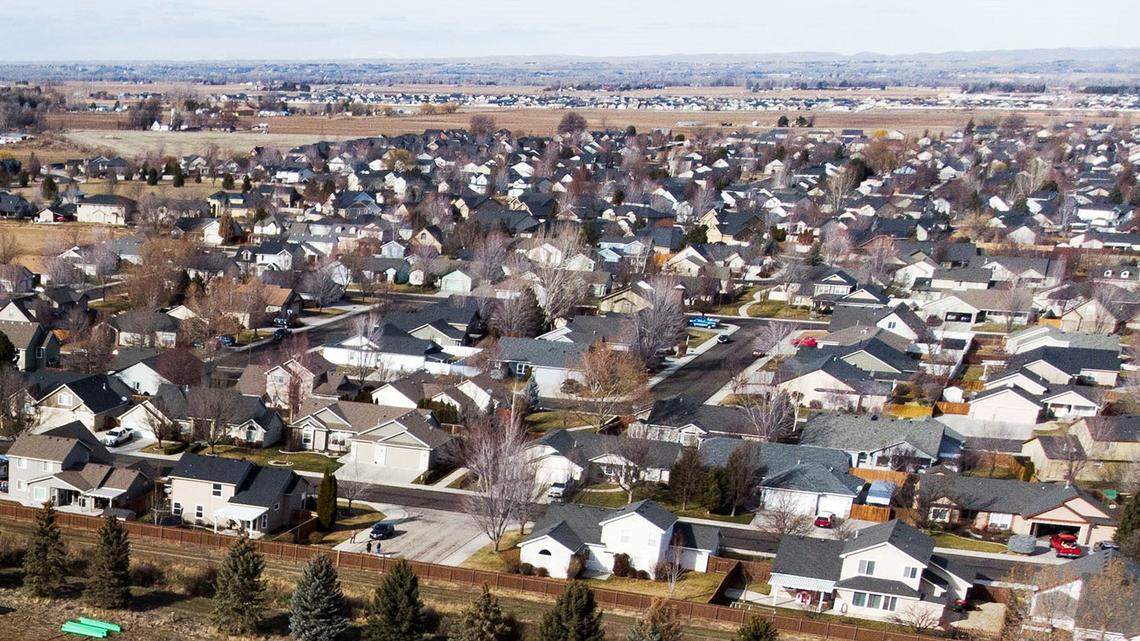
Now Emmett is rebounding. And more than that: Despite its distance from Idaho’s capital city, Emmett is becoming a Boise suburb. Homes with large acreages not found in other Treasure Valley cities are being sold to refugees from increasingly crowded and expensive Boise. More than 300 new homes are in the pipeline.
But the 45-minute commute to Boise doesn’t make Emmett’s housing affordable. Homes aren’t cheap: The median price for homes sold in Gem County in January and February was $500,000, according to the Intermountain Multiple Listing Service. That’s only $45,000 less than the median price in Ada County during those same two months.
“I think Emmett has blown up the way it has because you’re far enough from the hustle and bustle, but close enough to do easy shopping at Costco or Home Depot,” John Evans, a real estate broker who grew up in Emmett and is co-owner of Evans Realty, said in an interview.
“We have some out-of-state people coming in, but usually what happens is people come from the Treasure Valley,” Evans said. “They realize Emmett is a better place to live, because it’s what everyone is looking for. We have a lot of people from Kuna, Meridian and Nampa who feel it’s getting too cramped there, so they’re moving out this way.”
Population crept up slower than in other towns
Emmett’s population has grown 35% since 2000, increasing from 5,500 in 2000 to 7,400 this year. Yes, that growth rate pales in comparison with Middleton, where the population tripled to 9,300; Star, which now has 11,822 residents after beginning this century at 1,795; or Kuna, which with 25,131 residents is five times larger than in 2000.
But it’s significant for Emmett. And more people are coming.
“We’re kind of like a hub here,” Evans said. “We’re 30 minutes from Caldwell. We’re 30 minutes from Nampa. We’re 45 minutes away from the Boise Airport. The atmosphere in Emmett is still a small-town environment where people know their neighbors.”
Emmett has spent several years making infrastructure improvements to handle the expected growth, said Mayor Gordon Petrie, a retired Idaho magistrate and district judge. With near-record low inventories of housing available over Freezeout Hill in neighboring Ada and Canyon counties since December 2016, it was only a matter of time before buyers started looking at Emmett, he said.
“We had to plan for it,” Petrie said by phone. “We knew it was coming when we saw what was happening over the hill. We started planning for the growth.”
Emmett was part of Shoshone-Bannock Tribe homeland
Emmett has a classic Western story to tell. Native Americans, members of the Shoshone-Bannock Tribe, roamed the area for thousands of years. Fur trappers were spotted as early as 1818. Settlers came to the Emmett valley after gold was discovered in the Boise Basin in 1862.
Two stage and pack train routes met along the Payette River, named for French-Canadian fur trader François Payette. That’s where, in 1863m Nathaniel Martin and Johnathan Smith operated a ferry and established Martinsville. The village later became known as Emmettsville, after Emmett Cahalan, the son of early settler Tom Cahalen. The name was later shortened to Emmett.
Early settler James Wardwell platted the town in 1888, and Emmett was incorporated in 1900. Two years later, the Payette Valley Railroad built a 30-mile line from Emmett to Payette, and the Idaho Northern Railroad brought service from Nampa, with the line later extended to McCall. Both railroads, which hauled lumber, fruit and other products, were later bought by Union Pacific.
When the Boise Payette Lumber Co. announced plans in 1916 to build a sawmill on a 300-acre site on the banks of the Payette, it was touted as the “most modern lumber mill in all of Idaho — or all the Northwest, for that matter,” according to an Idaho Statesman story. Timber was plentiful along the Payette River basin north of Emmett to McCall.
The mill’s opening led to a 20% increase in Gem County’s population, to 1,600.
In 1957, Boise Payette Lumber Co. merged with Cascade Lumber Co. to become Boise Cascade. The Emmett plants, lumber, plywood and beams, were part of the Boise company’s corporate region that included plants in Horseshoe Bend and Council.
Once known as the “Valley of Plenty,” Emmett was famous for its cherries, apples and peaches. It was a center for the production of turkeys, chickens, geese and ducks. Dairy farmers abounded, and many farmers grew clover and alfalfa seed.
Emmett and Gem County were also known for cattle and sheep production. Gov. Brad Little’s grandfather, Andy Little, who lived in a mansion at the east end of 4th Street at Substation Road, was known as the Sheep King of Idaho. The mansion was later owned for awhile by former Arizona Cardinals quarterback Jake Plummer, a Boise native.
Main Street was once filled with shops
The prosperity fueled by the mill persisted for several decades. Into the 1980s, Emmett boasted three furniture stores, two hardware stores, a pair of grocery stores, several mom-and-pop food stores, three new car dealers and three drive-in restaurants within a 500-yard stretch of South Washington Avenue, one of the city’s two main drags. Many of those businesses shut down after the well-paying mill jobs disappeared.
The sawmill shutdown idled 300 workers. The manufacture of laminated beams continued on a limited basis, but that, too, ended in 2011, following the Great Recession.
After the crash, during a time when the unemployment rate in Gem County was 12.7%, empty storefronts lined Main Street. Even the Idaho Youth Ranch, which opened a thrift store on Main in 1993 — Emmett native Kenny Keene, a former World Boxing Council cruiserweight champion, cut the ribbon at the opening — fell on hard times and closed in 2018. It occupied the former Safeway where Joe Albertson once worked.
A 5-mile extension of Highway 16 — the main route to Emmett from Boise, Nampa and Caldwell — from Chinden Boulevard to Interstate 84 will begin construction this summer. It will bring shorter commutes from Emmett and is expected to bring added housing demand and business interest.
“When they first started talking about it, I used to get five to six calls a week from people wanting to buy businesses and bring stuff in,” Evans said. “There’s a doughnut shop sale that’s pending along with a restaurant. People are looking for that kind of small business.”
Residents have long shopped ‘over the hill’
For decades, business owners complained about Emmett residents “going over the hill” to buy cars, clothing, furniture and appliances. They still do.
But Emmett has also had some luck attracting new businesses. Over the years, Arctic Circle and McDonald’s added restaurants, along with Idaho Pizza Co. Bi-Mart, Zamzows, D&B Supply, Walgreens and Tractor Supply have all opened in recent years
“But we don’t have a great big plant out here,” Tina Hefley, CEO of the Gem County Chamber of Commerce, said by phone. “We don’t have a Micron Technology,” referring to Idaho’s largest employer, with 5,600 workers in the Treasure Valley.
Ambitious plans for old Boise Cascade mill property
Emmett’s growth has contributed to a small resurgence in wood-products manufacturing, although not on a scale with the old Boise Cascade mill. There’s hope that demand will continue to create a market for locally produced goods.
Fruitland company Woodgrain Millwork bought Emmett’s Gem Forest Products in 2016. The company operates from a small portion of the old Boise Cascade plant, supplying lumber to the company’s Fruitland manufacturing plant.
Tiny Idahohomes also has a plant on the old mill property. It manufactures eight models of small homes on wheels that offer from 20 feet of space lengthwise for $41,500 to 38 feet for $86,000. The company was previously located in Caldwell.
Developer John Wood owns more than 60 acres of what is now known as the Mitchell Industrial Park. He named it after the late Sam Mitchell, an Emmett native who worked at the mill for 50 years.
“We have a bunch of businesses out here that are hiring local people working in the community,” Wood said by phone.
Wood is a partner in Stoney’s Road House, a bar that has attracted a stream of nationally known country bands since last summer. The Marshall Tucker Band, Colt Ford, Rodney Atkins and Neal McCoy have performed.
Wood has even grander plans for the mill complex. He’s working to develop an RV park, a special events center and a 1.2-mile race course for sports cars and go-carts. He even has a large outdoor screen to show drive-in-style movies.
“I want to do fun stuff,” Wood said. “The people in Emmett are really proud of this town. It’s a neat thing for me and my family. It’s a labor of love out here.”
Home prices approach Boise-area prices
Emmett, like Boise, used to be affordable.
A decade ago, the median home-sale price was $107,500 — 79% less than it is today. Five years ago, the median price had risen to $173,615. The median price in Ada County was $153,950 in 2012 and $250,000 in 2017.
As in the Treasure Valley, the house-price escalation makes it hard for ordinary Gem County workers to buy houses. The median household income in Gem County in 2020 was $53,720, compared with $69,952 in Ada County, according to the U.S. Census Bureau.
“The hardest part is watching young kids trying to buy a house nowadays,” Evans said. “It’s so expensive, and couples really need to have two jobs, and if they need a loan they’ll be competing against a cash buyer.”
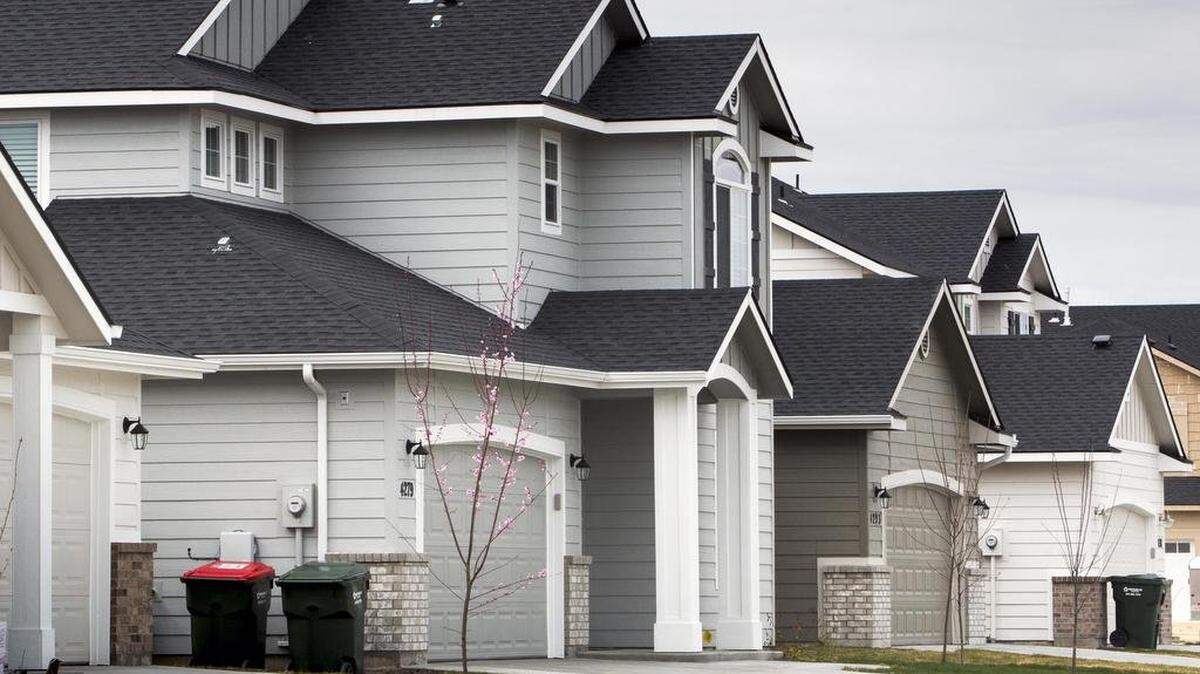
Houses in the new, 250-home Highland development are going up near the base of Freezeout Hill coming into Emmett on Idaho 16 on land owned by Gov. Little’s family. They’re priced from $447,000, for 1,645 square feet, to $625,000, for 2,684 square feet. It’s the largest housing development ever in Emmett, Evans said.
The project has several builders, including Toll Brothers, the nation’s largest homebuilder; Tresidio Homes; Agile Homes; and Sunrise Homes.
A second development, Harvest Valley, begun in the early 2000s, was stalled by the Great Recession in 2008 and started up again several years later. Evans said more than 200 homes have been built east of Substation Road and north of the Highland development.
For a long time, Emmett was seen as too far to commute to Boise, Nampa or Caldwell for work. Now, Toll Brothers touts its nearness to the Treasure Valley: “Toll Brothers at Highland’s proximity to State Highway 16 provides a swift commute to Meridian or Boise, along with convenient access to shopping, dining, and entertainment,” the company said in a news release promoting its 14 new homes.
Petrie and Evans said a lot of people moving in work at jobs that require them to drive to Boise or other towns.
“The vast majority go over the hill,” Petrie said. “There’s a big commute with just a constant stream of cars at certain times of the day.”
Even with the added traffic, Highway 16 seems adequate to handle the load, Evans said. There hasn’t been a push to widen the road to four lanes.
Lifelong resident Kris Howe, 67, said she worries that the growth and increased cost of housing are changing the nature of Emmett as a small community where people look out for one another.
“When I was growing up, everybody in the community was willing to pitch in and help each other, and they’re just not doing that anymore,” Howe said by phone. “You hear isolated stories that somebody went through the drive-thru at McDonald’s, and the car in front of them paid for their meal. But otherwise it has a totally different feel than it used to.”
This story was originally published March 24, 2022 at 4:00 AM.