The Idaho Statesman hosted a debate on ranked choice voting. Here are key takeaways
READ MORE
Idaho Elections 2024
Learn who’s running for state and county offices in Ada and Canyon counties, and follow our coverage of the May 2024 party primaries and the November 2024 election.
Expand All
The leader of Idahoans for Open Primaries got on stage with a national opponent of ranked choice voting on Thursday to debate Proposition 1.
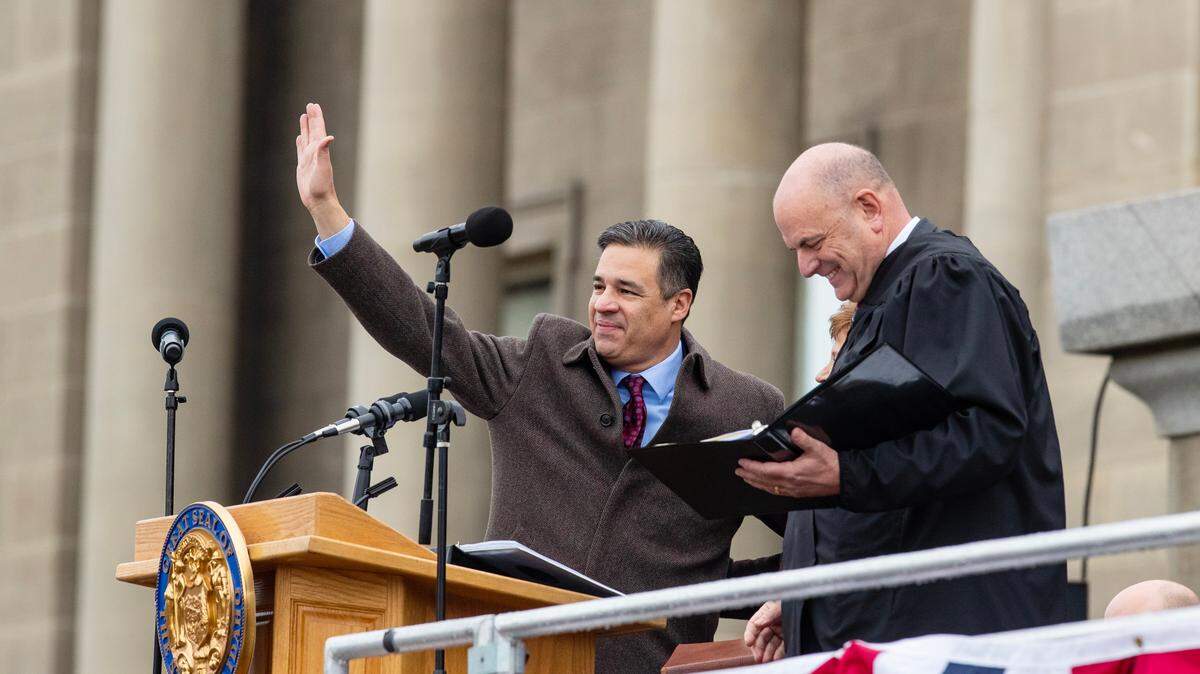
The measure would transform the operation of Idaho’s elections and has been hotly debated in living rooms, courtrooms and online this year. More than 100 people came to the debate, moderated by Idaho Statesman Opinion Editor Scott McIntosh, to learn about the proposed reform. It followed a Munk Debates style, and was between Luke Mayville of Reclaim Idaho/Idahoans for Open Primaries and Trent England of Save Our States.
Proposition 1 has two components: changes to who can vote in the state’s primary elections, and changes to how votes are tallied in the general election. Everyone would vote in one primary that includes all candidates regardless of party; the top four would advance, even if more than one are from the same party. In the general election, voters rank the four candidates, with their second and third choices becoming important if any of their preferred picks are eliminated for insufficient votes.
Here were the key arguments and other takeaways from the exchange about political primaries and ranked choice voting (RCV) at Boise State University.
For: The measure would open primary participation to more than a quarter-million voters
“Because we have closed primary elections, we are blocking 270,000 voters from participating in the state’s most important elections,” Mayville said. “That’s not just a problem for those voters who are being blocked. It is really a problem for all of us, because it turns out that when you block so many voters from participating in the process, you end up electing candidates who do not represent the broader community.”
Against: The problem isn’t primaries, it’s a lack of public involvement in the parties
“People want to have their cake and eat it, too,” England said. “If you care about who the Republican nominee is, well, roll up your sleeves, go talk to neighbors and get involved in the Republican Party. And the same thing for Democrats. If you’re not willing to do that, don’t sit back and complain that you don’t have a voice.”
For: Charges that RCV is overly complicated are silly
Mayville said arguments that RCV is too complicated are overblown, calling it “as simple as counting to four.”
“The candidate who comes in last place gets eliminated,” he said. “If that was your favorite candidate, your vote goes to your next choice. That’s it.”
Against: It’s complicated, has led to problems, can be ‘gamed’
England said he thinks RCV fails the “bus station test,” because if you went down to a bus station and explained ranked choice voting to people and then asked them to explain it to someone else, they might have trouble.
“I think a lot of people have a very hard time describing what’s going on in the system,” he said.
“The question isn’t, ‘Can it be gamed, can it be manipulated?’” England also said. “The question is: How?”
England pointed out that while the goal of the blanket primary is to winnow the candidates down to four ahead of the general election, political parties eager to win a seat could convince successful primary vote-getters — say, if three Republican candidates advance to the general in one race — to drop out and endorse their party’s candidate who is most likely to win.
That sort of maneuvering has led to a strange situation in a House race in Alaska, which has RCV. One Democrat and three Republicans advanced in the top-four primary. But then the two Republicans with the least primary votes dropped out to support the most popular Republican, leading the fifth- and sixth-place finishers — who together got little more than 1,000 votes — to make it to the general election. One of those candidates is a convicted felon in New York who has never lived in the state.
For: Idaho already has ‘eccentric’ candidates
Mayville responded that “most people here would agree” that Idaho already has “some eccentric candidates” under its current system. “If a candidate is really fringe who does not represent the values of the broader community, they’re really highly unlikely to win under Proposition 1, whereas in the current process you can win with 9% of the voters in a closed primary and then sail to victory in the general. You can be the most fringe candidate and still eke out a victory and make the laws that we all have to live under.”
(In Alaska, the fringe candidate who’s a felon is not expected to have a chance of winning, but if enough voters picked him as their first choice and ranked no other candidate, he could be a “spoiler.”)
Did they agree on anything?
Both debaters said that political parties as they are constituted today are a big part of the problem with American politics. England said that they have “become weaker and atrophied,” and that the ballot measure would make political parties less relevant than they are today, so as to “double down on past mistakes.”
Mayville agreed that parties have played an important role in the history of American politics. But he countered that they’re not working well now, and that Proposition 1 is aimed at solving a different but related problem.
He said a “common complaint” among Republicans is that the party’s far-right leadership does not represent the views of most Republicans.
“It may be true — and it probably is — that this reform won’t make parties stronger,” he said. “Those who want to do the work of revitalizing our political parties, they’re not going to do that through this particular reform.”
He added that telling independent voters they can sit out and vote in the general election will not satisfy them. “Everyone in Idaho understands that the election that really matters in Idaho is the primary,” he said.
The debaters also both discussed how the reform’s effects may not be what some people expect.
England said that voters in Alaska, even after RCV passed, “got elections that finally look a lot like the elections they had before, winners that look a lot like the winners they had before.”
Mayville said he thinks Republicans would still have the strong advantages they have in much of Idaho even if Prop 1 passes.
“The idea that this somehow favors one party or the other, (there’s) no evidence for that,” he said, pointing out that Alaska’s state legislature elected the same number of Republicans and Democrats after adopting its RCV system in 2022.
(In the 2021-2022 term, there were 22 Democrats, 34 Republicans and four unaffiliated lawmakers. In the 2023-2024 term, there were 22 Democrats, 32 Republicans and six unaffiliated lawmakers. One independent lawmaker resigned and was replaced by a Republican, raising their tally to 33.)
One change Mayville said the reform would cause is to make general elections “competitive for the first time in 30 years.” He said that many people feel their November vote is “meaningless” because the result is basically pre-determined.
“What it’s all about is electing candidates, regardless of their party, who really do represent the broader community and are accountable to every citizen, not just that tiny group of voters who vote in the closed primary,” he said.
This story was originally published October 18, 2024 at 4:07 PM.















.jpg)