Idaho Gov. Brad Little defends Republican bona fides. ‘The proof is in the pudding’
Subzero temperatures couldn’t have come at a worse time. It was calving and lambing season, 1989, for Highland Livestock and Land. Whatever means necessary were employed to keep newborns from freezing to death minutes after touching the bitter ground of the Boise Front.
“Poor little buggers, what a tough time to be born,” Emmett rancher Brad Little told the Idaho Statesman at the time.
Three decades later, nature presented another challenge at an inopportune time: a viral pandemic hardly a year into his first term as the 33rd governor of Idaho. While an experienced politician by then, the sagebrush statesman wasn’t prepared for a 100-year disaster the way he could foresee a cold snap in the hills his family’s sheep have grazed for generations.
So Little leaned on experts to guide him through the COVID-19 pandemic. In 1989, Little relied on longtime Basque herder “Highland” Joe Arrieta and more than a dozen ranch hands to weather the cold. In 2020, he had a coronavirus public health group and an economic rebound committee along with “very capable” staff.
“I had great advice and counsel,” Little told the Statesman in a recent phone interview.
Little’s friends and former colleague said his willingness to seek the counsel of others is among his best qualities.
“It takes a certain amount of humility to involve other people in decision-making,” Brent Hill, former Senate president pro tem, told the Statesman by phone last month.
Hill lauded Little’s coronavirus policies, but many fellow conservatives were not impressed. He’s been called a RINO (Republican in name only) — not for the first time in his political career — and a tyrant for briefly closing businesses and limiting gatherings. Those aren’t the kinds of words a Republican in deep-red Idaho wants to be associated with before a primary election.
In the May 17 GOP primary, Little faces seven Republican opponents who are challenging his record. But despite the crowded opposition, he is confident about his chances. At least that’s what his campaign communicated when he filed to run at the 11th hour and declined to publicly engage with his opponents.
Little is comfortable relying on his record. Riding the wave of booming growth and a swift economic recovery from the pandemic that plagued his first term, Little’s campaign has raised $2 million, more than triple his most high-profile challenger, Lt. Gov. Janice McGeachin.
“The proof is in the pudding,” Little said. Cutting red tape, tax relief, “those are not what you would associate with somebody that is not a Republican,“ he said.
Outside of Idaho, Little has maintained his reputation as one of the most conservative governors in the country, and remains at the forefront of the GOP’s biggest national fights. The first-term Republican governor sued President Joe Biden’s administration over COVID-19 vaccine mandates, slashed income taxes, sent Idaho National Guard members to the U.S.-Mexico border and kept Idaho open for most of the pandemic.
In step with several other Idaho elected officials, Little even supported a Texas lawsuit to overturn election results in battleground states that voted for Biden, despite his own attorney general calling the complaint unconstitutional. The U.S. Supreme Court later tossed out the lawsuit.
And he’s signed two bills in as many years to restrict abortion. The most recent bill deputizes citizens to deter abortions through a private cause of action. The Biden administration called it “radical.”
“You put him in any other state, he’s gonna be an ultra-conservative,” Hill told the Statesman. “Is he radical? No. Is he an extremist? No. You can’t be that way and govern appropriately.”
But Little’s campaign took a blow in November 2021, when his political rival, McGeachin, announced that former President Donald Trump endorsed her instead. Trump in the news release called her “a true supporter of MAGA since the very beginning.”
“I admit, to a certain extent, it was a little bit surprising,” Little told the Statesman during an April phone interview. “I have a very good working relationship with the president and his cabinet members, and I still have a very good relationship. I talked to one of the cabinet members just a couple of days ago about some of the things that we need to do going forward.”
Little’s Republican roots start early
At age 14, Little carried the Idaho flag at the 1968 National Republican Convention in Miami Beach, Florida, where Richard Nixon bemoaned “cities enveloped in smoke and flame” amid protests over the Vietnam War and racial injustice as he accepted the party’s presidential nomination. Four years later, Little was one of the convention’s youngest delegates.
Politics was in the family. His father, David Little, also an Emmett rancher, served seven terms in the Idaho Senate and one term in the House. David’s cousin Walt Little, a New Plymouth rancher, served half a dozen terms in the House, rising to the rank of House majority leader.
The cousins, both Republicans, were former presidents of the Idaho Wool Growers Association, a sheep industry trade group that Brad Little would eventually lead as well.
In 1972, Brad Little enrolled at the University of Idaho, where he majored in animal science and pledged Phi Delta Theta. The following year he went to Washington, D.C., to intern for U.S. Sen. James McClure, R-Idaho. McClure is known for helping to create the federal Department of Energy, and working with Democratic Idaho Gov. Cecil Andrus to create the Hells Canyon National Recreation Area.
“He really taught me the value of knowing the intricacies of policy,” Little, who listed McClure as one of his mentors, told the Statesman last month. “He was famous … for really understanding the details of policy, and he expected all of us to work for him to have that same grasp, even if I was only 18 at the time.”
Little later interned at the Idaho Capitol, where he filmed Joint Finance-Appropriations Committee meetings and filed minutes. For a semester-long research project, he worked on streamlining financial data input for the legislative fiscal office.
“I’ve always kind of had the philosophy the system is too big to fight, so you’d better learn how it works,” 22-year-old Little told the Statesman. He believed the less government regulation the better, “a philosophy I’ve had pounded into me,” he said with a smile.
A third-generation Idaho rancher, Little spent much of his career advocating for agribusiness. But Little was ambitious early in his political career, according to his friends and colleagues. That includes Jeff Siddoway, a sheep rancher and former Idaho senator who worked alongside Little for years at the Idaho Wool Growers Association.
Siddoway said his wife, Cindy Siddoway — a Republican committeeman and former president of the American Sheep Industry Association — predicted Little would be governor when he was still working for trade associations.
“Anybody who becomes governor is ambitious. Actually anybody that becomes a senator is pretty ambitious,” Joe Stegner, an Idaho senator from 1998 to 2011, told the Statesman by phone. “I think it comes with politics.”
In 1976, Little wouldn’t say whether he had political ambitions. “After graduation I’ll probably go back to the ranch eventually, but I’d like to work for someone else for a while,” he told the Statesman at the time.
Five years later, he was filling in for his father in the Idaho Senate.
Little’s lifestyle the ‘essence of the American West’
Before 30, Little was crafting legislation on the Joint Finance-Appropriations Committee, the powerful budget-setting group. As a fill-in for his father, in his 60s — who co-chaired the committee, but was often away due to his battle with prostate cancer — one of the younger Little’s first votes backed a motion from a Democrat.
“I expected to see Dad crawling in through the door,” he said at the time.
Little then entered politics in his own right. Representing the family business, Highland Livestock and Land Co., he joined a number of trade organizations, including the Idaho Cattle Association and the Idaho Association of Commerce and Industry.
The Littles have raised sheep in Idaho since the 19th century, when Andy Little, a Scottish immigrant, earned the nickname “Idaho sheep king.” A century later, Brad Little managed thousands of sheep in Emmett and several hundred cattle in Bear Valley along the Salmon River. The sheep eventually were sold, and now his sons run the cattle business.
As vice president and later president of the Idaho Wool Growers Association in the 1980s and ’90s, Little represented sheep ranchers in Idaho and Washington, D.C. Deeply involved in grazing rights and public land management, Little lived a lifestyle that “epitomizes the very essence of the American West,” a Statesman reporter wrote in 1995.
Wolf reintroduction was a divisive issue at the time. Once numbering in the thousands, wolves were eradicated in Idaho by the 1980s, when federal wildlife officials proposed bringing them back. Ranchers, fearing wolves would prey on their livestock, fought the proposal.
Little and Siddoway for years lobbied against wolf reintroduction. They tapped Little’s relationship with McClure, who pushed in Washington to ensure the predators were removed from the endangered species list.
“If they were fully listed and fully protected, then no matter what the wolf did, they would have priority,” Siddoway said.
Dozens of wolves were reintroduced in Central Idaho and Yellowstone National Park while a compromise classified the wolves as an experimental, nonessential population, which gave ranchers greater control to protect their livestock.
Idaho’s wolf population has since grown to about 1,500. The animals were removed from the endangered species list in 2011 when the state took over wolf management. Little continues to support ranchers in the decades-long debate.
Last year, he signed into law a bill backed by hunters and ranchers that allows the state to hire private contractors to kill wolves. Lawmakers who sponsored the measure said they want Idaho’s wolf population reduced to 150, the allowed minimum.
Little pushes for more education funding
Little, now 68, continues to abide by the small government principles instilled by his father. “The government should have the lightest possible hand” is his political philosophy. But policymakers still have an obligation: to motivate Idaho kids to stay in Idaho, Little said, repeating his first-term mantra.
That’s the driving force behind his “Leading Idaho” plan, he said, an agenda to make investments in education; transportation; and broadband, sewer and water infrastructure.
“When you come to a fork in the road, and there’s a decision, if that decision means that our kids are going to want to stay in Idaho, you’re making the right decision,” Little told the Statesman last month.
Little has touted his work in education funding, particularly for literacy programs as well as teacher pay and benefits.
Every year of his first term, Little pushed increased funding for literacy programs. With the Legislature’s support — most of the time — the state’s literacy budget jumped five-fold in Little’s first four years.
He also successfully lobbied the Legislature for increased teacher pay. In 2019, the minimum salary for teachers jumped from $35,800 to $40,000. This year, the state directed an additional $300 million to K-12 public schools, a 12.5% increase from the previous fiscal year. Among the investments were $104 million in the teacher career ladder and $180 million meant to improve teacher benefits.
Little and his wife Teresa’s two sons and six grandchildren still live in Idaho. Adam Little, 40, is a lawyer, and David Little, 39, is an accountant. Together, they manage Little Cattle Co.
Teresa Little, 67, also comes from a livestock family. A Weiser native, she met Brad Little at the University of Idaho, where she studied home economics education. They married in 1978. She worked in youth programs and philanthropy and served on Idaho Public Television’s board of directors before becoming Idaho’s first lady. In that role, she has provided “tremendous support” for the governor behind the scenes, Stegner said.
“She’s a much bigger asset to the administration than most people appreciate,” he said. “If they know her, they appreciate that.”
Little climbs ladder in Idaho politics
In the late 1990s and early 2000s, Little’s name was floated for multiple appointments to the Idaho Legislature, as seats in the House and Senate were vacated. Little deflected suggestions that he seek an appointment while his sons were still in school. Then in 2001, Gov. Dirk Kempthorne offered him a Senate seat.
“This happened to come two weeks before our youngest son graduated,” Little recalled last month, “so plunged in perfectly happy to be a part-time legislator, and things evolved since then.”
Little said his father, who died during his first Senate term, was “very proud that I was there.” The younger Sen. Little won his first election in 2002, and four more followed.
He supported two controversial bills during his tenure: Gov. Jim Risch’s property tax overhaul, which cut property taxes for public schools by $260 million and forced them to rely on unpredictable sales tax revenues, and a proposed constitutional amendment to ban same-sex marriage. Little initially opposed the amendment — which would have updated the Idaho Constitution to only recognize marriage between a man and a woman — but he later changed his mind, citing pressure from his home district.
Little crafted some of his own legislation, but his main responsibility was herding senators in the Republican caucus. Little’s colleagues elected him majority caucus chairman before his first full legislative session.
“Obviously, you don’t get into the leadership of your particular house without being respected and appreciated by your colleagues,” Hill, who started his 20-year Senate tenure the year before Little, recently told the Statesman. “He was well-liked. He was independent. I saw him take some tough votes, at times, out of principle.”
After eight years in the Senate, Little earned a spot on Gov. C.L. “Butch” Otter’s shortlist for lieutenant governor candidates when then Lt. Gov. Jim Risch was elected to the U.S. Senate in 2009. Little and Otter had a previous relationship, shared a mutual political philosophy and lived similar experiences in agribusiness, Stegner said.
“It was an immediate, obvious pick,” he said.
The Idaho lieutenant governor, a part-time job, has no constitutional duties, except to fill in for the governor when absent from the state and preside over the Senate — which comes with no real authority to shape legislation.
Amid the Great Recession, as employment plummeted, Little conducted trade missions around the country and abroad. Clif Bar’s 300,000-square foot bakery in Twin Falls is one result of his effort to market business-friendly Idaho.
Otter also directed his No. 2 to vet gubernatorial appointments as well as study cybersecurity and transportation maintenance, experiences that later informed Little’s policies as governor.
“Those are all things that I really got exposed to, but it was also helpful to learn about the detail of those state agencies and how they work with local government,” Little told the Statesman last month. “That was really important.”
Little retained the lieutenant governor’s office with ease in the 2010 and 2014 elections. After two terms, Otter announced his retirement and threw his support behind Little in the 2018 governor’s race. Little edged out then-Congressman Raúl Labrador and developer Tommy Ahlquist in the GOP primary and handily defeated the Democratic nominee, former state Rep. Paulette Jordan, in the general election.
Little quickly got to work cutting business regulations. In his first month as governor, he issued executive orders directing state agencies to find and cut burdensome “red tape.” His office said the state has since “cut or simplified” 95% of regulations and is now the least-regulated state in the country. Some of Idaho’s top employers, such as Micron Technology, J.R. Simplot, Idaho Power and Melaleuca, rewarded Little with maximum campaign contributions this year.
“What a year!” Little proclaimed in his 2020 State of the State address.
Two months later, on March 13, Idaho recorded its first case of COVID-19.
Idaho governor issues stay-home order
At the height of the pandemic, Little regularly participated in virtual town halls, and Idahoans weren’t afraid to vent their frustrations. “How bad is this virus, really?” one caller asked. “Why doesn’t anybody have the political backbone” to mandate masks? asked another.
Following federal public health guidance, Little issued a three-week lockdown order on March 25, 2020, which he later extended through the end of April. The state limited mass gatherings until February 2021. The political retribution was swift.
A few weeks into the stay-at-home order, Rep. Heather Scott, R-Blanchard, compared Little to Adolf Hitler — and it wouldn’t be the last comparison between coronavirus restrictions and the Holocaust. Other conservative leaders, including Little’s lieutenant governor, urged people to disobey the restrictions. The Republican-dominated Legislature unsuccessfully tried to restrict the governor’s emergency powers. A group of North Idaho residents launched a campaign to recall the governor over his COVID-19 policies — it fizzled.
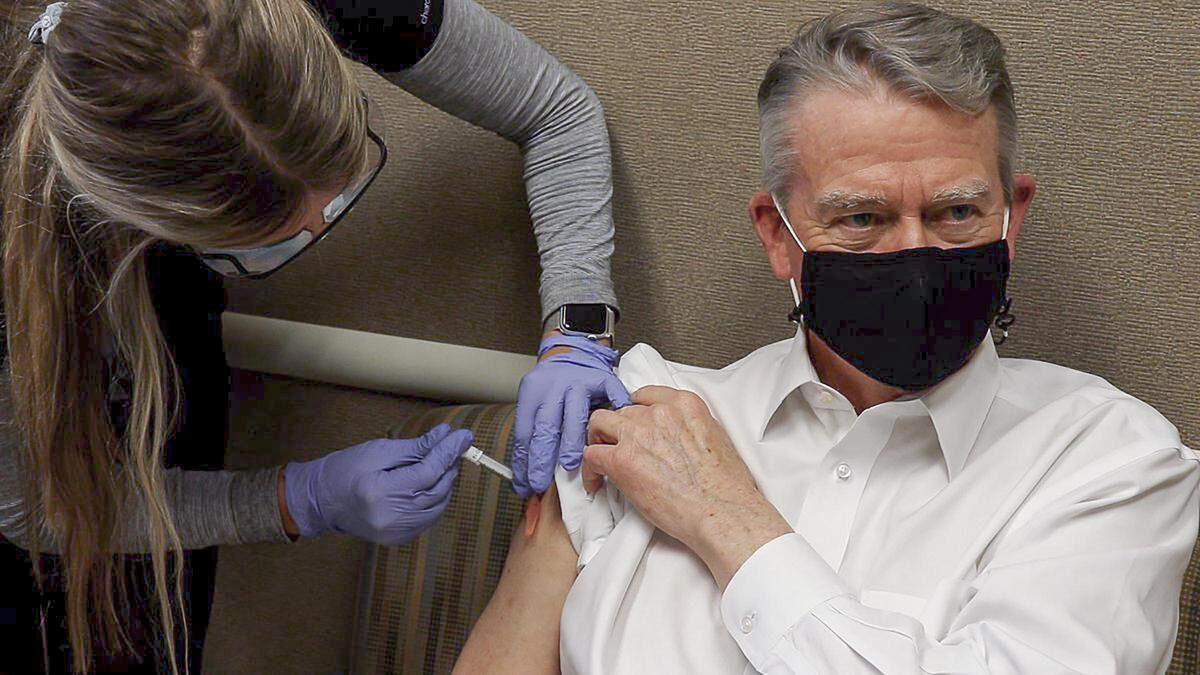
Amid a flurry of misinformation, Little promoted mask-wearing, and he urged vaccination when it became available. But Idaho’s restrictions were limited compared to other states. Idaho never imposed a statewide mask mandate — to the chagrin of many Idahoans. Some GOP-led states, including Texas, did enforce a mask mandate.
Little emphasized local control over COVID-19 rules, many of which weren’t enforced anyway. When McGeachin issued an executive order banning mask mandates while Little was traveling, he said it was “contrary to a basic conservative principle — the government closest to the people governs best.”
Little told the Statesman he kept “the interests of Idaho in the top of mind” during the pandemic. Other Republicans supported him. That included former political rival Ahlquist, a doctor who ran against him in the 2018 election and was critical of the state’s response to COVID-19 — but has since donated to Little’s 2022 campaign.
Ahlquist in October told the Statesman he was proud of the governor for “standing up” to the pressure from his own party.
“That takes courage, and that’s courage that someone like Janice McGeachin does not have,” Ahlquist told the Statesman. He called McGeachin “a danger to Idaho.”
Idaho had one of the fastest recoveries in the nation following an economic downturn caused by coronavirus. As a result, the state cut taxes in back-to-back years. The governor shepherded two tax cuts totaling nearly $1 billion in one-time and ongoing income tax relief. Along with one-time rebates, the top income tax rates for individuals and businesses was permanently reduced to 6%.
“Four years ago, I said we need to get the income tax rate down to 6%,” Little told the Statesman. “Well, we did that. I didn’t think we’d be in a good enough position to hand 8% of the money back last year and 12% this year. That was kind of an add-on.”
Despite his support of fiscal and social conservative causes, Little’s conservative credentials continue to be called into question, by right-wing bloggers, legislators and, especially, his opponent in the Republican primary election. McGeachin claims to be the gubernatorial race’s only true conservative.
Hill said Little didn’t take the easy way out, despite the obstacles he’s faced.
“It’s easy to take extremist positions, it’s easy to throw grenades,” Hill said. “It’s more difficult when you have the responsibility to govern, and people’s lives and livelihoods depend on your decisions. You’ve got to take everything into account and not just ideology.”
This story was originally published May 8, 2022 at 4:00 AM.