Idaho faces a COVID-19 crisis. Could Gov. Little have taken more aggressive action?
After implementing crisis standards of care, Idaho public health officials continued to report record-breaking COVID-19 patients in hospitals. More COVID-19 patients in the ICU than ever before. The deadliest weeks of the pandemic. Plus, patients with severe COVID-19 cases were getting younger.
Yet despite the state’s health care crisis reaching its worst point in the pandemic, Republican Gov. Brad Little has taken less action than before.
Little began the pandemic with a stay-at-home order and a staged reopening. Idaho advanced through the stages before failing repeatedly to advance out of Stage 4 of the reopening plan, and even moved backward twice. But since then, Little has mostly resorted to encouraging more residents to get vaccinated and providing additional resources to hospitals.
Political analysts and Little supporters say pressure from the far-right wing of his party, outcries from the public, national polarization and political backlash have prompted the change in approach since last year. In public comments, Little has maintained that he believes behaviors in Idaho today won’t change even with restrictions in place.
With the 2022 GOP primary election looming in May, Little’s supporters and critics both say he’s in a tough spot — more COVID-19 restrictions could mean losing reelection. And losing reelection likely would mean putting the state in the hands of his political rival, Lt. Gov. Janice McGeachin, who’s running to unseat him, and has been highly critical of health safety measures and government action to slow the spread of the virus during the pandemic.
Little has not declared his official run for reelection, but has raised nearly $500,000 for a campaign.
With vaccines now widely available, the inoculations have entered the political fray, pitting state leaders against each other and causing large swaths of residents to decline to be vaccinated.
Little “knows that he’s vulnerable” against McGeachin and her supporters on the far right, said David Adler, Alturas Institute president and a longtime Idaho Falls-based political analyst. Adler said Little won’t take “the next logical step” of imposing vaccine mandates for state employees to protect the health of Idaho residents.
In nearby states, governors have become more aggressive in their efforts to quell the virus. Washington Gov. Jay Inslee, for instance, has mandated vaccines for most state employees and all health care workers. In California, Gov. Gavin Newsom became the first to announce a planned COVID-19 vaccine mandate to attend school in person. Building evidence suggests that mandates have so far been successful in increasing vaccination rates.
“He’s trying to straddle the fence here,” Adler said of Little. “I think Gov. Little’s appraisal of the state of politics in Idaho informs him that it’s not wise for him to (impose mandates). Therein lies the rub, because that means that our state is, in many ways, held hostage to the anti-vaxxers.”
Knowing that McGeachin is running in the GOP primary election, Little must consider the consequence of every decision he makes, particularly when it comes to COVID-19, said Bruce Newcomb, former Idaho House speaker.
Newcomb said Little has done the best he could with the hand he’s been dealt, and with not as much support as he should have had in the Legislature.
“If he mandated masks, and if he had tried to mandate vaccinations, you would have huge amounts of turmoil, and I think you’d have a real rebellion,” Newcomb told the Idaho Statesman. “I think he’s walked that tightrope pretty well.”
Trump, national politics shape trust in COVID-19 vaccines
The politicization of vaccines, Adler said, can be traced back to a change in messaging from former President Donald Trump during the presidential campaign.
Trump once touted that vaccines would hasten the end of the pandemic, and two COVID-19 vaccines were eventually authorized under his administration. But his messaging changed as his presidency drew to a close.
Trump lauded other ineffective and unapproved treatments against COVID-19 during the presidential election, such as hydroxychloroquine, as public health officials said the vaccine wouldn’t be widely available until 2021. And unlike many world leaders, he was quietly vaccinated in private before leaving the White House in January. He refrained from encouraging the public to get vaccinated until late February.
Because the vaccine rollout has happened under a Democratic president, political pressures have altered how conservative state leaders are “oriented” toward working with the federal government, said Jaclyn Kettler, an associate professor of political science at Boise State University.
Tommy Ahlquist, a former emergency medicine physician and current developer who ran against Little in the 2018 primary, has been publicly critical of Republicans’ response to COVID-19. But he recently donated $5,000 to Little’s campaign and said he’s been proud of the governor for “standing up” to the pressure from his own party.
“That takes courage, and that’s courage that someone like Janice McGeachin does not have,” Ahlquist told the Statesman, adding that McGeachin is “a danger to Idaho.”
Newcomb called McGeachin “an extension of Wayne Hoffman,” who heads the right-wing Idaho Freedom Foundation.
In a statement sent by her office, McGeachin said “there is nothing dangerous about advocating for individual rights and personal choice.”
“On the contrary, it is incredibly dangerous to allow government to usurp the rights of parents and individuals,” McGeachin said. “This is what I am fighting to prevent.”
Gov. Little weighs COVID-19 restrictions, reopens state
On March 25, 2020, Little issued a stay-at-home order in Idaho, closing many businesses temporarily. He already had declared a state of emergency.
“Our focus is on slowing the spread of coronavirus to protect vulnerable individuals and preserve capacity in our health care facilities,” he said in a statement on March 13, 2020, the same day the first Idaho case was announced.
In April 2020, Little set in motion a staged reopening plan, called Idaho Rebounds, tying the reopening of the state’s economy to specific public health criteria. Though the requisite criteria have changed multiple times in the past year and a half, the state’s plan was to tie the progress to public health.
He has also stressed the importance of ending the pandemic for the state’s economy and its schools, and Idaho’s economy has performed well, something the governor has touted.
For a time, the state kept to these guidelines, reducing restrictions in spring 2020 as metrics improved, and reimposing them as numbers worsened significantly in the fall. The state progressed through four stages of reopening, then regressed to Stage 3 in October and Stage 2 in November last year.
Idaho moved forward again to Stage 3 in February 2021 and to Stage 4 in May, removing all suggested gathering size limits.
The Stage 4 guidelines include “strongly” recommending face coverings and requiring face coverings be worn at long-term care facilities.
Months later, with the state still in Stage 4, Idaho has set records for COVID-19 hospitalizations, ICU patients and deaths — including a record 170 deaths the week beginning Sept. 26. Younger patients, including children who don’t qualify for the vaccine, are more frequently hospitalized over serious cases, and resource-strapped hospitals have been forced to curtail or alter care for nearly all patients — COVID-19 or otherwise — that enter their facilities.
For months, the state has not come close to meeting all of the COVID-19 metrics for reopening.
When Little took Idaho from Stage 4 back to Stage 3 on Oct. 26, 2020, there were 286 patients hospitalized with COVID-19 and 72 patients in intensive care, according to data from IDHW. At the end of September 2021, hospitalizations had soared past the numbers seen last fall. On Sept. 24, there were 793 patients hospitalized with confirmed or suspected COVID-19, a 177% increase from last October. In ICUs, there were 213 patients — an increase of 196%.
And though vaccines have been widely available for months, just over a majority of eligible Idaho residents have gotten one, with the rate being 53.6% as of Friday. That places Idaho second-to-last in the nation. Among those 65 and older, 78% have been vaccinated in Idaho, compared to 84% nationwide.
In written responses to the Statesman, a spokesperson for Little stated that the difference between now and earlier pandemic stages was the availability of vaccines and other therapeutics.
“The criteria have not changed, but Gov. Little has said his goal with the pandemic response is to protect lives and critical health care capacity while ensuring Idaho’s economy and education system can move forward,” spokesperson Marissa Morrison Hyer said. “There are multiple factors to consider, and the wide availability of the vaccine is what separates our situation now from our previous situation pre-vaccine when our only defense was protection measures such as distancing, masking and other limitations.”
She added: “If a variant made the vaccine ineffective, Idaho may consider a different approach. That is not the case now. The vaccine remains extremely effective at preventing infection, hospitalization and death.”
Little has also said that the state is better equipped to battle COVID-19 this year, as public health experts have a better understanding of the infection and disease.
Over the past year, Little has directed millions of dollars to health care facilities and therapeutic treatment centers, has deployed the National Guard and is in the process of expanding testing in schools. And Idaho remains in a state of emergency that Little declared in March 2020, which has helped the state secure millions in federal funding.
“I have resisted putting in place statewide mask mandates and vaccine mandates all along because COVID-19 mandates from high levels of government do not work to change behavior in places where people hold fiercely independent values,” Little wrote in a blog post on Sept. 24. “Idaho has leaned on a more localized approach with these decisions, consistent with the law.”
A survey released by the governor’s office in June polled 300 adult Idaho residents who had not yet received the COVID-19 vaccine. About half could not be persuaded to get the shots, the survey concluded.
At an AARP town hall at the end of September, Little was asked whether he was “concerned (his) opposition to vaccine mandates is harming the state’s efforts to get the population vaccinated.”
”Yes,” he responded. “That’s my short answer.”

‘Only so much the governor can do,’ political scientist says
With the pandemic in its 20th month, measures that may have seemed like temporary pains to stifle the virus have become more difficult to enforce on a public exasperated with COVID-19 and eager to return to normal life.
“There is only so much the governor can do if people are not going to personally comply,” Jeffrey Lyons, an associate professor of political science at Boise State who studies public opinion, told the Statesman.
Though he doesn’t yet have the data, Lyons surmised that, if polled today, most Idahoans would be less supportive of public health restrictions than they were last year. Lyons said Boise State plans to conduct another survey in the next couple of months.
Despite the resistance to a public health approach, the actions of individuals are connected to the current crisis in hospitals. Public health officials have consistently said the vast majority of ICU patients with COVID-19 are unvaccinated. Since May, more than 88% of cases, 90% of hospitalizations and 87% of deaths have been among unvaccinated Idahoans, according to Health and Welfare.
In late September, Jim Souza, chief physician executive at St. Luke’s, said that 90% of patients in its hospitals beds were not vaccinated, and among ICU patients, 98% were unvaccinated, leaving them in far more danger of dying.
The state had reported 3,251 COVID-19-related deaths as of Friday.
Unlike 2020, when many Americans faced a similar viral reality, the prevalence and politicization of vaccines has left Idahoans in two starkly different worlds. Vaccinated Idahoans gathered by the thousands at the Treefort music and arts festival in Boise last month, while nearby at St. Luke’s Boise Medical Center, intensive care units and hospital wards were brimful with record numbers of unvaccinated people.
“You have two sets of people … who are very much not in the same boat in terms of how susceptible they are to the public health threat,” said Charles Hunt, assistant professor of political science at Boise State.
Increasingly, several political scientists say, vaccines are being viewed through a national, partisan lens.
“Partisanship is the most important factor pushing attitudes about most things,” Lyons said. “More and more in America today, we live in a world where the national stuff just overwhelms the state and local stuff. … Republicans wake up in the morning and they put on their Republican glasses, and that’s how they see the world. The Democrats wake up and put on their Democratic glasses, and that’s how they see the world.”
In a Boise State survey of Idaho adults conducted in late November and early December, before vaccines were available to the public, Lyons and his colleagues found that 77% of Democrats said they would get a vaccine, while only 45% of Republicans said they would. Nationally, six in 10 adults still unvaccinated identify as or lean Republican, according to a September survey from the Kaiser Family Foundation.
“There’s that quote … (that) all politics is local,” Lyons said. “I think there’s a very real question today about whether that’s actually the case or not. People are focused on the national and they use the national to understand the local. And what that means is that local officials just don’t have as much power to shape attitudes and beliefs.”
Misinformation and falsehoods have played a role, too. Misleading and incorrect statements about vaccines are widespread on social media, prompting some Idaho health care workers to fear personal harm from residents so buried in conspiracy theories that they believe health care workers are trying to hurt or kill their family members.
And in September, a doctor who has spread misinformation about vaccines and advocated for treating the coronavirus with ivermectin — an antiparisitic drug that’s not authorized by the FDA for COVID-19 patients — was confirmed to the Central District Health board, which oversees four counties, including Ada County.
Ahlquist said Little’s reopening decisions have been a result of pressure from members of the Republican Party.
“There are still people that are denying (COVID-19), that are putting pressure on him because they don’t believe in the vaccine, they don’t believe in masks, they don’t believe in anything that’s happened,” Ahlquist said. “That pressure is there. That’s clearly what it is.”
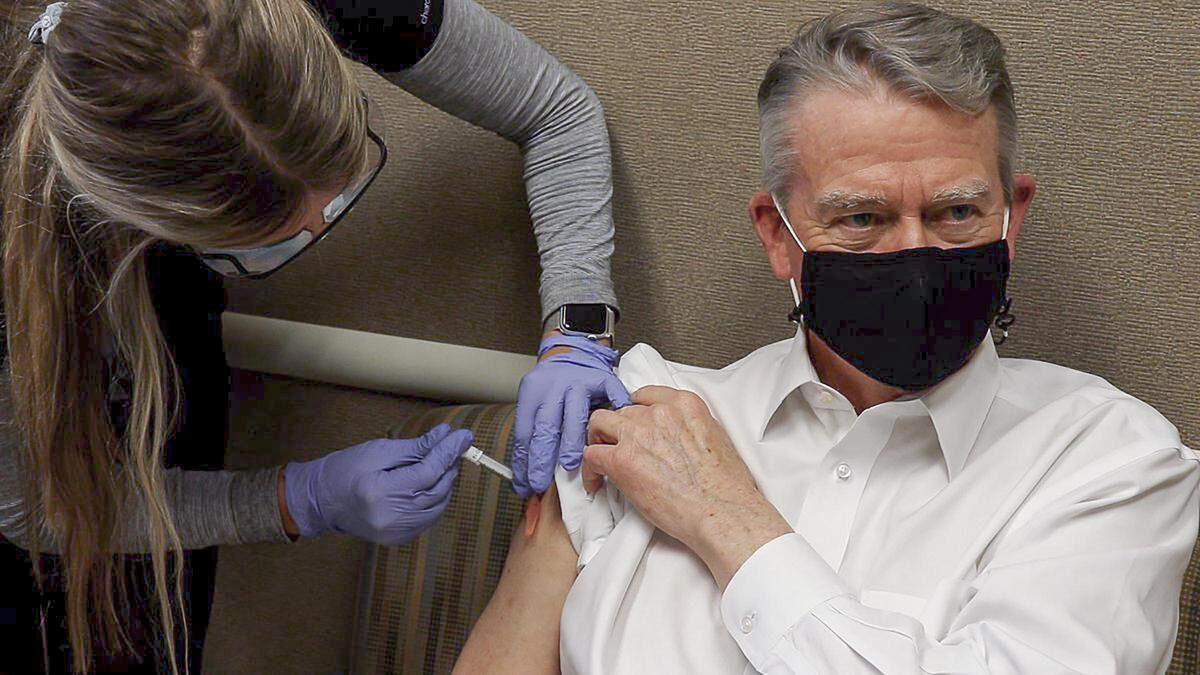
Little faces political challenge from the far right
Hunt added that Little faces a new political reality as 2022’s Republican primary in May approaches.
McGeachin has repeatedly pilloried Little for his already limited approach to public health. Despite the governor’s decisions not to implement any vaccine mandates, not to require masks, not to limit public gatherings and to ban state agencies from using “vaccine passports”, McGeachin has still said even his encouragement of vaccinations has gone too far.
At a press conference in August before the start of school, Little said “we need more Idahoans to choose to receive the vaccine.” He added that he wanted to thank the Idahoans who “have shown love for their neighbor by choosing to receive the safe and effective vaccine.”
McGeachin followed up with a tweet calling Little’s request “shameful.”
“It was shameful for Brad to suggest today that Idahoans must make a specific medical choice in order to show love for their neighbors,” she said.
Though she has claimed that she’s not anti-vaccine, the lieutenant governor has propagated vaccine misinformation, misrepresenting an Israeli study about vaccine side effects, and tried to prevent mandatory testing for COVID-19 in schools. No Idaho public schools have required testing so far. In 2020, she also urged Idahoans to disobey the governor’s stay-at-home order.
“I am against health mandates in any form,” McGeachin said in a statement last week. “I trust Idahoans to make their own personal medical decisions for themselves and for their children.”
Other far-right candidates also have entered the Republican primary, including Ed Humphreys, who has called the governor’s decision to offer paid time off for state employees to get vaccinated “manipulating.”
But not all Idaho politicians agree. Sandpoint Mayor Shelby Rognstad recently urged the governor to implement “an aggressive campaign to get the rest of the state vaccinated” and “implement a statewide COVID response” during the emergency, while acknowledging the difficulty of “stand(ing) up to the most extreme elements of the governor’s political party.”
“We can’t let extremists dictate public health policy when people are dying,” Rognstad wrote in the Statesman. “The people of Idaho need the governor to take responsibility and use his constitutional authority to bring the pandemic under control.”
In Boise, Mayor Lauren McLean issued a statement in September on the day crisis standards were declared, calling on the governor to do more. While masks are required in city buildings and large events permitted by the city require proof of vaccination or a negative test to enter, the mayor has so far refrained from issuing a citywide indoor mask mandate, which she did last year.
“This is a state problem, a state crisis,” her statement said. “We as Boiseans are asking the state to step in because this virus knows no city borders and we are seeing the devastating impacts of this surge in our local medical centers.”
Caught in the middle, Little is forced to make policy decisions that will affect people’s lives and may also determine his political future.
“He sort of feels like he’s in a sort of damned if he does, damned if he doesn’t kind of position here, in terms of pushing folks to get vaccinated,” Hunt said.
Little clearly wants residents to get the shots, Hunt said, but the state’s low and dwindling vaccination rate indicates there may not be many more residents who will be reached by that message.
“I don’t envy the governor,” Hunt said.