Two years of COVID: ‘Huge burden’ of thousands of deaths, ‘ongoing’ public health fight
COVID-19-related deaths: 4,819. Hospitalizations: 16,213. Patients in intensive care: 2,786. Total cases: 437,931.
Two years into the pandemic, COVID-19 has had a transformative effect on Idaho.
It likely will take years to understand the full extent of the impacts of the coronavirus’s spread around the world, the U.S. and Idaho, but at least one statistic can already be seen in stark terms: the death toll.
In both 2020 and 2021, COVID-19 was the third-leading cause of death in Idaho, ahead of Alzheimer’s disease, diabetes and suicide. Only heart disease and cancer killed more people.
Sunday marks the two-year anniversary of the first reported case in Idaho — on March 13, 2020.
“This is killing a lot more people than flu does, even in a bad flu season,” Dr. Christine Hahn, Idaho’s state epidemiologist, told the Idaho Statesman.
Compared to influenza, officials said the coronavirus death count has been massive. There were more than 2,700 COVID-19-related deaths in 2021, with just four recorded flu-related deaths, according to preliminary data from the Bureau of Vital Records and Health Statistics within the Idaho Division of Public Health.
In 2019, before the pandemic changed people’s behavior and took the sting out of cold and flu season, there were only 73 flu-related deaths in Idaho, according to the bureau.
The COVID-19-related death rate is about 1.1% of total known cases in Idaho, which Hahn said is lower than public health experts initially feared it might be, but still significant.
“If you had a one in 100 chance of winning the lottery, you’d buy a ticket every day, because you’d think that’s pretty good odds,” Hahn said — noting the odds of dying from the disease if you test positive are the same.
A significantly larger portion of COVID-19 victims died in 2021 than in 2020, in part because the delta variant, which hit Idaho in the late summer and persisted through fall, was likely more virulent.
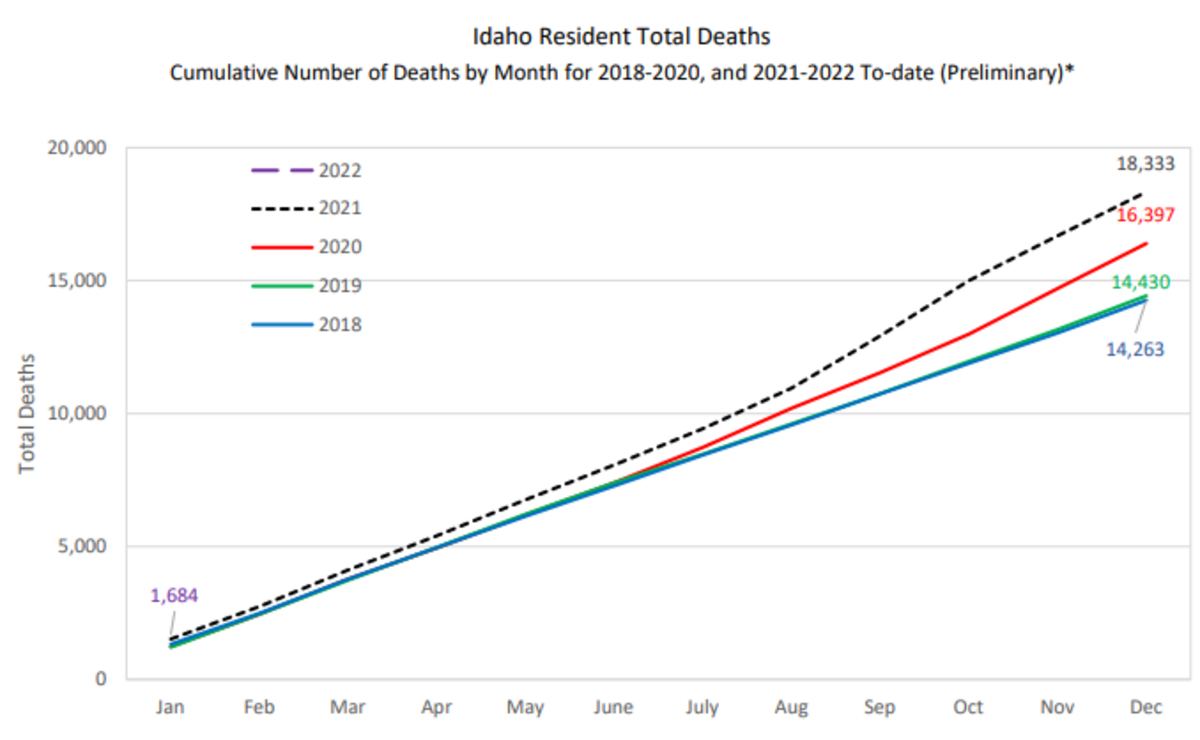
In 2021, a total of 2,403 people died of COVID-19 — a slightly different statistical category than COVID-related deaths — after 1,357 died in 2020. The 2021 total accounted for 13% of all Idaho deaths last year, according to the preliminary Bureau of Vital Records data, which reported those statistics. These numbers include only deaths where the virus was the underlying cause; COVID-19-related deaths include those to which the disease contributed.
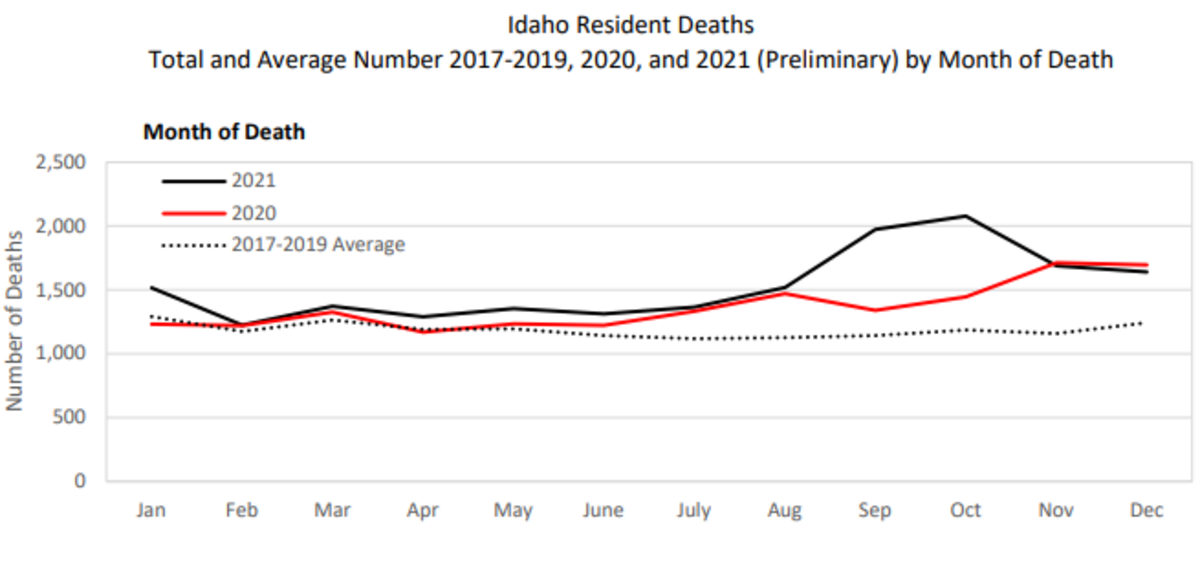
The toll of the pandemic pushed the number of deaths in Idaho from all causes the past two years to counts that easily exceeded numbers from the prior three years.
Roughly 1,100 to 1,250 people died during most months in 2017, ‘18 and ‘19, but that figure jumped to roughly 1,700 in November and December of 2020, according to state data. In September 2021, monthly deaths totaled nearly 2,000, and they hit close to 2,100 in October.
In 2021, an average of more than 1,500 people died per month — exceeding 2019’s monthly average by more than 300.
Breaking down Idaho’s COVID-19 deaths
About 59% of the COVID-19 deaths in the state have been men, according to state data.
Nearly 42% of deaths were people in their 80s, 28% were in their 70s and roughly 18% were in their 60s, according to that same data.
Eight percent of those who died were Hispanic, and though that ethnic group’s death rate wasn’t higher than for non-Hispanic people, those who died were younger and lost more potential years of life, Hahn said.
Based on death rates, Idaho has performed better than Montana and Wyoming, but significantly worse than Oregon and Washington, according to data from the Centers for Disease Control and Prevention.
The Gem State has had 268 COVID-19-related deaths per 100,000 people, which is markedly higher than the 160 per 100,000 in Oregon or 158 per 100,000 in Washington, according to the CDC. Wyoming’s rate is 302 and Montana’s is 300. Hahn noted that age and demographic differences among state populations can make drawing conclusions on these comparisons difficult.
Jennifer Johnson-Leung began tracking COVID-19 death and case statistics in 2020 at the University of Idaho, where she leads the Idaho Pandemic Modeling Group and is an associate professor of mathematics. As the data came in, she said she realized the implication of each number as she processed deaths or cases by age and ZIP code.
“You look down and you realize, every single one of them is someone who’s afraid, someone whose families are afraid for them, who are hoping everybody’s going to be OK,” she said. “It’s just so much psychological burden. I think we probably need some time to mourn, but I don’t know that we’re going to give ourselves that.”
Helen Brown, an associate professor of public health and nutrition who is also part of the Modeling Group, said she has many students who come from small towns in rural Idaho with populations of a couple thousand people, if that.
With nearly 5,000 deaths, “to put it in perspective, that’s (a) town, or that’s two towns,” she said. “It’s a huge burden for our nation and for Idaho.”
Vaccinated vs. unvaccinated
The rollout of vaccines in Idaho provided protection to many residents, and public health officials say the interventions changed the nature of the pandemic over the past year.
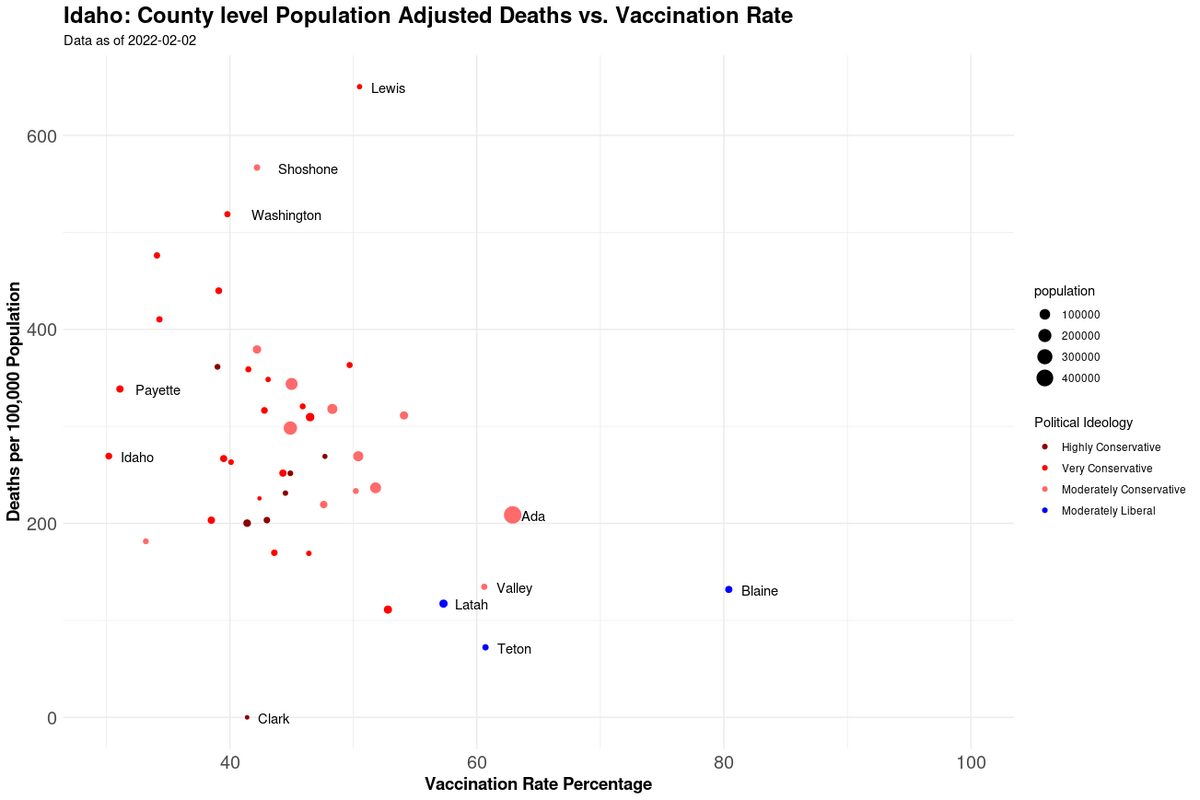
Across Idaho counties, the rate of vaccination has a “significant” correlation with per-capita deaths, according to a data analysis conducted by Erich Seamon and Johnson-Leung at U of I, using disease data from The New York Times and vaccination data from the CDC. Death rates were generally lower in counties with higher vaccination rates.
“We see drastically different outcomes in the beginning of the pandemic, and then later in the pandemic,” Seamon told the Statesman. “Particularly if you divide between prevaccination and postvaccination, even across the country and in Idaho, we saw dramatic differences.”
The Idaho Department of Health and Welfare has previously reported that people who are vaccinated and boosted are 11 times less likely to be hospitalized and 20 times less likely to die of COVID-19 than unvaccinated people, based on data collected between early December and late January.
In December 2020, the average age of a COVID-19-related death was 77.9 years, according to Health and Welfare. In September of 2021, during the peak of the delta variant wave, it was 70.4. As of January, it was 73.
While 76% of Idahoans 65 or older are fully vaccinated, that figure drops to 66% for 55-to-64-year-olds, according to state vaccination data.
“The average age at death in 2021 dropped, and that’s because we started seeing more people in their 50s who had underlying health conditions that were dying of COVID that we didn’t see in 2020,” Hahn said. “Most people that died, the vast majority were unvaccinated. And I think delta was just a nastier strain. It wasn’t just affecting the feeblest and oldest among us.”
‘Watching a train wreck every single day’
It became apparent how politics played a role in the pandemic early on, and a person’s political party acted as a stronger predictor of whether they were vaccinated than did demographic factors like age, race or education level, according to an October survey by the Kaiser Family Foundation.
“There is a highly significant association between voting preference and vaccination in the counties of Idaho as well as the expected significant negative correlation between vaccination rates and deaths from COVID,” Johnson-Leung said in an email.
“The association between voting preferences and death is weaker because it is not an intrinsic relationship but is from the vaccine attitudes,” she added, noting that implying causation is not justified based on Idaho’s statistics, although the connection between the two factors is warranted based on the “larger picture.”
The U of I research compared how counties voted in the 2020 presidential election, with locales labeled as very conservative, moderately conservative or moderately liberal based on what percentage of votes went for Donald Trump, the Republican candidate, or President Joe Biden, the Democrat.
All three of the state’s “moderately liberal” counties — Latah, Teton and Blaine — were in the top-five vaccinated counties, along with “moderately conservative” Ada and Valley counties.
Latah, Teton, Blaine and Valley counties also had the lowest death rates, aside from Clark County, which has zero recorded COVID-19-related deaths. The East Idaho county is highly conservative, according to the analysis, but it is the least-populated county in the state.
The loss of so many Idahoans since vaccines have been available has left U of I’s Brown dismayed that many deaths were preventable.
“Wearing a public health hat, it’s been missional work for me my whole life,” Brown said. “I feel like I’m watching a train wreck every single day. And I know it’s coming, I know the train is coming, and nothing is stopping it.”
Lessons for the future
With COVID-19 cases declining quickly in Idaho, many mask mandates have been jettisoned as residents prepare for a post-pandemic world. But transmission rates are still elevated in many places, and public health officials warn that new variants or other case spikes could bring back public health measures.
Numerous times over the past two years, public health recommendations have shifted, both as conditions change and as new information comes to light. Hahn said she thinks public health agencies should emphasize this reliance on information as a strength moving forward.
At the start of the pandemic, Hahn said the CDC was overly confident in its messaging, as part of an attempt to reassure the public. But when the nation’s public health arm got things wrong, Americans lost confidence.
“One thing public health has really got to continue to work on is to always … say, ‘This is the best information we have right now, but that could change, and if it changes, we’ll change our recommendations,’ ” she said. “That should be a strength, not a weakness, to change your recommendations,” she added, since it indicates that analysts are following the data and making decisions based on real-world circumstances.
Hahn also noted that Idaho’s limited testing ability hamstrung the state at the start, and that officials “had a hard time scaling up.”
Nationwide pandemic preparedness largely presumed a viral pandemic would be caused by influenza, Hahn said, catching some leaders off guard when a coronavirus pandemic hit.
Other public health researchers point to the widespread prevalence of misinformation about vaccines and COVID-19 as a source of the nation’s stumbles and ultimate loss of life.
“When people look back now, it’s like that Monday morning quarterback saying, ‘Oh, we could have actually kind of inoculated people against this misinformation. We should have anticipated that this would happen and started educating people about how to discern information,’ ” Brown said. “But you know, we were all completely caught so unaware. Who’s lived through a pandemic before?”
‘See the truth that exists for other people’
Lindsey McConnell-Soong, a public health program manager at University of Idaho Extension, has been organizing mobile vaccine clinics all across the southern part of the state since December.
The clinics, which are in partnership with the Idaho Immunization Coalition and the Idaho State University College of Pharmacy, are unusual in that they are aimed at reducing vaccine hesitancy by providing educational outreach and follow-up, in addition to the vaccination service itself.
McConnell-Soong told the Statesman that her clinics have been aimed at reaching out to vulnerable groups such as agriculture workers, many of whom are Hispanic, and to those who might have particular reasons for avoiding vaccination.
“Just showing up on site with the mobile vaccine clinics doesn’t really serve those people who are unsure and hesitant,” she said. “They don’t decide to get (the shot) just because it’s there. Usually they have questions and concerns.”
She said her clinics aren’t necessarily designed to change minds, but rather to provide information to people who need it.
“We can’t get anywhere if we are judgmental and unwilling to see the truth that exists for other people,” she said. “I have many family members who are against vaccines, and I love them and support their choice and hope for their wellness.”
McConnell-Soong’s clinics have been held at dairy farms and at the Mexican Consulate in Boise, among other places. Seven clinics have been part of the project thus far, and she said they provided education to more than 400 people. About 80 COVID-19 vaccine doses have been administered, as well as 65 flu shots, according to McConnell-Soong.
About 46% of Idaho’s 5-and-older population remains unvaccinated, according to Health and Welfare.
In future pandemics, or further iterations of this one, McConnell-Soong said “my hope would be that we are able to approach science, health and wellness from a reasonable, trusting stance that is not so political or divisive. That we can put our trust in sources and information that have earned that, and take action to keep our communities safe and healthy.”
Hahn said public health measures have long been controversial.
“It’s the society’s ongoing discussion about the rights of the individual — ‘freedoms,’ if you will — … versus the responsibility and the right of government to protect people,” she said. “That’s what governments are supposed to do, keep us safe and healthy. And so it’s a constant back and forth.”
This story was originally published March 13, 2022 at 4:00 AM.