Ada Highway District weighs huge fee increase to raise $1.6B. Here’s who would pay
AI-generated summary reviewed by our newsroom.
- ACHD proposes splitting Ada County into east and west zones for impact fee collection and service.
- Western Ada County could see impact fees for single-family homes rise by over 150%.
- Proposed changes aim to fund growth-related highway projects; public input open through Oct. 16.
The Ada County Highway District is considering a new plan for making “growth pay for growth” — one that would jack up fees for new development with what is by far the largest increase in at least a decade.
In a public comment period starting Sept. 25, the highway district rolled out proposed changes to its impact fees, which are fees charged to developers to pay for the cost of road construction needed to accommodate growth. The changes, which involve more than doubling rates in some instances, are part of a more aggressive plan to generate more revenue from new development, according to ACHD officials.
The money would help fund eligible road projects the highway district says will be needed to serve drivers over the next 20 years. Those include widening Eagle Road between Lake Hazel and Amity roads and building the Linder Road overpass in Meridian.
But they’d come at a cost, one that could be passed to buyers of new homes and commercial buildings. And for the first time in over a decade, that cost could be different depending on where in the county development occurs.
The proposal would split the county into two service areas, east and west, divided by Cole Road in Boise, explained Megan Anderson, ACHD’s impact-fee administrator, in an interview with the Idaho Statesman. Impact fees collected from developers in one service area would go only toward eligible road projects in that area.
The plan would yield the following rates:
These fees would go toward $1.3 billion worth of eligible projects in the west service area, and $339 million in the east. That’s a total of $1.6 billion of eligible projects included in the highway district’s draft 20-year capital improvement plan. Today’s fees were adopted in 2022 to go toward $630 million worth of eligible projects.
The suggested rates represent a stark rise particularly in western Ada County, where impact fees for single-family homes would see a more than 150% increase from the roughly $3,500 they are today. In eastern Ada County, those fees would increase by 53%.
If the highway district proceeded with one service area, fees for single-family homes would still jump to more than $7,800.
ACHD considers developer-fee hikes as much as 150%. Why?
Why the need for such a big increase? Because of inflation and rising projects costs, especially following the coronavirus pandemic, according to ACHD.
“The cost of land and construction has gone up significantly,” reads a page on ACHD’s website about the proposed fees. “Project cost estimates have not been updated in more than five years, and the new, higher costs are the main reason fees need to be adjusted.”
Anderson’s message to the Statesman was similar. The impact-fee administrator called “exponentially” rising costs the “primary driver” of the rates, highlighting inflation during and since the pandemic as well as shifts in the Treasure Valley real estate market that have caused land-acquisition costs to balloon. But she also nodded to how comprehensive — and therefore expensive — the list of needed projects is.
“At this point, we’ve done very little to filter out some projects that will only include the right-of-way cost and not the construction cost,” for example, she said by phone. In the past, Anderson said, the ACHD Commission has instructed staff that “We don’t want the fee to go over ‘X’ number, or we only want to include the construction costs for ‘X’ number of years.”
That’s not been the case for this nearly $2.3 billion capital-improvement plan, she said.
“What we’re seeing here, what we’ve calculated, is almost the maximum allowable impact fee,” Anderson said. Then it would be up to the commission to decide, “Are we really going to include all of these costs?”
Why the commission opted to review this almost-maximum-number is not entirely clear. But Anderson noted that the proposed fees were calculated based on the project costs in accordance with state law. And she said that they came out of a two-year process in which ACHD analyzed its impact fees top-to-bottom with the goal of finding “opportunities for changes” including “to make sure we were capturing as much revenue as we could through impact fees for growth-related expansionary projects.”
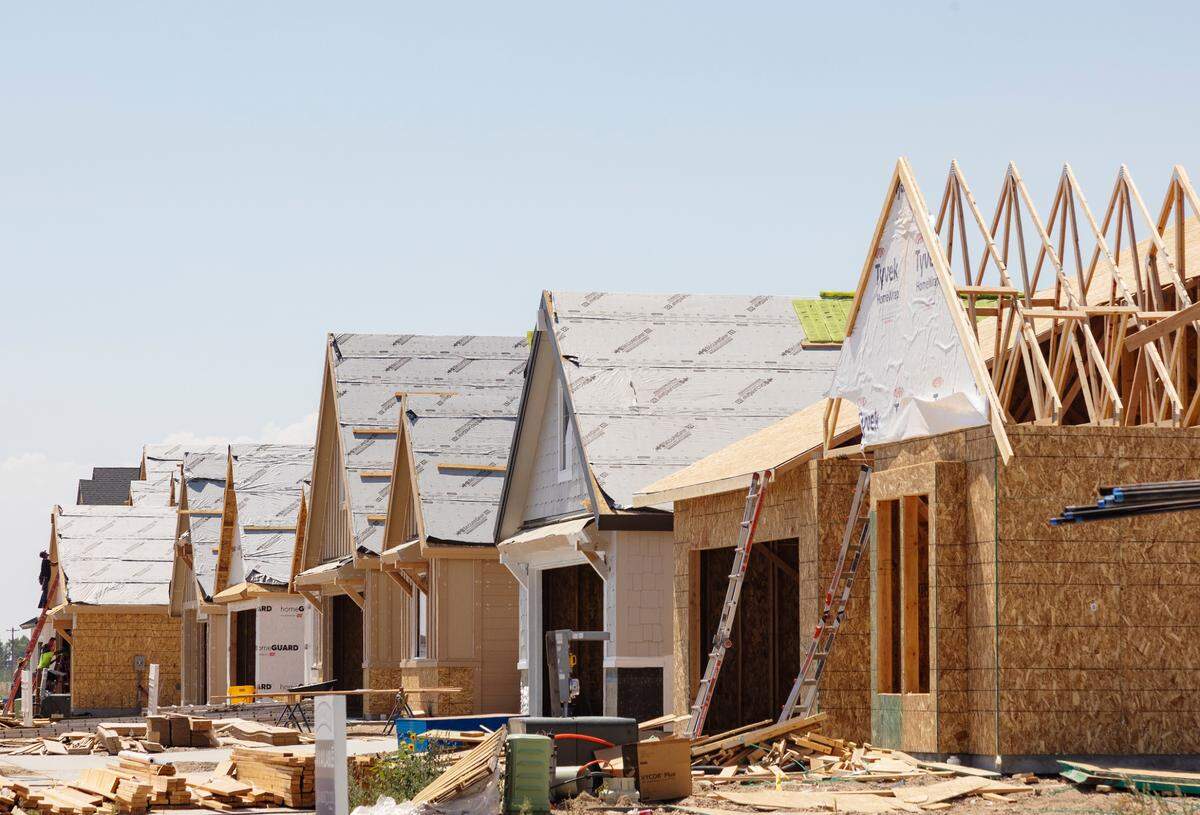
Highway district maximizing how growth pays for growth?
While impact fees are charged to developers, they can be passed down to home buyers through the cost of homes. But Anderson emphasized that they’re still a way “for growth to pay for growth.”
“It’s not the city paying these fees,” she said. “It’s not existing residents in the county ... That is a big misconception.”
She continued, “The goal of this is to identify who’s generating the need for expansionary projects and have the fee assessed directly to them, as opposed to a revenue source like property tax, where everyone’s paying that, and it may or may not be tied to who’s benefiting from the projects.”
Anderson noted that, by law, impact fees can only go toward growth-related work, such as adding new lanes to a major road because new development necessitates it. Maintenance work or improvements related to existing road deficiencies or congestion are not impact-fee eligible and need to be funded through other means.
At a commission meeting in July, Kent Goldthorpe, who represents ACHD’s District 4 encompassing southern Meridian, Kuna and parts of unincorporated Ada County, drew a similar tie between the rates and growth.
Goldthorpe, who said he favors the single service area over the east-west model, noted his desire for the public to weigh in on the proposed fees and areas. “They are the ones with the biggest mouths about development not paying for itself and that sort of thing,” he said. “And I think we need to holler it from the treetops so that they have every chance to weigh in.”
Part of how ACHD identifies who’s benefitting from the projects — and how the district, by law, calculates fees — is trip capture. In Ada County, 91% of vehicle trips that start in the county stay the county, ACHD’s most recent analysis found.
Within the proposed west service area, that number is 74%, while in the east, it’s 65%.
“With the Impact Fee Act, we are supposed to identify an area that functions as a system,” Anderson said. “So by showing a high internal capture rate for roads, we’re showing, ‘Yeah, most people that drive in this area stay in that area.’”
Drag your cursor left or right along the above map to see the proposal for two service areas compared with the existing single-service area.
Comparing the two service areas, planned projects are also significantly more costly in western Ada County than eastern.
Multiple service areas source of ‘interest’
Anderson told the Statesman that service areas were one of the topics the ACHD Commission directed her team to look into as part of the analysis that started two years ago.
“The commission was aware that we’ve had multiple service areas in the past, and we had moved toward one countywide service area in 2012, and they wanted to see if that still made the most sense,” she said.
Anderson added that members of the commission had received feedback from residents and local officials that there was “interest” in creating multiple areas. “So that was something that was passed along to staff as, ‘Let’s explore this,’” she said.
She noted that both the single service area and the two service areas divided by Cole Road are supported by data and comply with the law, so the commission’s decision “really will be just a policy” one.
At the July commission meeting, Alexis Pickering, who represents ACHD’s 2nd District, including most of Garden City and Boise’s West Bench, said she’s heard “desire” for the two-service-area model “from city leaders (and) all different types of folks,” in part so fees would stay where they were generated.
“What I’m hearing from the city of Meridian and other places is they don’t want the impact fees generated in their communities to go to projects like the Lake Hazel Road extension” in Southeast Boise, as an example, Pickering said.
She added that bringing the request to the public for feedback would be a way to “test” whether he proposal has broader support “rather than kind of this ‘He say, she say’ type things that we’ve been hearing.”
Goldthorpe and another commissioner, Dave McKinney, representing western Meridian, indicated they did not support the two-service-area model.
“If it were voted on tonight, it wouldn’t pass,” Goldthorpe said.
Have your say: ACHD seeks public comment
While commissioners are split on the service-area models, the highway district is seeking public comment on the proposal, including the increased fees, through Oct. 16. Members of the public can learn more and submit feedback online or take an online survey.
The highway district is also accepting feedback on its draft 20-year capital improvement plan.
After the public comment period, ACHD plans to workshop the proposal in November and then hold a public hearing on it in December, where the public can weigh in as well. Passage would require a supermajority of four out of five commissioners.
This story was originally published October 1, 2025 at 2:48 PM.