Changes are coming to Idaho’s busiest non-Interstate highway. What to expect
AI-generated summary reviewed by our newsroom.
- ITD will permanently close or block three Eagle Road turn points to cut crashes.
- Nighttime microsurfacing work will affect traffic between I-84 and State Street.
- Variable speed-limit signs delayed, with installation expected by year’s end.
The Idaho Transportation Department will permanently close two left-turns and block another on Eagle Road as part of safety improvements along the high-crash highway.
The changes come after years of concerns over congestion and crashes on the road, also known as Idaho 55, which is Idaho’s busiest non-Interstate highway. The transportation department, which started work Monday, hopes that the eliminated “conflict points” will result in lower crash rates.
In a news release Monday, ITD announced that it would remove the following turn lanes:
- The northbound left-in at Baldcypress Street.
- The southbound U-turn at Bourbon Street near Ustick Road.
“Drivers will see both median modifications and updated traffic control,” ITD spokesperson Jill Youmans told the Idaho Statesman in an email.
Signs will block a third turn location, Youmans said. That location, a two-way left turn between Island Woods Drive and the north channel of the Boise River, was never a designated turn or turn-lane, she said. But people have started using it to get off Eagle Road and onto a dirt road where they can then float the river.
Youmans said by phone that altogether it’ll be like closing “two and a half turns.”
ITD earlier planned to close two additional turns, a southbound left-in at Meadowdale Street and a northbound left-in at Lanark Street. But those were dropped, and the Boise River location was “identified as a high conflict point,” according to Youmans.
“We looked closely at crash trend data and listened to public feedback to determine the locations with the greatest potential to reduce risk,” Youmans said. “That’s why these specific turn locations were selected.”
Eagle Road saw 317 crashes last year, none of which were fatal, according to ITD crash data. There have been 160 crashes so far this year.
Microsurfacing to preserve roadway life
The improvements will also involve “micro-surfacing” the seven-mile corridor between Interstate 84 and Idaho 44, or State Street. During construction, drivers can expect the following:
- All lanes will remain open during the day.
- Nighttime work will occur from 10 p.m. to 5 a.m.
- One lane will be open in each direction at night.
- Drivers may encounter rough surfaces and loose gravel and are encouraged to use caution.
“Microsurfacing is a preventative pavement sealcoat that is applied to road surfaces that are already in good condition,” according to an ITD project page. It is expected to preserve the roadway’s life and prevent the need for more expensive repairs.
Work started at I-84 and will move north, with an expected end-date of late September.
More safety changes delayed, but still to come
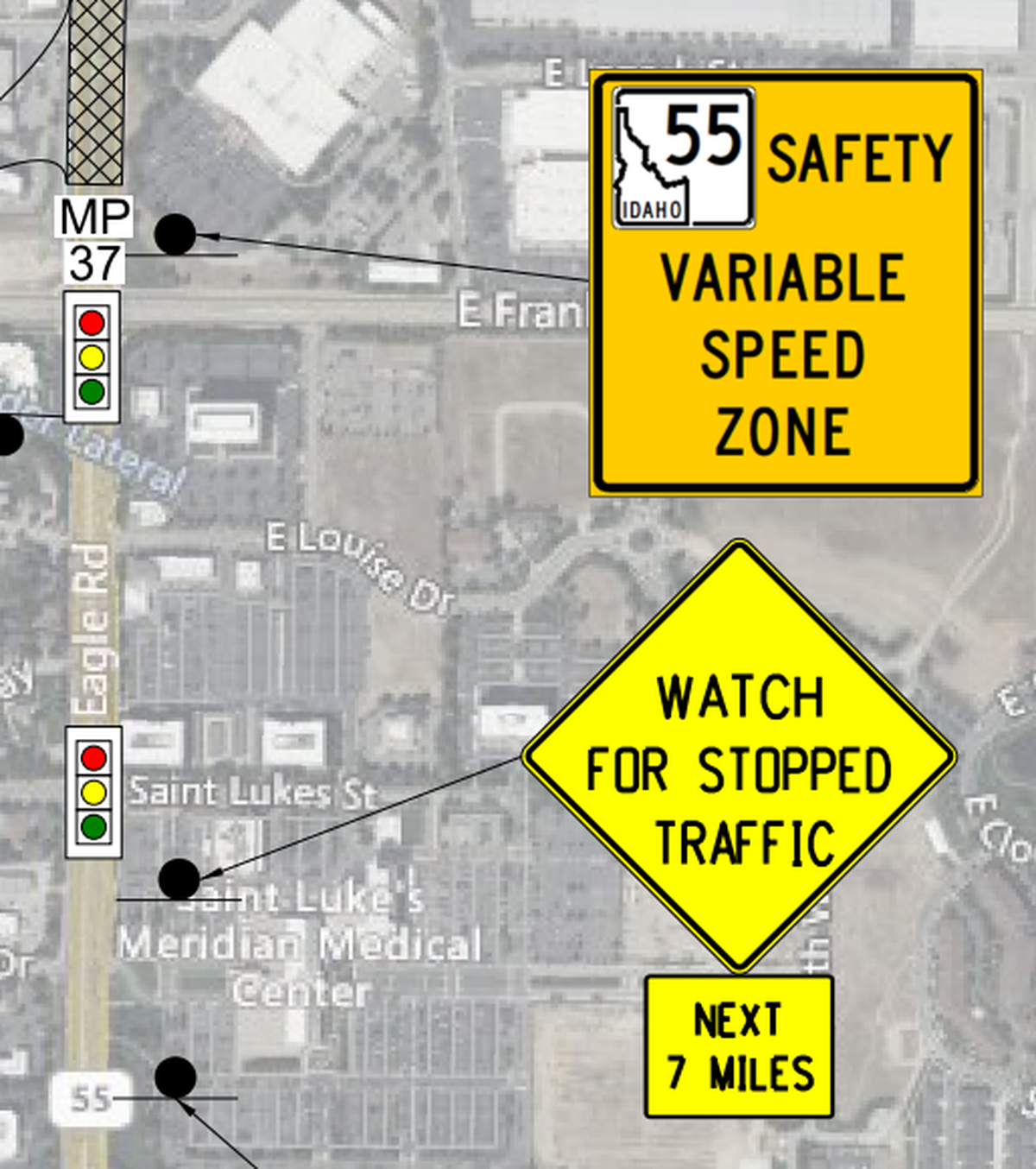
ITD also plans to pilot variable speed limits on the corridor, it announced roughly a year ago. In December, drivers were told that that would start this spring.
But ITD is still waiting on the new speed-limit signs, thanks to a back-up on the manufacturing side, Youmans said. They’re now expected to be installed by the end of this year, though Youmans did not provide an estimated date.
Once installed, the signs will instruct drivers between Franklin Road and Chinden Boulevard to reduce speeds to a 45 mph limit during peak congestion. During nonpeak hours, the signs would revert to the current limit, 55 mph.
Variable speed-limit signs have been used by ITD in temporary construction zones, but not on a signalized urban highway corridor like Eagle Road, the Statesman previously reported.
Additional “driver feedback” signs are also expected to be added along the corridor.
“We’ll continue to study the corridor, as we do with all corridors, and make adjustments if we find additional opportunities to improve safety for Idaho drivers,” Youmans said.
This story was originally published August 11, 2025 at 1:20 PM.