Harris Ranch developers sued, then taxpayers struck back. Here’s what happened next
The legal battle between Harris Ranch developers and disgruntled taxpayers took another turn as the developers dismissed their case that claimed they were defamed.
The developers of Harris Ranch previously sought a permanent injunction to stop residents of the Harris Ranch Community Infrastructure District from allegedly defaming them, hurting their business and using the Harris Ranch name.
Last week, the developers dismissed all claims in what one developer says is an invitation to the opponents to drop their cases too.
“This CID business is causing a diversion of our attention,” Doug Fowler, president of Barber Valley Development Inc. and LeNir Ltd. said in an interview with the Idaho Statesman.
The previous request for a permanent injunction was filed in Ada County’s Fourth District court.
For months leading up to the request for a permanent injunction, the Harris Ranch Community Infrastructure District Taxpayers’ Association had publicly expressed displeasure with the special tax district and questioned its legality.
The plaintiffs were Harris Family Limited Partnership, Barber Valley Development Inc. and LeNir Ltd. The defendants were the Harris Ranch Community Infrastructure District Taxpayers’ Association, Larry Crowley and Bill Doyle. Crowley is president of the taxpayers association’s executive committee, and Doyle is vice president.
A community infrastructure district, or CID, is a tool the Idaho Legislature authorized in 2008 intending to help growth pay for itself. Once it’s formed, a developer is assured it’ll be reimbursed for roads, parks and other improvements. Property owners in the district, including houses not yet built when the district was formed, pay a tax to the district. Thus, those improvements aren’t shouldered by existing taxpayers.
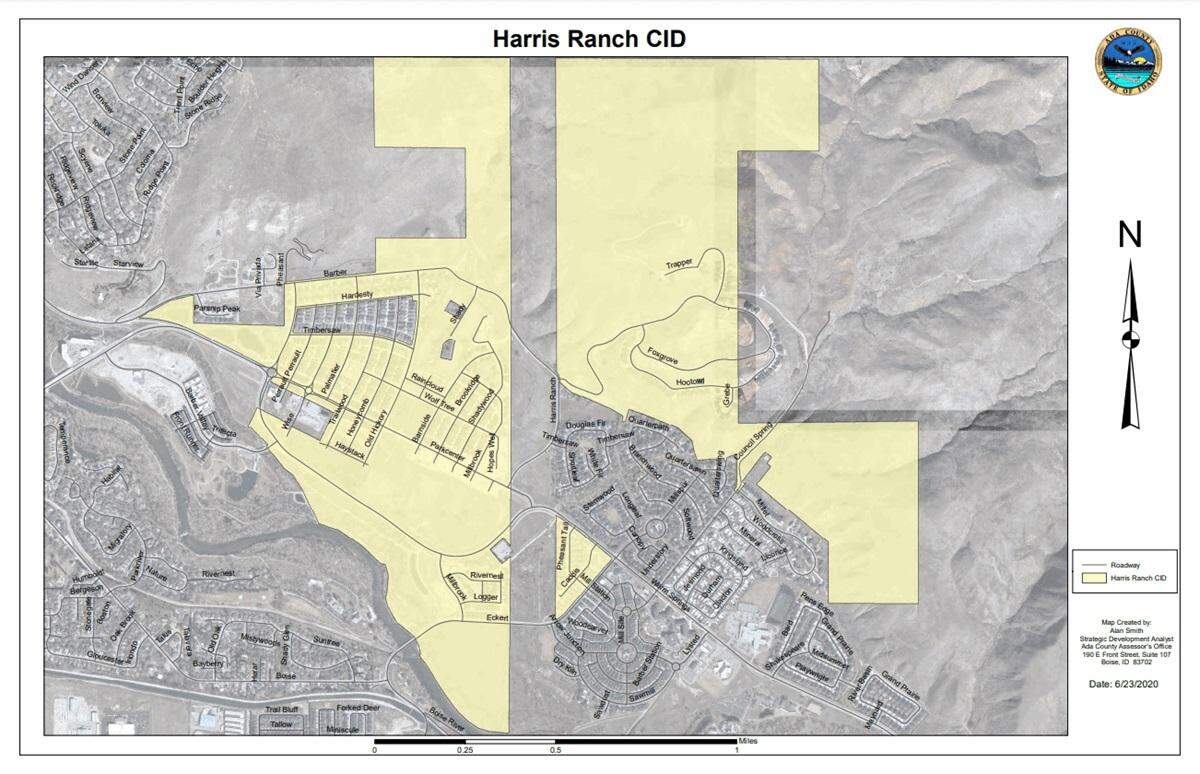
City Council approval is required for a CID’s formation. Three council members are required to serve on the district’s board.
The Harris Ranch CID in east Boise’s Barber Valley has been in existence since 2010. The first houses in the district were built in 2011. There are now 988 residential properties within the CID, according to Ada County records. The special tax district operated without much resistance until the past year. Greenbelt improvements, fire station improvements and preserving the land for the future Alta Harris Park were made reimbursed by the CID.
Crowley began questioning why his property taxes were about 30% higher than the taxes of similar Harris Ranch property owners outside the CID. Throughout the summer, Crowley and Doyle campaigned against the district and argued it should be dissolved since they believe it wasn’t formed legally.
After the developers claimed defamation in November, the taxpayers association responded. Crowley, Doyle and the taxpayers association filed a petition for judicial review challenging the legality of the CID board approving certain payments — specifically payments of $5.2 million and $7.1 million, both approved by the board on Oct. 5. The payments related to road projects within the district.
The district itself and Boise City Council members Elaine Clegg, TJ Thomson and Holli Woodings were named as respondents in the petition. The council members sit on the district’s board.
With two legal actions at once, Fowler said his attorneys and the taxpayers’ association’s attorneys entered settlement negotiations. Fowler said his preference would be for all the litigation to be dropped.
The taxpayers’ attorney offered an agreement in which both parties would drop their cases, Fowler said.
“We think it’s an enormous waste of resources,” Fowler said.
Crowley declined to comment.
The developers dismissed the case requesting a permanent injunction “to prevent the irreparable harm that will be caused if Defendants are free to continue to make defamatory statements.” The dismissal, though, was “without prejudice,” meaning it could be refiled at any time.
The Harris Ranch CID Taxpayers’ Association has yet to drop its petition. Fowler said he’d be willing to dismiss the case with prejudice once the taxpayers drop theirs. “With prejudice” means the case could no longer be refiled.
Fowler said he has “no idea” if the dismissed case might be refiled in the future.
As these legal actions unfold, developers are planning future phases of the Harris Ranch development. They recently presented ideas to the Barber Valley Neighborhood Association. A food hall, amphitheater and town center are all potentially in the works.
Fowler said certain Harris Ranch amenities, like wide sidewalks, wouldn’t have been possible without the CID.
Without the CID, developers would be responsible for paying for those improvements. The quality of the area wouldn’t be as high if not for the CID and future projects depend on it too, Fowler said.
“It’s costly and time consuming and threatens those plans for the future,” Fowler said of the litigation. “In the meantime, (it) slows (upcoming projects) down. So we would like to get this resolved so that doesn’t happen.”
Fowler said he understands why Harris Ranch residents have concerns about their rising taxes. He believes there may be some possible solutions to address those while keeping the CID intact.
One idea he thinks could work would be to impose a 3% cap on how much the CID tax could increase by each year. This would address the potential big spikes from one year to the next. But he doesn’t want the district to be nixed.
“If the CID disappeared,” Fowler said, “one can only guess what the remainder of Harris Ranch would look like.”
This story was originally published January 2, 2022 at 4:00 AM.
CORRECTION: The Harris Ranch Community Infrastructure District Taxpayers’ Association has filed one petition for judicial review of certain decisions made by the district board. A previous version of this story misstated how many legal actions the taxpayers association has filed.