Should growth pay for itself? Why tax district claiming to do that angers some Boiseans
Larry Crowley and the neighbors on both sides of his Harris Ranch house wondered why their property tax bills had increased so much. So one afternoon last summer, Crowley and his neighbors met for coffee on his patio to compare notes.
The group was puzzled by one particular taxing jurisdiction: the Harris Ranch Community Infrastructure District.
Crowley set up a spreadsheet to examine their bills further. He compared property taxes for houses inside the community infrastructure district to similar houses just outside it.
“We were just floored,” Crowley said in a phone interview.
The more information Crowley gathered, the more questions he had. What was the money paying for? And who was making these decisions? Those questions point to a wider topic. As Boise adds more housing and more people, who is responsible for paying for infrastructure to keep up?
A community infrastructure district, or CID, is one of the tools the Idaho Legislature has authorized intending to help growth pay for itself. By winning City Council approval to create a district, a developer is assured of recouping money the developer spends on roads, parks and other improvements through a tax on owners of properties in the district, including houses not yet built when the district is created. That means those improvements won’t have to be shouldered by existing taxpayers.
But Crowley disagrees with the idea that the CID is an example of growth paying for growth. He says homeowners like him are “paying for facilities ... used by people who live outside the CID.” The result is unequal taxation, including within Harris Ranch itself, where some homeowners were excluded from the district, he said.
With momentum growing among Crowley’s neighbors, a legal battle looms.
Harris Ranch becomes home to Idaho’s first such district
It’s a turbulent moment in the life of a middle- to upper-middle-class development that has drawn little controversy before.
Harris Ranch used to be a ranch owned by the Harris family before homes were built on the land. It’s a planned community in southeast Boise’s Barber Valley, between the Foothills and the Boise River. Its houses now sell for an average of $799,500, says Realtor.com.
The first homes were built in the Mill District and Spring Creek neighborhoods just off Warm Springs Avenue starting in 1999. Plans for the entire development were approved by the city of Boise in 2007. The city deemed it important enough to give the development its own section of city code.
In 2008, many houses in those neighborhoods were already built when the Legislature passed the Community Infrastructure District Act. Its purpose was “to encourage the funding and construction of regional community infrastructure in advance of actual developmental growth that creates the need for such additional infrastructure,” according to the statute.
The general idea is that people in the district pay for long-term bonds that are sold to finance improvements. The district can pay for things like roads, parking spots, trails, parks and public safety facilities that “directly or indirectly” benefit its residents.
Along with the act came specific rules, some of which would emerge 13 years later as issues for Crowley and his allies: A community infrastructure district requires at least a two-thirds vote in favor of its creation by district residents or by all of the landowners within the proposed district. The district must be governed by three city council members. The land making up the district must be “contiguous” unless “specifically determined by the district board to have a substantial nexus to the initial district.” Anyone selling property in the district is required to inform the buyer of the CID’s existence.
In 2010, Harris Ranch became the first development in the state to take advantage of the CID Act. The Harris Ranch CID was formed with just three votes. The first two came from the developers, Barber Valley Development and Harris Family Limited Partnership. The third came from a farmhand and tenant on the property who lived in a mobile home, Ronald Murray.
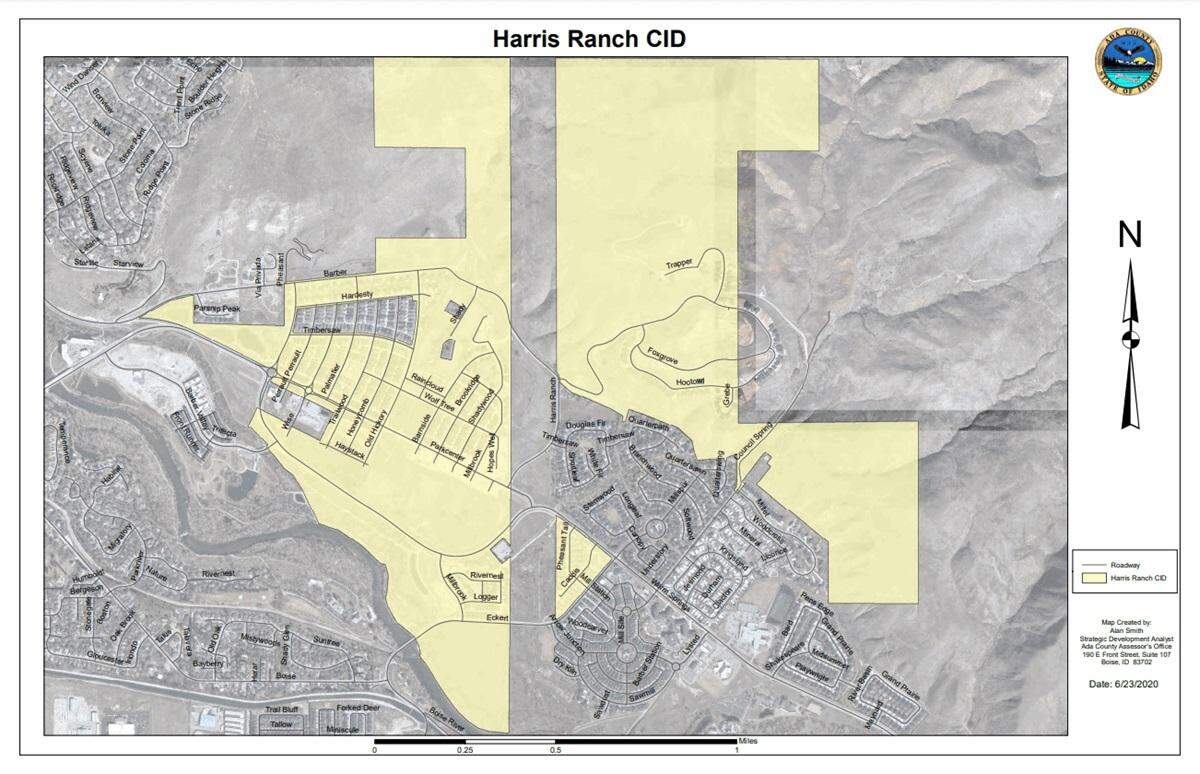
The developers purposely excluded Harris Ranch’s Spring Creek and Mill District neighborhoods from the CID.
“Would it have been nice to have everybody in Barber Valley join the CID? You bet it would have been,” said Doug Fowler, president of Barber Valley Development, in an interview. “But go next door to Spring Creek and say, ‘Hey guys, you want to join the CID? Your taxes are going to increase.’ That’s not going to happen.”
The first homes within the CID were built in 2011. For years, the special tax district operated with virtually zero pushback.
Taxpayers argue against CID
Then came Larry Crowley. He moved to his home in the district in 2018. Within two years, he began to wonder about his property taxes.
Now semi-retired, Crowley has a background in economics. He worked for Idaho Power and other companies looking into cost structures and how services are priced based on those costs. Crowley questioned why his property taxes were about 30% higher than those of similar Harris Ranch homeowners outside the district.
The handful of neighbors Crowley first talked to has grown to hundreds. He organized the Harris Ranch Community Infrastructure District Taxpayers’ Association and sits on its executive committee as president.
Throughout recent months, the district’s board has been bombarded with letters opposing and supporting the CID.
In a Sept. 7 letter, the taxpayers association disputed how much disclosure people receive as they’re buying a home within the district. Bill Doyle, vice president of the taxpayers association and a retired municipal bond attorney, and Crowley say homebuyers haven’t found out about the additional taxes until right before their house purchases are about to be finalized.
Hethe Clark, an attorney for Barber Valley Development, batted down these claims. In a letter responding to Doyle, Clark included email excerpts showing that Crowley’s builder informed Crowley of the CID.
Another complaint came in a Sept. 27 letter as Doyle disputed the vote that formed the CID. Doyle argued the two votes from business entities shouldn’t have counted. He also wrote that Murray may not have been an eligible voter. Even if he was, having the fate of the district decided by one person “can’t be right,” Doyle wrote.
In response, Clark wrote that corporations are allowed to vote on CIDs and that Murray was qualified. Clark added that the formation of the tax district isn’t up for debate more than 10 years later.
The taxpayers association said the land making up the tax district is not contiguous, as the law requires.
“It is absurd,” Doyle said in an interview.
Fowler’s response was that the district’s area was based on the land the Harris family still owned when the district was formed in 2010. Including the already built neighborhoods outside the Harris family’s ownership likely would have meant the defeat of the district.
“There was nothing nefarious about it,” Fowler said.
Crowley and Doyle also took issue with who has access to the improvements paid for by the CID.
Crowley believes district homeowners in the district shouldn’t be the only ones paying for improvements that people outside the district benefit from. Because of the way the tax district was drawn, lots of people outside the district use the infrastructure they didn’t pay for.
So far, the district has reimbursed the cost of several projects including the ParkCenter Boulevard roundabouts, Alta Harris Park and Fire Station 15 land, roads, rights-of-way and Idaho Power service to the fire station. The price tag of those reimbursed projects has already totaled more than $19 million, according to city records.

Fowler’s counterargument is that just because residents from outside the district use these facilities doesn’t mean they’re invalid.
“There’s some controversy that you’ll hear, ‘We’re paying for these amenities but other people get to use them.’ Yes. That’s true,” Fowler said. “... But if somebody from Kuna comes down to Ann Morrison Park, are you going to kick them out?”
As he dug deeper into the history of the tax district, Crowley dug deeper into his stance.
“The goal is to find a way to get property tax parity or equality for CID homeowners,” Crowley said. “The most realistic option is for the CID to go away. I think it’s flawed structurally, fundamentally, philosophically.”
Meanwhile, homeowners’ tax bills keep going up. As the taxpayers association’s objections ramped up, city of Boise Deputy Treasurer David Hasegawa told the district’s board at a Sept. 7 meeting that the average home will have to pay $1,400 to the district this year compared with $1,100 last year because of the rise in property values.
Future plans for district
The fight has put the district’s board in the middle.
Nowadays, the board is made up of Elaine Clegg, TJ Thomson and Holli Woodings. They’ve been serving on the Boise City Council since 2004, 2010 and 2018, respectively.
With the taxpayers association and Barber Valley Development each sticking to their stances, the Boise City Council on Sept. 28 approved an agreement with the district to allow the city to pay up to $250,000 in legal fees on behalf of the district for the next three years.
At the board’s next meeting Oct. 5, Hasegawa said the taxpayers association had informed the district staff that it plans to challenge the board’s decisions in court if the board approved a project resolution or bond resolution. Shortly after, the board unanimously approved three projects costing $7.1 million.
The board members discussed how their oversight is narrow and that their role is to simply evaluate whether the projects fit within the scope of previous agreements.
The association says it will sue to invalidate the district’s debt.
There are now 983 residential properties within the CID, according to Ada County records. That number has climbed significantly in recent years, from 609 in 2018, as new houses have been built.
Fowler has plans to build about 100 more houses and 1,500 to 1,800 multifamily units. The development still has several more years to go.
Based on the district development agreement, bonds can be issued for 30 years from the district’s formation and for up to $50 million in total.
As property values rise and more homes are built, more money will flow into the Harris Ranch CID. That could help pay off the reimbursements faster. With the district having almost 20 more years to go, the taxes still add up. Crowley estimates he’ll pay tens of thousands of dollars to the CID by the time it expires.
Fowler says the district has been good for Harris Ranch and for Boise.
“It really is a tool for growth to pay for itself,” he said. “That’s the key.”
Clegg, like many city council members across the valley, agrees that growth should pay for itself. Clegg has worked since 1998 for Idaho Smart Growth, an organization that advocates for growth management and types of land uses.
But as an elected Boise official and a member of the CID board, Clegg also takes note of voters’ complaints.
“The act was passed for the purpose of allowing growth to more fully pay for itself directly and doing it in a way that allowed development to offer high-quality services,” Clegg said in a phone interview. “I think there are many people who would say that that has been the case in Harris Ranch. And there are some who would say it hasn’t.”
Idaho Statesman Editor Chadd Cripe, who lives in the Harris Ranch Community Infrastructure District, is on a mailing list for email updates from the Harris Ranch Community Infrastructure District Taxpayers’ Association. Cripe has taken no part in the association, nor has he participated in the editing of this story.