Harris Ranch taxpayers take their fight against special tax district to new battlefield
Some residents of Boise’s Barber Valley are fighting back against a special tax district they believe is unlawful.
Harris Ranch taxpayers are objecting to the Harris Ranch Community Infrastructure District, which has collected taxes to reimburse money the developer spends on certain types of infrastructure.
Larry Crowley, Bill Doyle and the Harris Ranch Community Infrastructure District Taxpayers’ Association have filed a petition in Ada County’s Fourth District Court. Crowley is the association’s president, and Doyle is vice president.
Their petition was filed against the district and Boise City Council members Elaine Clegg, TJ Thomson and Holli Woodings, the trio who sit on the tax district’s board because state law requires it.
The taxpayers previously voiced several objections to the CID’s existence, and leaders said they wanted the tax district dissolved. In their most recent legal action, they highlight objections with two resolutions approved at the Oct. 5 CID Board meeting.
One resolution approved $7.1 million of payments requested by Harris Ranch’s developers, Barber Valley Development Inc., Harris Family Limited Partnership and Lenir Ltd., for projects related to the development. The other authorized the issuance of $5.2 million in bonds by the CID.
The petition for judicial review challenges the legality of the board’s approval of these payments, the issuance of bonds and the annual levy of the special property taxes.
The taxpayers request that the court “find and determine that the adoption of the Harris Ranch CID Resolutions and the actions authorized and approved thereby were and are unlawful, invalid and void.”
The taxpayers argue the land included in the district is not “contiguous,” as Idaho law requires, because it comprises two unjoined areas. They also take issue with the fact that only one person lived within the district at the time it was formed, when a majority of eligible voters was needed in an election to establish the district. And now the district is responsible for collecting millions of dollars in taxes from homeowners who had no say in its creation.
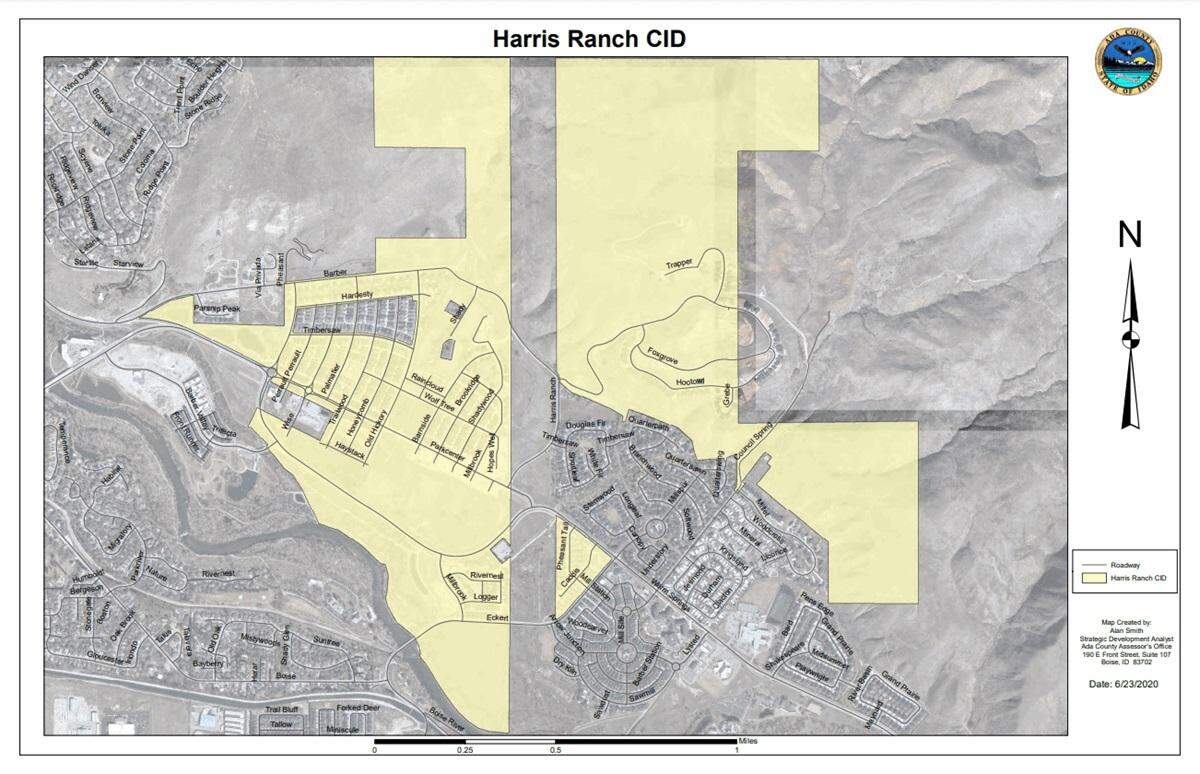
Doug Fowler, president of Barber Valley Development Inc. and LeNir Ltd., said in a previous interview with the Statesman that the district intentionally excluded already-built homes because people living there would not have agreed to the extra taxes.
In early November, the Harris Family Limited Partnership, Barber Valley Development Inc. and LeNir Ltd. struck first by suing the taxpayers association and Crowley and Doyle. The developers alleged that they “made public statements (verbally and in writing) grossly defaming” them and interfered with their contracts and prospective economic advantage. The developers are seeking reimbursement for damages and hope “to prevent the irreparable harm that will be caused if defendants are free to continue to make defamatory statements,” the lawsuit reads.
A community infrastructure district, or CID, is one of the tools the Idaho Legislature has authorized to help growth pay for itself. By winning City Council approval to create a district, a developer is assured of recouping money the developer spends on roads, parks and other improvements through a tax on owners of properties in the district, including houses not yet built when the district is created. That means those improvements won’t have to be shouldered by existing taxpayers.
The Harris Ranch CID formed in 2010 and operated for roughly a decade without much pushback. But as property taxes rose recently, taxpayers began taking notice. Crowley and Doyle have led the charge against the CID.
Crowley estimated his property taxes were about 30% higher than those of similar Harris Ranch homeowners outside the district. Boise Deputy Treasurer David Hasegawa said at a Sept. 7 CID Board meeting that the average homeowner will have to pay $1,400 to the district this year compared with $1,100 last year because of the rise in property values.
The fight with the developer has taken place for several months as letters from the taxpayers and the developer flew back and forth, addressed for the tax district’s board. Throughout the summer and fall, the taxpayers threatened to take legal action.
As the legal battle has continued, the taxpayers association has asked residents who live within the CID to donate money to pay for legal fees.
This story was originally published December 8, 2021 at 4:00 AM.