Harris Ranch developers sue group of disgruntled Harris Ranch taxpayers. Here’s why
The fight over a special taxing district in Harris Ranch designed to make growth pay for itself is headed to court.
The developers of Harris Ranch are seeking a permanent injunction from disgruntled residents of the Harris Ranch Community Infrastructure District to stop them from allegedly defaming them, hurting their business and using the Harris Ranch name.
They are suing in Ada County’s Fourth District court. The plaintiffs are Harris Family Limited Partnership, Barber Valley Development Inc. and LeNir Ltd. The defendants are the Harris Ranch Community Infrastructure District Taxpayers’ Association, Larry Crowley and Bill Doyle. Crowley is president of the taxpayers association’s executive committee, and Doyle is vice president.
The developers allege that the taxpayers association, Crowley and Doyle have “made public statements (verbally and in writing) grossly defaming” them and interfered with their contracts and prospective economic advantage. The developers are seeking reimbursement for damages and hope “to prevent the irreparable harm that will be caused if defendants are free to continue to make defamatory statements,” the lawsuit reads.
The developers are also claiming trademark infringement for using the “Harris Ranch” name as part of the name of the taxpayers association.
The lawsuit comes after months of letters back and forth between the two sparring groups addressed to the CID Board.
Doug Fowler, president of Barber Valley Development Inc. and LeNir Ltd., declined to directly address the lawsuit but said in a Zoom interview that he remains committed to completing the Harris Ranch development. He said “we’re getting pretty close” to building the village center, featuring commercial space, and multifamily units.
“We really want to keep that as our focus and not be deterred by anything that would diminish that focus,” Fowler said.
Crowley declined to comment.
Harris Ranch is a planned community in southeast Boise’s Barber Valley, between the Foothills and the Boise River.
In 2008, with part of Harris Ranch already built, the Legislature passed the Community Infrastructure District Act “to encourage the funding and construction of regional community infrastructure in advance of actual developmental growth that creates the need for such additional infrastructure,” according to the statute.
It was intended to create a mechanism for people living in a new development to pay for the costs of roads, parks and other improvements in the development. When people buy houses in the development, the district taxes their properties to reimburse the developer. Thus these projects wouldn’t be paid for by taxpayers outside the development.
The Harris Ranch CID was formed in 2010. At the time, only one person lived on the portion of Harris Ranch that now makes up the district. In a previous interview with the Statesman, Fowler said the district intentionally excluded existing homes, believing their owners would not agree to pay additional taxes.
The special tax district hummed along without much pushback for most of the past decade. In the past year, opposition picked up, spearheaded by Crowley and Doyle.
Throughout the summer and fall, the Harris Ranch CID Taxpayers’ Association flooded the Harris Ranch CID Board with letters arguing against the tax district. An attorney representing Barber Valley Development responded frequently, batting down the claims.
The board is made up of three Boise City Council members: Elaine Clegg, TJ Thomson and Holli Woodings.
Among the taxpayers’ complaints were how the district was formed and how much disclosure new homebuyers receive about the district when purchasing their home.
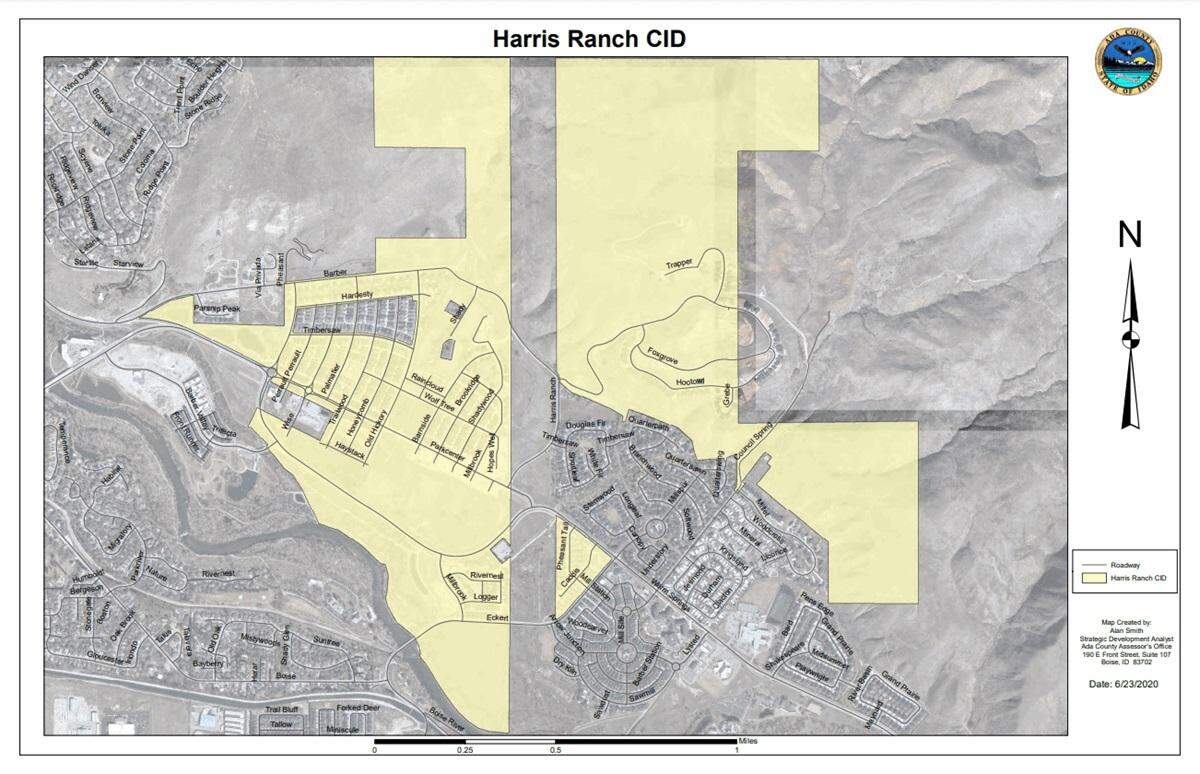
Crowley estimated his property taxes were about 30% higher than those of similar Harris Ranch homeowners outside the district. And their taxes have been climbing: Boise Deputy Treasurer David Hasegawa said at a Sept. 7 CID Board meeting that the average homeowner will have to pay $1,400 to the district this year compared with $1,100 last year because of the rise in property values.
By early October, the taxpayers association had informed Hasegawa and the district’s staff that it planned to sue the district board if it approved $7.1 million for certain projects. The board approved them on Oct. 5.
On Oct. 8, an attorney representing the three plaintiffs wrote a letter to Crowley, Doyle and the taxpayers’ association demanding that they “immediately cease and desist from all communications that defame and disparage the Harris Family Limited Partnership, Lenir Ltd. and Barber Valley Development Inc.”
Now, the developers allege in the lawsuit there was at least $10,000 in damages due to a “loss of reputation, business and income, and the time and money expended to correct public records and defend themselves from the public defamation before the HRCID Board.”
In a previous interview with the Statesman, Crowley said his association’s goal is for the tax district to dissolve. The association on Oct. 31 emailed district homeowners asking each of them to contribute $500 to pay for a lawsuit to dissolve the district, invalidate its bonds and make homeowners’ property taxes consistent with those of other Boise homeowners.
This story was originally published November 5, 2021 at 11:17 AM.