Altered plan for downtown Boise towers takes a leap forward despite criticism. Why?
Despite criticism from nearby neighbors, Boise’s Planning and Zoning Commission recommended approval of a plan that would change parts of downtown Boise’s controversial Idaho Central Credit Union towers.
The unanimous nod of approval came Tuesday after a dispute among nearby neighbors, the city of Boise and Meridian’s Ahlquist Development. Neighbors, who have long opposed the project, alleged that the company had broken its hard-fought development agreement with the city by shifting from building over 100 rental units to 69 for-sale condominiums.
Ahlquist Development is already constructing the building with two towers at 200 N. 4th St. Offices would fill the 13-story south tower, while residential units would fill the 11-story north tower.
Residents argued that the city first approved the building with a minimum of 100 residential units because it would provide an influx of much-needed housing. They said the new changes went against that reasoning.
“Every decision by the city lately seems to underline the need for more housing, not less,” said Dan Everhart, a nearby resident and member of neighborhood group Better Change for East Downtown, at Tuesday’s public hearing. ”This decision isn’t a change that will help solve Boise’s housing problems — it will literally result in the reduction of the planned housing by a third.”
“If this is not in the best interest of the city and its citizens, why recommend approval?” Everhart said.
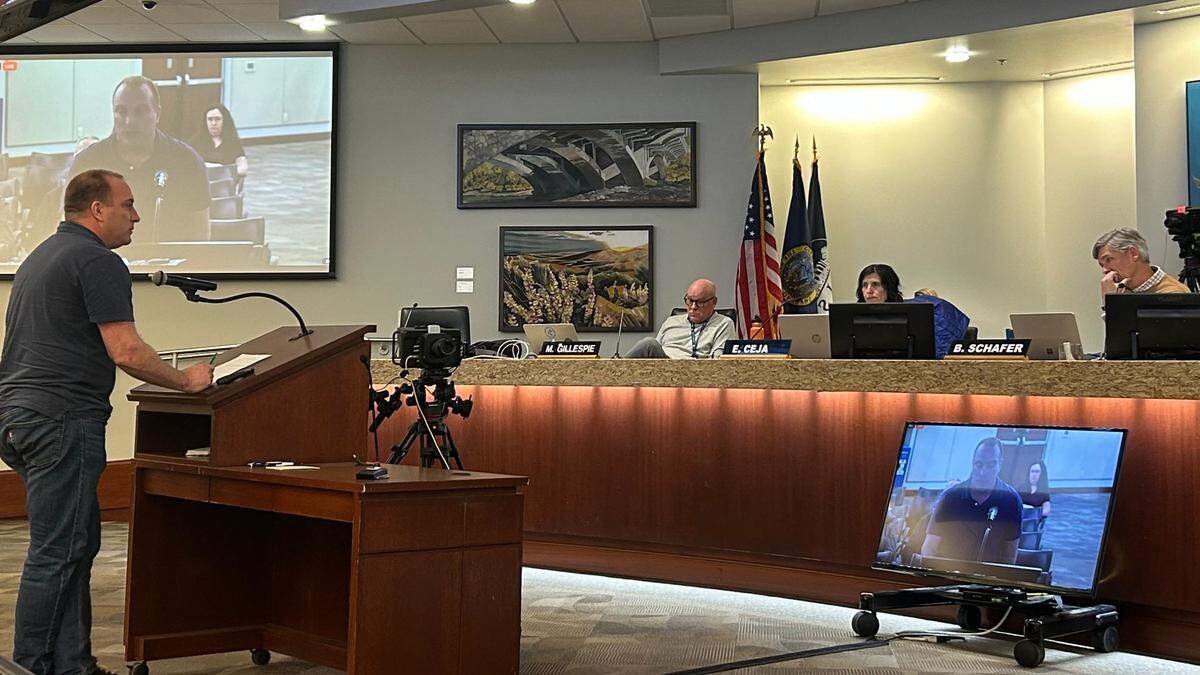
But, importantly to the commissioners, the company followed all the procedures to modify the agreement.
“I’m always troubled whenever we see a project that proposes a certain number of housing (be) reduced, and in this case reduced significantly by a third,” said Commissioner Tony Torres. “Unfortunately, I don’t see anything in the code (that would allow me) to … recommend denial on this.”
The other commissioners agreed, saying they had no legal recourse to deny the shift.
The Boise City Council still has to approve the changes before Ahlquist is in the clear.
What was the issue?
When the ICCU building was first proposed in 2020, neighbors rallied against it for being too tall for the mostly residential neighborhood. Most nearby buildings have one or two stories, except for the 12-story Imperial Plaza Condominiums.
Residents angry with the development formed Better Change for East Downtown and allied with Preservation Idaho, the Imperial Plaza Condominium Association and the North and East End neighborhood associations to oppose the development.
The original proposal called for 39 apartments, an urgent care clinic, an ICCU branch with a drive-through, eight floors of office space and four to eight condos on the top two floors of the northern tower. After months of back-and-forth, the developers agreed to several concessions, including reorienting the towers and increasing the number of residential units.
“We heard their reasonable requests,” wrote Ahlquist Development CEO Tommy Ahlquist; then- CEO and President of ICCU Kent Oram; and David Turnbull, the founder of Meridian’s Brighton Corp., in a 2020 op-ed published in the Idaho Statesman. “We addressed them. We redesigned the project.”
When the city finally approved the project in 2021, the development agreement required Ahlquist Development to build at least 100 units, with five reserved for people with housing vouchers. Ahlquist said they wanted to go above the minimum and build 124 units.
Housing vouchers are a federal program that help disabled, low-income and elderly individuals find housing in the private market, according to the U.S. Department of Housing and Urban Development. The program pays a piece of participants’ rent.
But the ever-shifting market put Ahlquist in a bind. Construction and labor costs soared in 2022 and 2023 as interest rates swelled. Micron’s $15 billion Boise expansion and Meta’s $1 billion Kuna data center also contributed to a growing worker shortage as the projects vacuumed up an already strained construction workforce.
The shift to 69 condos, a plan which the company hammered out with city staff, was a way to keep the project alive amid the rough market with the housing vouchers intact.
Boise’s Planning and Development Services Department and Ahlquist Development tried multiple routes to get the towers to make financial sense, including moving the housing voucher component to Ahlquist’s upcoming College of Western Idaho campus in Boise’s West End neighborhood.
“That project is near the river and would be a perfect landing spot for the five affordable residential units,” wrote Tonn Petersen, chief development officer and legal counsel for Ahlquist Development, in an April email to the city. “We discussed that during our meeting and it seemed to me there was consensus among the group that the CWI project would be a good alternative.”
According to Petersen, transferring the affordable housing requirement would have allowed the company to transition to a full “for sale” model for the ICCU towers. But with the poor market conditions, the company decided to keep the affordable housing for the towers and switch the rest of the units to 69 condos.
Shawn Wilson, the new director of the city’s Planning and Development Services Department who took over from Tim Keane in July, gave the company verbal approval to move forward with this plan, said Tommy Ahlquist in an October video interview with the Statesman.
Seeing modifications, nearly 4 years on
Neighbors said the change, without approval from the Planning and Zoning Commission or Boise City Council, went against the allowed rules. According to the development agreement, city staff can approve minor deviations from the plan while bigger modifications need approval from one, or both, the commission and council.
Everhart, who led much of the recent opposition, said the shift was large enough that it should have gone through public hearings. Some city staff agreed and, after the Statesman’s reporting of their concerns, the city added the shift to the Planning and Zoning Commission’s agenda.
Some on the commission, however, questioned whether it really was a big enough change to warrant a public hearing.
“I just don’t see it,” said Milt Gillespie. “It’s the same building, the same trees, the same parking load. Everything is the same except the number of units. And I have a hard time understanding how that impacts anybody making testimony tonight.”
This story was originally published December 3, 2024 at 10:33 AM.