Confusion and doubt: Did a prominent Idaho developer break agreement over Boise towers?
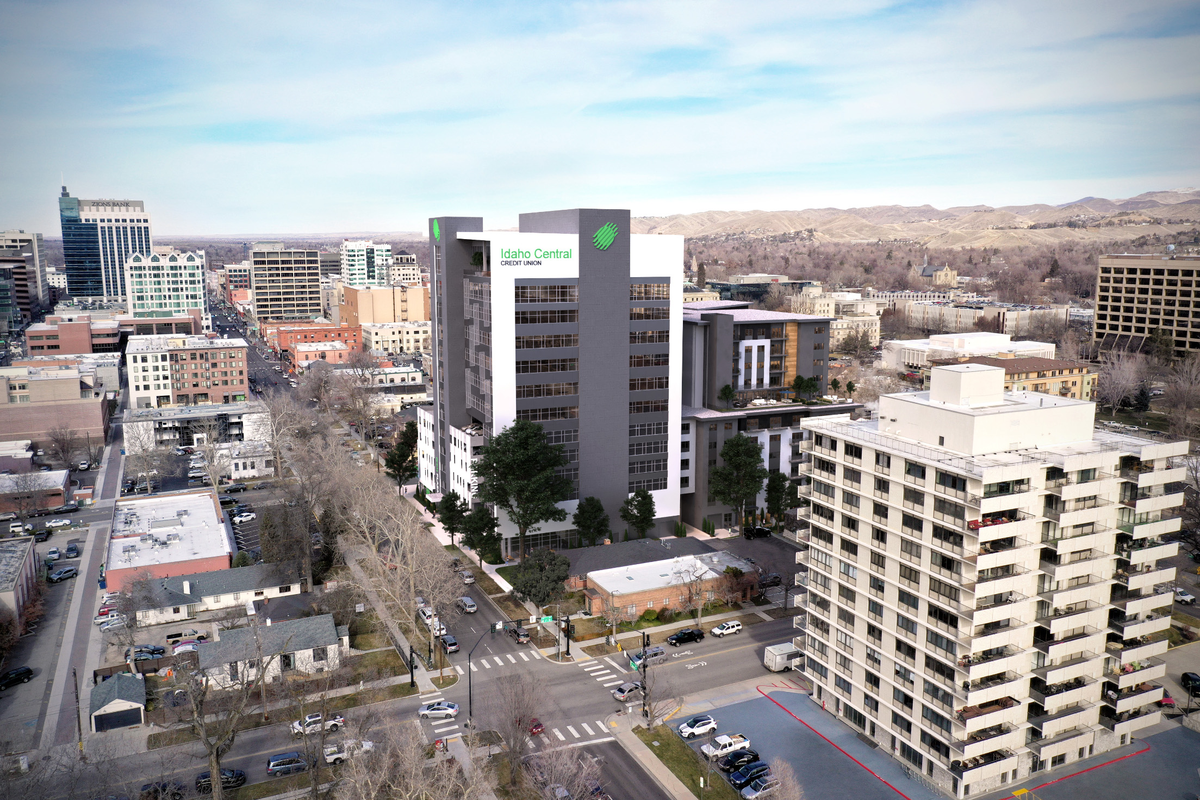
It wasn’t too long ago that residents of Boise’s East Downtown neighborhood had found a common mission: opposing the two-tower Idaho Central Credit Union Plaza going up at 200 N. 4th St., between Bannock and Idaho streets.
Nearby residents thought the original ICCU Plaza towers were too tall and the development wouldn’t fit into the mostly residential area. They spent a year and a half rallying against it until the Boise City Council, in a tie vote broken by Mayor Lauren McLean, approved it.
But plans for the project may be in doubt after all. Neighbors question whether Meridian’s Ahlquist Development, formerly known as Ball Ventures Ahlquist, broke its development agreement with the city by changing the number of units offered and damaging a tree.
The city, nearby residents with neighborhood group Better Change for East Downtown say, has refused over several months to answer questions about the agreement and how it enforces such agreements.
“The whole point of going through this tortured process was to end up with an agreement that would be enforced,” said Dan Everhart, a nearby resident and member of Better Change for East Downtown, by phone. “We’re concerned that in the couple years that have passed … that the city has been pretty casual in its enforcement of that agreement.”
Tommy Ahlquist, the founder and CEO of his namesake company and a well-known physician who ran as a Republican candidate for governor in 2018, said the company had not broken its agreement and had been following what the city said to do.
“We’ve been meeting with the city, and we’ve been very cooperative,” Ahlquist told the Idaho Statesman in a video interview. “And that’s all I’m going to say.”
The building is now under construction. Crews have built the bones of several stories already.
Arguments, delays and redesigns?
First proposed in 2020, the original plans called for a 16-story north tower and a nine-story south tower, an urgent care clinic and an ICCU branch with a drive-through, according to prior Statesman reporting. The second through sixth floors of the southern tower would have been for parking, and the seventh through ninth floors for 39 apartments.
The northern tower would have included eight floors of office space and four to eight condos on the top two floors.
Neighbors, frustrated by the height — most nearby buildings are one- and two-stories except for the 12-story, 1964-built Imperial Plaza Condominiums — banded together in opposition and founded Better Change for East Downtown. Others joined in, including Preservation Idaho, the Imperial Plaza Condominium Association and neighborhood associations for the North End and East End.
To appease neighbors, the developers made several concessions, including reorienting the towers, relocating a garage entrance and increasing the number of residential units.
“We heard their reasonable requests,” wrote Ahlquist; then- CEO and President of ICCU Kent Oram; and David Turnbull, the founder of Meridian’s Brighton Corp., in a 2020 op-ed published in the Statesman. “We addressed them. We redesigned the project.”

The city approved the development in April 2021 with an 11-story residential north tower and 13-story south office tower. The building was to have a minimum of 100 apartments with five reserved for those with housing choice vouchers, according to the development agreement. Ahlquist said they wanted to go above the 100-apartment minimum and build 124 units.
Housing choice vouchers are a federal program that helps low-income, elderly and disabled individuals find housing in the private market, according to the U.S. Department of Housing and Urban Development. The program pays a piece of participants’ rent, and they are allowed to choose any type of housing including single-family homes or apartments. In some cases, those funds could be used to buy a home.
“(The agreement) wasn’t a slam dunk,” Everhart said. “But (Better Change for East Downtown) was proud of that effort and the work that we’d done.”
A stick in the side of ‘Idaho’s developer’
Ahlquist Development demolished the old ICCU building that sat on the lot after the city’s approval, but hit the pause button as interest rates and construction costs skyrocketed. It began construction in late 2023.
In April, Everhart reached out to the city about a somewhat straightforward issue: Ahlquist Development had allegedly removed fencing and used heavy equipment to dig into the root zone of a large sycamore tree that was protected in the development agreement, he said.
According to the agreement, “tree mitigation shall go above and beyond” guidelines for preserving large mature trees on the site, including the sycamore and oak tree.
The city sent inspectors and determined that Ahlquist Development, which dubs itself “Idaho’s developer,” had not violated the agreement, despite images of damaged root systems, according to emails Everhart provided to the Statesman.

“Damage to trees on the property continues to take place,” Everhart wrote on July 10. “As recently as May 31st, ICCU removed another street tree from the property. This is also documented below but serves to heighten our concern regarding developer compliance with the development agreement.”
Ahlquist said the tree issue had been resolved, and that they had to dig around it for utilities. The city, he said, had been aware of the issue and said there was no longer a problem.
According to Lindsay Moser, spokesperson for the city’s Planning and Development Services Department, inspectors had found that the trees were not in danger of being dug up and that contractors were working within the physical constraints of the site to save the trees. However, contractors found unforeseen issues with a water line within the line of roots during construction.
“This can be common in large projects such as this, and our arborist determined that the tree in the SE corner would need to be removed and the developer would be issuing payment to the parks fund,” Moser said by email. “The city believes that the contractors are working within the DA and we are working to ensure that the trees mentioned above remain healthy and intact.”
Everhart said the city has continued to keep Better Change for East Downtown in the dark. Emails Everhart sent to the city in May, June and July asking for clarification have not been answered, he said.
“(There seems to be an) inability by city staff to respond in a timely fashion,” Everhart said.
It was not Better Change for East Downtown’s intention to embarrass the city into action, Everhart said, but he worried the trees could be a slippery slope into ignoring other parts of the agreement.
“What other deviations from the signed agreement will be proposed by the developer and allowed by the city?” Everhart said by email. “Will the building design be changed? Will light pollution be allowed to impact residential neighbors to the north?”
Did developers break their agreement?
Fuel was added to that fire, Everhart said, when Ahlquist Development changed its plans for the development without the official approval of the city or public hearings.
According to Ahlquist, the company met with the city several times to find ways to make the development pencil out amid poor market conditions. Some of those discussions included switching the rental units to for-sale condos and moving the affordable housing component to another development.
The company found a possible solution by redesigning the interior of the building to offer 69 for-sale condominiums — and keeping five units for those with housing vouchers — rather than the 100 apartments the city had approved.
Ahlquist said Tim Keane, the former director of the city’s planning department, told the company that it could switch from apartments to condos as long as it kept the housing-voucher apartments. Ahlquist said Shawn Wilson, the new planning director, had verbally agreed.
But that verbal agreement may be in conflict with the development agreement and the planning department’s own rules.
The plans were conceptual by nature, according to the agreement. City staff can approve minor deviations, while larger changes must be approved by the City Council. The planning director determines what constitutes minor or substantial changes.
The City Council seemed to be swayed to approve the development in the first place because of the amount of rental housing it would add to the market, Everhart said. That has now been slashed nearly in half and converted to high-end condos.
“There is some irony in having sold this to City Council as one more solution to the housing problem, and having the mayor break the tie vote, only to switch it up to a high-end project that sells the residential neighborhood that is negatively impacted as an amenity,” Everhart said.
The proposed changes, he said, seemed major.
The development agreement requires a minimum of 100 units. According to Moser, if Ahlquist tries to go lower, the company will need to go through City Council and possibly the Planning and Zoning Commission, with public hearings included.
“It cannot go lower than 100,” Moser said.
Everhart said, “The development agreement is quite clear that deviations from the conceptual plan have to be approved by the City Council.”
According to Moser, Ahlquist Development has yet to file for any changes to the plan.
“They have not come in for a (development agreement) modification,” Moser said. “Nothing has gone through our process to change.”
According to Ahlquist, “We were told we didn’t need to do anything if we accepted the five units … The reason we haven’t done it is because they told us we didn’t need to.”
Ahlquist said Wilson would either approve the modification himself or have staff approve it, with no City Council approval or public discussion. He said he wasn’t sure why the neighborhood was making such a big deal out of it.
“Any time they find a way to be adverse to anything, they will create a problem,” he said.
Everhart said the development agreement was carefully considered by the City Council in a public meeting and reflected the concerns of the neighborhood, the council and the public.
“City staff should not have the authority to alter agreement requirements, nor should the public be excluded from participation if alternatives are considered,” he said. “Ultimately, the value and validity of development agreements as a useful and enforceable tool for public planning in Boise is in question.”
If the city can approve significant changes without going through the proper steps, it could put residents in precarious positions, he said.
“The role of the city is to look out for the interests of the citizens,” Everhart said. “What happens elsewhere in the city when a development agreement is put in place for a project and no-one is paying attention?”
This story was originally published October 31, 2024 at 12:25 PM.