Season analysis: Boise State’s first year in new offense was a roller-coaster ride
Boise State’s first season under new offensive coordinator Tim Plough was full of ups and downs.
The Broncos showed a lot of promise and looked good in spurts, but growing pains in an unfamiliar scheme, injuries on the offensive line and an ineffective running game left Boise State in search of consistency.
Things improved when starting running back George Holani returned to full health after the bye week, but Boise State’s offense finished the season ranked in the middle of the pack in the 12-team Mountain West. The Broncos were No. 5 in the conference with 29.2 points a game, No. 7 in total offense (381 yards per game), No. 10 in rushing (120.4 ypg) and No. 5 in passing (260.6 ypg).
Here are three things Boise State fans learned about the Broncos’ offense in 2021, three story lines to keep an eye on in 2022 and some awards for players on offense.
Note: This is the first installment in a five-part series wrapping up Boise State’s 2021 football season. Tomorrow, the Idaho Statesman will break down what was a resurgent season for the defense.
What we learned
1. The passing game can be dangerous
Plough was known for his team’s ability to score a lot of points at UC Davis. He said he wouldn’t even look at the scoreboard until the Aggies hit 50. Boise State scored 50 points in a game just once this season — a 54-13 win over UTEP. The Broncos also posted 40 points in a win at Fresno State and shut out New Mexico 37-0 at home.
The Broncos gave some glimpses of how productive their passing game could be this season, especially when they were playing with a fast tempo and quarterback Hank Bachmeier was spreading the ball around. The junior posted career highs in passing yards (3,079) and touchdown passes (20), and completed passes to 15 different players.
The offensive line didn’t protect Bachmeier very well early in the season, but he didn’t take nearly as many hits as linemen got healthier and the same group of starters was able to string a few games together in the latter half of 2021. The bulk of the starters on the line are expected back next season, and Boise State added a player with Pac-12 starting experience in Washington State transfer Cade Beresford in December. If the line can give Bachmeier time to operate in year two in Plough’s read-pass option (RPO) scheme, the Broncos could hit that magical 50-point mark against more opponents in 2022 and be better than 29 points per game.
2. There is depth at wide receiver, just not a lot of experience
Boise State’s passing game has the potential to be lethal because of the Broncos’ depth at wide receiver. Veteran wideouts Khalil Shakir, Octavius Evans and CT Thomas declared for the NFL Draft, and Boise State football coach Andy Avalos hasn’t confirmed whether he plans to bring Davis Koetter back for a super senior season, but the Broncos have a group that is not lacking in explosiveness, even if its members are a bit short on experience.
Stefan Cobbs and Latrell Caples are obvious breakout candidates, and they’re pretty similar on the field. Neither is all that big, but both are lightning quick, which makes them tough to cover.
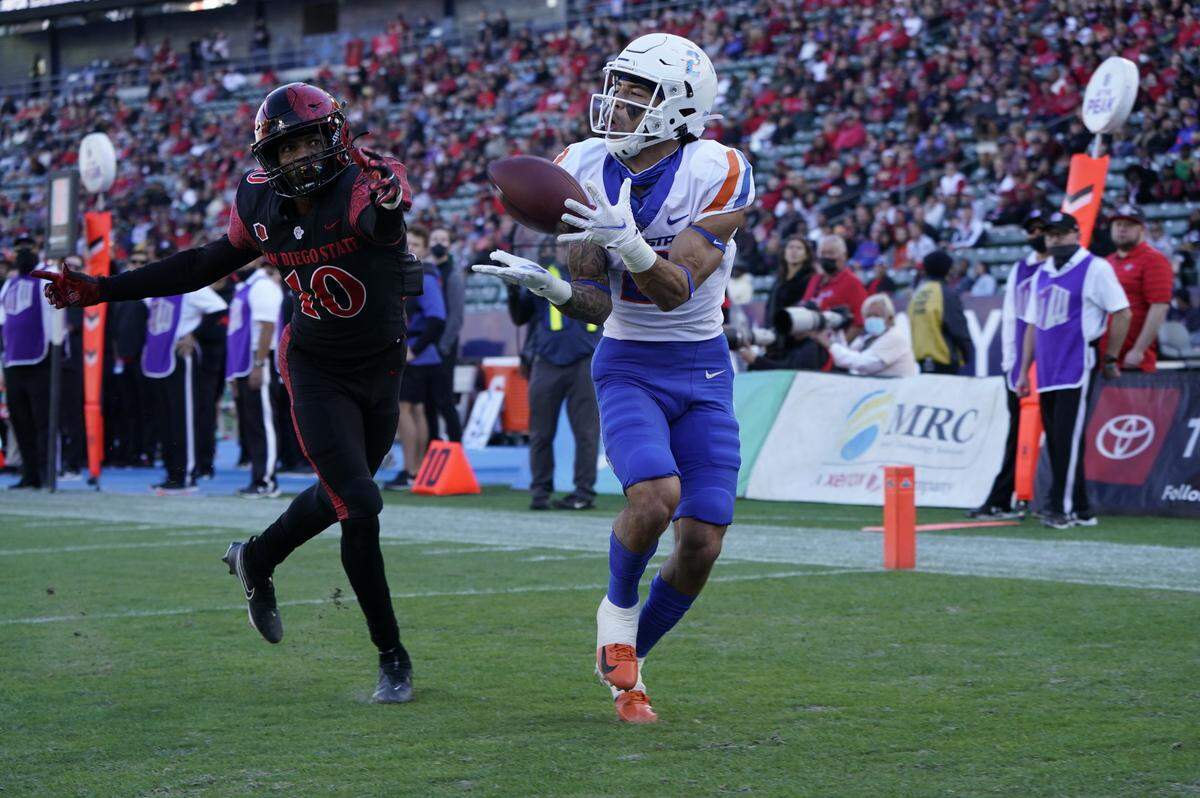
Cobbs already had his breakout game, scoring on an 81-yard punt return and a 61-yard pass in the Broncos’ 2021 home opener against UTEP. Caples saw the most extensive playing time of his redshirt freshman campaign in the regular-season finale at San Diego State. He caught two passes for 30 yards, bringing in one with an impressive toe tap on the sideline. Cobbs also make an acrobatic, one-hand catch near the sideline against the Aztecs. It’s safe to assume Cobbs and Caples will be big-play threats on offense and special teams in 2022.
Behind them, the Broncos have a couple of receivers who have been around for a few years: Billy Bowens, who set career highs this season with 12 catches for 140 yards, and Shea Whiting, who has struggled to get on the field in three years. After that, Boise State will rely on young receivers to step into prominent roles, including redshirt freshmen Eric McAlister, Jalen Richmond and Kaden Dudley, and redshirt sophomore Cole Wright.
3. The Broncos struggle when Holani isn’t on the field
If there’s one thing that was made perfectly clear about Boise State’s offense the past two years, it’s that the Broncos aren’t the same without Holani. With him on the sideline for most of 2020, the Broncos ranked last in the Mountain West at 107.1 rushing yards a game. Holani was hampered by injuries again this year, and at one point early in the season, the Broncos averaged just 87.5 yards on the ground a game, which ranked No. 120 in the country.
Despite missing three games and playing in a limited capacity in several others, Holani led the Broncos with 569 rushing yards. His vision, quickness and ability not just to run around defenders but through them makes him a next-level athlete. Boise State has to find a way to develop depth behind him, though. There aren’t many college football teams that make it through a season with one workhorse running back. The physical demands of the position are too great. If the Broncos are going to take the next step as an offense, they need a couple of playmakers in the backfield. Simply relying on Holani isn’t going to cut it.
Story lines to watch in 2022
So who can emerge to help Holani?
Getting Oregon transfer Cyrus Habibi-Likio back for another season would have been huge for the offense, but he was one of the first Boise State players to declare for the NFL Draft this winter. Habibi-Likio didn’t exactly light the world on fire in his only season with the Broncos (374 rushing yards, 2 TDs), but he was an explosive, versatile option who ranked No. 4 on the team with 23 catches.
The question is who takes Habibi-Likio’s place in 2022. The unfortunate answer is it’s too early to tell. During his introductory press conference, new running backs coach Keith Bhonapha spoke positively about junior college transfer Taequan Tyler, who hasn’t seen the field much in the past two seasons. He missed all of 2020 with a torn Achilles tendon and appeared in only three games last year. Tyler Crowe, a former walk-on from Skyview High in Nampa, is also expected back after he earned a scholarship and scored his first career touchdown.
Bhonapha spoke even more glowingly about incoming freshman Ashton Jeanty, who enrolled early and is already on campus. Jeanty, a three-star recruit, rushed for 1,843 yards and 31 touchdowns at Lone Star High in Texas, and added 42 receptions for 803 yards and 10 more touchdowns.
“The thing he brings to the table is he’s very versatile,” Bhonapha said. “He catches the ball well out of the backfield, and he’s played other positions. Those have been some of the better backs in my history, guys who have a great FBI — football IQ.”
Who steps up in passing game?
Cobbs and Caples are the obvious answers. They’ve already shown glimpses of their big-play ability, and they’re only going to get stronger and faster after another year in the Broncos’ strength and conditioning program. Their speed and ability to run crisp routes also make them both a natural fit in Plough’s RPO scheme, which specializes in making defenders pause for just a second.
Bowens should see his snaps increase, and 2022 could be a make-or-break year for Whiting.
The less obvious answer when it comes to which of Boise State’s young wide receivers will step into the spotlight is McAlister. He has the size (6-3, 193) and athleticism to compete with cornerbacks on the outside. The native of Azle, Texas, isn’t going to match the speed of Cobbs and Caples, and he doesn’t have the same pedigree that Dudley and Richmond have — they both led their high school teams to multiple state championships. But a big-bodied receiver who can compete for 50-50 balls and be a threat in the red zone is what Boise State’s passing attack is missing. McAlister should have a chance to fill that role.
Where does Ben Dooley start?
The argument could be made that offensive lineman Ben Dooley already had his breakout year. He started every game in 2021, beginning the season at right tackle and bumping inside to guard near the midway point. Dooley earned second-team All-Mountain West honors and the admiration of his teammates.
“Just seeing his progression and growth this year in run blocking and everything was something to see,” former Boise State offensive lineman Jake Stetz said. “Ben worked his butt off, and I’m really excited to see him moving forward.”
Dooley is one of as many of five linemen with starting experience who could return. All signs are pointing to Dooley being groomed to eventually replace John Ojukwu at left tackle, who is eligible to return for another season. Dooley could stay at right guard — which is where Boise State offensive line coach Tim Keane said he performed best in 2021 — but the Broncos also brought in Beresford, who has starting experience at guard.
Dooley’s most likely starting spot in 2022 is exactly where he started the 2021 season: right tackle. The Broncos have to replace Rice transfer Uzo Osuji, who is out of eligibility after starting nine games at right tackle the past two seasons. Dooley already has experience at the position, and if he’s truly the Broncos’ left tackle of the future, it makes sense for him to get as many snaps against edge rushers as possible.
Season Awards
MVP — WR Khalil Shakir (77 catches, 1,1117 yards, 7 TDs): This one isn’t even close. Shakir was, by far, the most reliable wide receiver on Boise State’s roster, and he showed not just some of the surest hands in the Mountain West, but in the country. He posted what felt like a career’s worth of acrobatic catches this fall, two of which landed him on ESPN “SportsCenter” Top 10 Plays of the Day: a one-handed grab against UTEP and an improbable catch with two defenders draped all over him in a win at BYU.
Shakir led Boise State in receptions, receiving yards and receiving touchdowns. He also ran the ball 21 times for 130 yards, attempted the fifth pass of his career, and returned punts and kicks. The native of Murrieta, California, who threw his first touchdown pass in 2019, finished his career with 25 total touchdowns (20 receiving).
Comeback Player of the Year — WR Octavius Evans (34 catches, 409 yards, 2 TD): For years, Boise State players and coaches shared stories about impressive feats of athleticism by Evans in practice, but it didn’t show up in games. That changed this year. The fifth-year senior set career highs in receptions and receiving yards, and his two receiving touchdowns matched his career high from his true freshman season in 2017.
Evans finished the season averaging 40.9 receiving yards a game. That’s almost three times as many yards as he averaged in 2019, which was the last time he played a full season. After appearing in just two games, Evans took a leave of absence from the team in 2020 to deal with a personal issue. He found a way to thrive in Plough’s scheme in what turned out to be the final season of his college career. Evans declared for the NFL Draft earlier this month.
Breakout POY — WR Stefan Cobbs (34 catches, 421 yards, 5 TDs): Cobbs’ name came up almost every time a Boise State player or coach was asked this offseason about candidates for a breakout season, and he proved them all right. He set career highs in receptions, receiving yards and receiving touchdowns. The native of Fort Worth, Texas, also showed off his big-play ability with an 81-yard punt return for a touchdown and a 61-yard touchdown catch in the Broncos’ home opener against UTEP.
This story was originally published January 11, 2022 at 5:00 AM.