Boise State rushing attack ranks No. 120 nationally. What are the keys to fixing it?
Boise State has built its reputation over the years with program-altering wins on a national stage, the iconic blue turf in Albertsons Stadium and a long list of 1,000-yard rushers.
The Broncos extended their streak of seasons with a 1,000-yard rusher to 11 straight when running back George Holani had 1,014 yards as a true freshman in 2019. That streak ended last year, but the 2020 season can get an asterisk in the record books — Boise State played only seven games in a COVID-19-shortened season.
Also, Holani was lost to a knee injury in the second game of the season and made only a brief return in the regular-season finale at Wyoming. His absence exposed a lack of depth in the Broncos’ backfield, as Boise State ranked last in the Mountain West with 107.1 rushing yards a game.
With its star running back healthy this season and added depth in the form of Oregon transfer Cyrus Habibi-Likio, Boise State expected to pick up where it left off in 2019 and return to a vaunted rushing attack. But through four games, that hasn’t been the case.
Boise State ranks No. 10 in the Mountain West and No. 120 out of 130 FBS football teams nationally with a paltry 87.5 rushing yards a game. That’s simply not up to the Broncos’ standard, running backs coach Winston Venable said. And the million-dollar question at Boise State right now is, what’s wrong?
“Just to win football games, you have to have some type of a run game,” Venable said. “Championship teams, they’re not going to be a pass-only offense. They’re going to be well-balanced.”
Holani hasn’t looked right in a regular-season game yet this fall, and he hasn’t carried the ball more than 15 times since the 2019 Mountain West championship game against Hawaii. He missed the season opener at UCF with an injury and he was on a snap count in the Broncos’ home opener against UTEP.
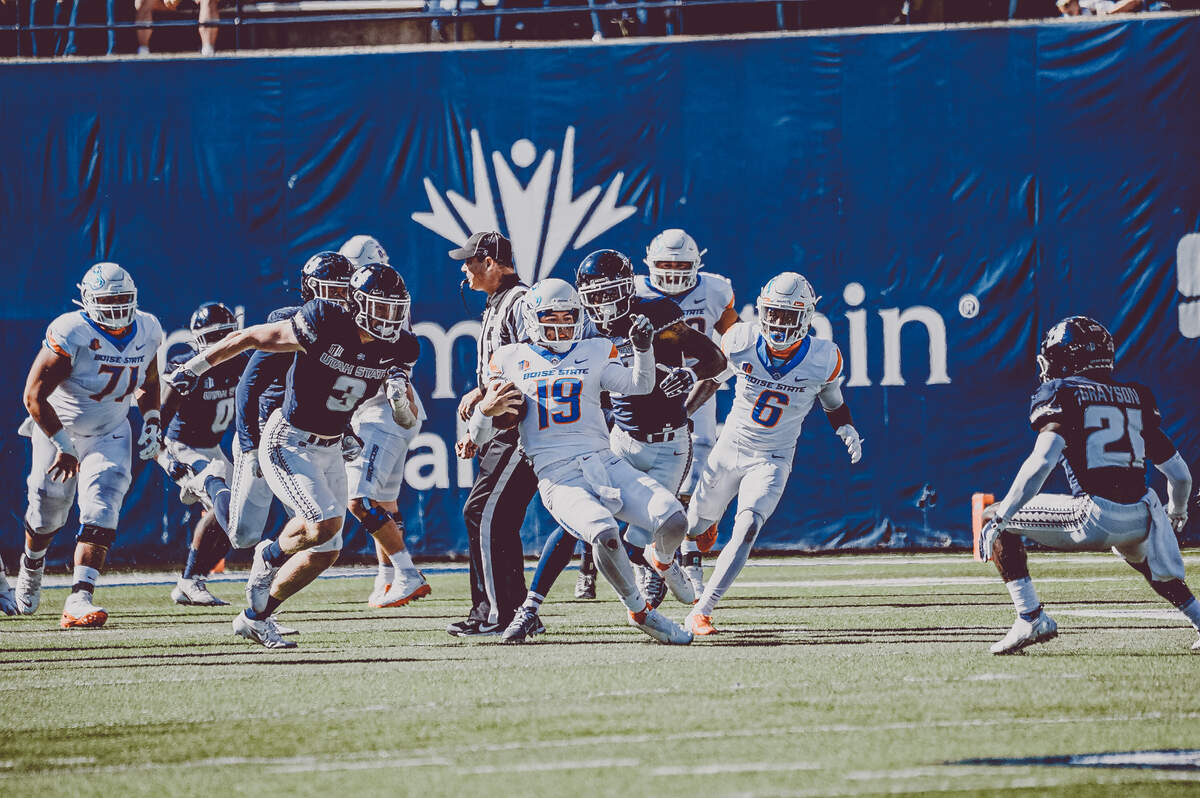
Boise State coach Andy Avalos said Holani was ready to play without limitations in the Broncos’ home game against Oklahoma State, but he hasn’t been a factor in either of the past two games. Holani was limited to 46 yards on 13 carries at Utah State on Saturday, and Oklahoma State held him to 28 yards on 12 carries.
Holani is averaging 3.2 yards a carry and 32 yards a game, and he leads Boise State with just 96 rushing yards this season. But he isn’t the only running back struggling to pick up positive yards.
Former walk-on Tyler Crowe is second on the team with 65 yards, most of which he accrued during mop-up duty. Habibi-Likio has been explosive in spurts, but he has just 60 yards and a touchdown on 26 carries, an average of 2.3 yards per carry. Andrew Van Buren leads the team with four rushing touchdowns, but he’s averaging just 1.9 yards a carry.
Boise State’s coaches have fielded plenty of questions about the Broncos’ inability to run the ball the past few weeks. Are the running backs or quarterback Hank Bachmeier missing assignments in an unfamiliar offense that relies heavily on run-pass-option (RPO) plays? Is the offensive line not creating enough of a push to open running lanes? Here’s a look at what they have pinpointed as the main issues.
A Boise State learning curve
Bachmeier never ran an offense that relies so heavily on RPO plays before this year. He spent his high school career in a spread system and the first two years of his college career in a pro-style offense under former Boise State coach Bryan Harsin.
There’s a lot new to take in for everyone involved, said Boise State offensive coordinator Tim Plough, who brought an uptempo, high-scoring offense with him from UC Davis after joining Avalos’ staff in January.
“I think for the whole offense, there’s a learning curve there,” Plough said. “I know everyone would love to see that end in victories. No one wants to see that more than us. But every single game, those guys are going to learn a lot about what we’re trying to do offensively, and our staff is going to learn a lot.”
Venable, who was a linebacker for the Broncos in 2009 and 2010, said he had to start from scratch when learning Plough’s scheme — just like the players.
“Learning and teaching at the same time makes it difficult, but that’s the situation we’re in,” Venable said. “The way coach Plough teaches us as a staff and players, it’s awesome because he does a great job breaking it down and he makes it very simple for us to learn.”
Plough said being consistently successful in an RPO-driven offense comes down to excelling in three areas: playing fast and efficiently between snaps, execution and finishing plays.
Playing fast: “Can we be more consistent in getting aligned into our tempo so teams can’t get set defensively?” Plough asked. “A big part of what we’re trying to achieve offensively is beating them to the line of scrimmage, so they’re not ready when we snap the football.”
Much of the success of an RPO play hinges on the quarterback making quick decisions before and after the snap. Before the play begins, he has to scan the alignment of the defense and anticipate what it’s going to do. After the snap, he has to read his keys — whether that’s a crashing defensive lineman or a safety coming down to help against the run — and decide whether to throw, hand the ball off or keep it himself.
The quarterback’s timing is key, offensive lineman Garrett Curran said.
“The quarterback has to be on time,” he said. “If the quarterback’s timing is off, I don’t know if it’s a run or pass, and I could get caught downfield.”
Execution: “Offensive football is execution, assignment football,” Plough said. “We need 11 guys to execute their assignments correctly.”
As a team, Boise State is averaging just 2.5 yards per carry this season. The Broncos have converted just 38% of their third-down attempts, and they’ve picked up a first down on the ground just 28 times in four games.
Finishing plays: “Whether that’s the tempo of how we get the ball to the ref and get to the line for the next play, or how we finish a block or finish a run with ball security,” Plough said. “If we can get those more consistent, we’ll not only see success in the first half, like we have, but we’ll see success though the entirety of the game.”
Boise State’s offense has been efficient in the red zone this season. The Broncos have scored on 17-of-19 trips, and they’ve come away with a touchdown 10 times.
The Broncos are particularly effective near the goal line when they go with their jumbo package, which usually includes 295-pound defensive tackle Scott Matlock lined up as an extra tight end and Van Buren, who weighs 240 pounds, crashing into the end zone. All four of Van Buren’s rushing touchdowns this season have been scored on runs of 3 yards or less.
How much should Bachmeier run?
A critical aspect of any RPO offense is the threat of the quarterback running the ball, Plough said.
“If (teams are) going to load the box and you’re in shotgun, you’re going to have to show that the quarterback is willing to run,” Plough said. “It can be the great equalizer. But in shotgun, if you can’t run the quarterback, it makes things stack up against you. The defense knows he’s not going to run, so they can x him out of the run fit.”
Bachmeier showed he can be a threat with his legs at Utah State on Saturday. He finished second on the team with 44 yards on seven carries, and he moved the chains with his legs four times, including on a 20-yard jaunt early in the third quarter.
Bachmeier has never been shy about running the ball. He’s even been a little too willing to put himself in harm’s way in the past. That’s part of why he missed six games his freshman year with injuries. That begs the question: How much should Bachmeier be running the ball?
“The amount where it’s enough to make sure teams have to respect it,” Avalos said. “We don’t need Hank to run the ball 10 times a game by any means. But there’s certain situations where if we’re not doing that, the edge players are running down the line and chasing after running backs, and his number is not being accounted for.”
Plough said part of what his quarterbacks are graded on each week is their ability to run the ball without absorbing big hits. He referenced Seattle Seahawks quarterback Russell Wilson and Arizona Cardinals quarterback Kyler Murray as players who run all the time but rarely get hit.
“We want him to be a runner, but not the runner,” Plough said. “Hopefully we can use him in ways to keep the defense honest, but he’s got to also protect himself. That’s part of the deal. He has to get out of bounds or slide.”
Where’s the push up front?
Perhaps the biggest concern shared by Avalos and Plough when it comes to struggles in the running game is a lack of consistent physicality from the offensive line.
The Broncos returned four starters from a year ago on the line but have been dealing with injuries. Starting center Kekaniokoa Holomalia-Gonzalez hasn’t played for undisclosed reasons, Curran has been dealing with nagging injuries, and right guard Jake Stetz left the season opener at UCF with a leg injury, and then missed the home opener against UTEP. He has started the past two games, but he still had a noticeable limp at Utah State on Saturday.
The coaches have had to plug and play guys in a lot of different positions. But no matter which five linemen have been on the field, there haven’t been consistent running lanes for the backs to hit because defenders aren’t being moved off the line of scrimmage.
“It’s not where it needs to be,” Avalos said of the physicality on the Broncos’ offensive and defensive lines. “Is it there at times? Yeah. But we have to be more consistent with it. … That starts with our fundamentals and our discipline, and to be able to execute those consistently and with confidence.”
There has been no word from Boise State on whether Holomalia-Gonzalez will play against Nevada on Saturday.
Will there be an Air Raid?
Plough’s offense at UC Davis averaged more than 40 passing attempts a game in 2018 and 2019. He didn’t call it the Air Raid like Texas Tech and Washington State, but Plough’s offense wasn’t far removed from it. And Boise State might just have the personnel to pull off something similar.
Wide receiver Khalil Shakir has been a matchup nightmare for defenses this season. Stefan Cobbs might be the fastest wide receiver on the roster, and veterans Octavius Evans and CT Thomas have been more involved in the offense in recent weeks.
Portland State transfer Davis Koetter hauled in some clutch passes against Oklahoma State, including his first touchdown as a Bronco, and Billy Bowens and Latrell Caples have moved the chains with catches this season.
Boise State has 14 players who have caught at least one pass this season, including running backs, tight ends and Matlock, who hauled in his first career touchdown pass at Utah State. The Broncos had only 12 players record a catch all of last season.
“To me, that’s beautiful football, when we can get everybody involved and everybody feels like they’re a part of it,” Plough said.
Don’t expect the Broncos to start slinging the ball around in an Air Raid offense anytime soon, though. Plough said it’s a scheme that produces a lot of points, but it’s not championship football, from a historical perspective.
“When you look at the history of college football and look at teams that are consistently in championship games, you see at the end of the year you need to run the ball to win games,” Plough said. “You can throw the ball to score points, but you need to run the ball to win games.
“We have a talented group of wide receivers and a talented quarterback. We could throw it 50 or 60 times a game and that would be fun, but too much of anything can be a bad thing. We have to find some balance in some capacity.”
NEVADA AT BOISE STATE
When: 1:30 p.m. Saturday
Where: Albertsons Stadium
TV: FS1 (Alex Faust, Petro Papadakis). That’s channel 146 on Sparklight, 219 on DirecTV and 150 on Dish Network.
Radio: KBOI 670 AM/KTIK 93.1 FM (Bob Behler, Pete Cavender)
Records: Boise State 2-2; Nevada 2-1
Series: Boise State is 30-13 all-time against Nevada, and the Broncos have won six in a row against the Wolf Pack.
Vegas line: Boise State by 6.5
Weather: High of 73 degrees, 1% chance of rain, 6 mph winds