‘We do not like the Mexican.’ Racist chapter of Idaho history revealed by research
During a cold holiday season 100 years ago, dozens of Mexican families living in the shadow of a sugar beet factory were in trouble.
The Mexican workers and their families had come to Idaho earlier in 1918 under a special immigration agreement meant to fill farmers’ desperate labor needs during World War I. For months, they thinned and harvested sugar beets in the Blackfoot area for the Utah-Idaho Sugar Company — then supported and controlled by The Church of Jesus Christ of Latter-day Saints.
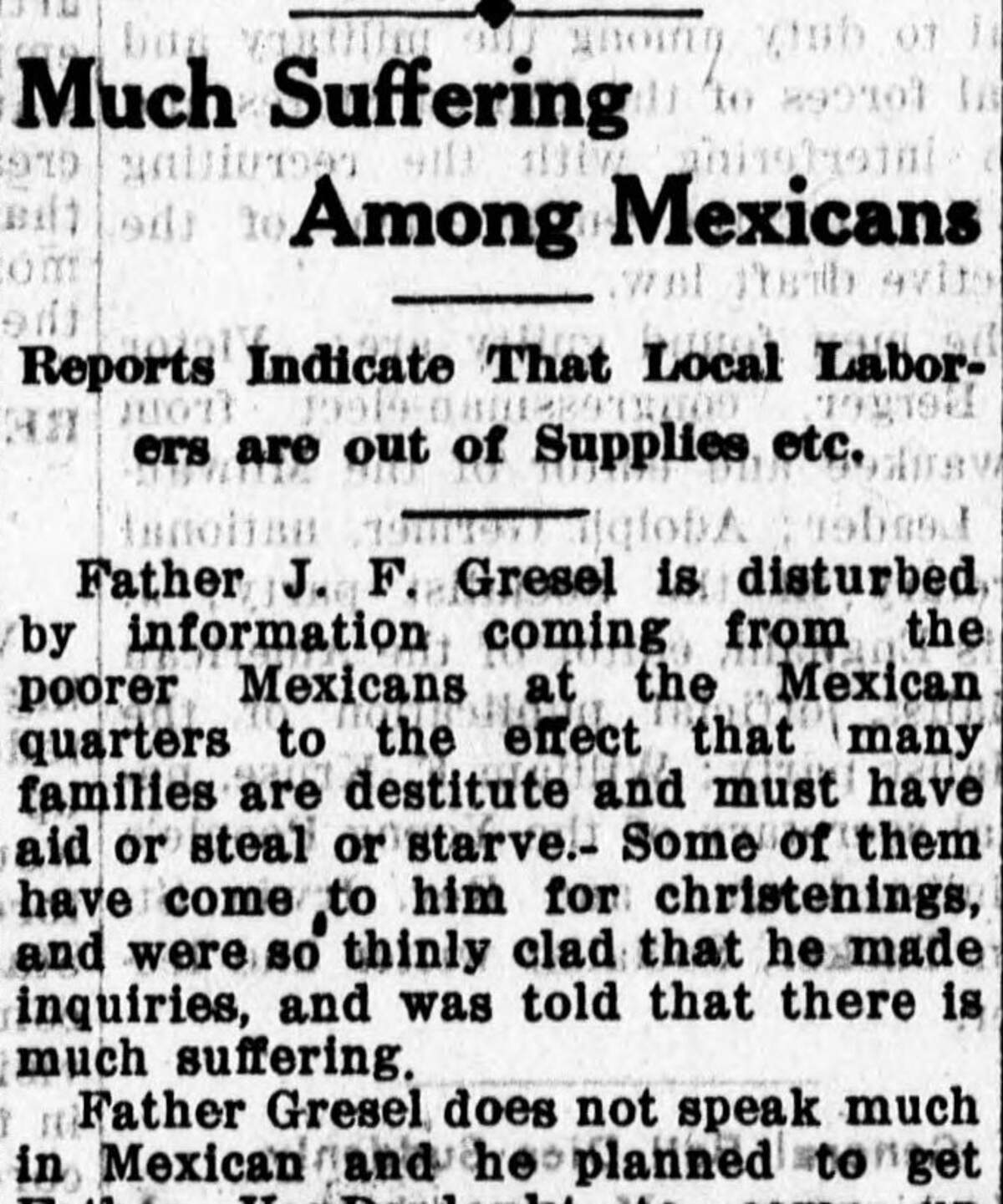
But when winter came, the work and the money dried up quickly. It wasn’t until a local Catholic priest, Father James Francis Gresl of Saint Bernard’s Church, noticed that several of the families who approached him for christenings and other services didn’t have warm enough clothes for the frigid eastern Idaho winter.
The Blackfoot priest, shocked at the conditions, turned to the community and local government officials for help. His discovery launched state and international investigations into the sugar company’s treatment of workers, and ignited a racist backlash preserved in newspaper articles and investigator reports on the incident.
Matthew Godfrey, a Utah historian and author, uncovered the incident for research he presented to the 2018 Mormon History Association Conference in Boise, titled “Much Suffering Among Mexicans: Migrant Workers in Idaho and the Utah-Idaho Sugar Company, 1917-1921.”
“I look at this as an example of this earlier period where numerous migrant workers from Mexico entered Idaho earlier usually than we thought people were coming here to work,” said Godfrey, who is now the managing historian of the Joseph Smith Papers in Salt Lake City. “It also highlights the racism these workers would face when they would come to this region.”
After initial concern, a racist backlash
To meet the desperate labor needs of growers across the country, laborers from Mexico were exempted from restrictions implemented under the immigration laws passed in the early 1900s, which required literacy tests, blocked certain nationalities and more.
Thanks to the exemption and demands of farmers, thousands of Mexicans eager to escape the aftermath of the Mexican Revolution began immigrating to states like Idaho starting in 1910 to work in mines, build railroads and fill agricultural jobs. Godfrey said the men were often encouraged to bring their families, in the hopes it would prevent their integration into the surrounding community or to discourage them from skipping out on contracts.
At first, Gresl’s chilling report in Blackfoot prompted outcry, further investigation and requests for donations of food and clothes. But reports from newspapers like the Idaho Republican in Blackfoot indicate the surrounding community’s concern for the families’ well-being quickly soured.
“These people are like the proverbial grasshopper that spent the summer with song and dance,” the January article reads. “If it comes to the worst, they may be expected to steal rather than starve, and the sugar company and the community will have to meet the situation in some way.”
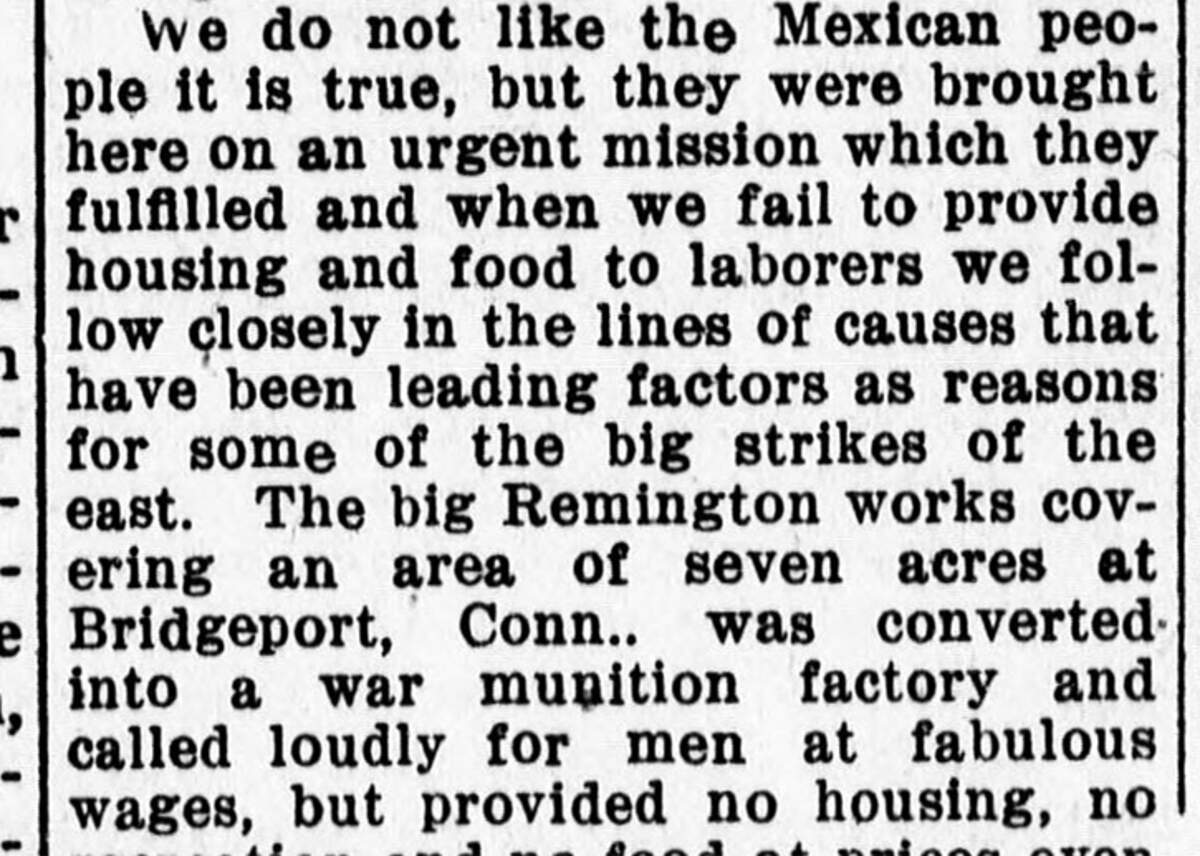
Even initial reports describing the dangerous winter living conditions of the Mexican immigrants — Gresl and another local priest found people in thin clothing with no food, fuel or bedding, with mothers who had no clothes for newborns trying to keep them warm by staying in bed — cast blame on the suffering workers themselves. Initial articles on the situation published in the Idaho Republican in January called the workers “improvident,” “simple-minded children” responsible for spending their wages in the summer with no thought for the cold winter months.
The Idaho Republican newspaper even addressed this bias, acknowledging to readers “we do not like the Mexican people it is true.” But the reporters and publishers of the paper stood squarely on the side of the sugar company, alternately suggesting that the workers had spent advance wages frivolously, surprised the sugar company by bringing their wives and children, were foolishly unprepared for an Idaho climate or simply had not returned home at the end of the contract as required.
It does not appear the newspaper interviewed any of the Mexican immigrants themselves, instead relying on dispatches and explanations from the Utah-Idaho Sugar Company.
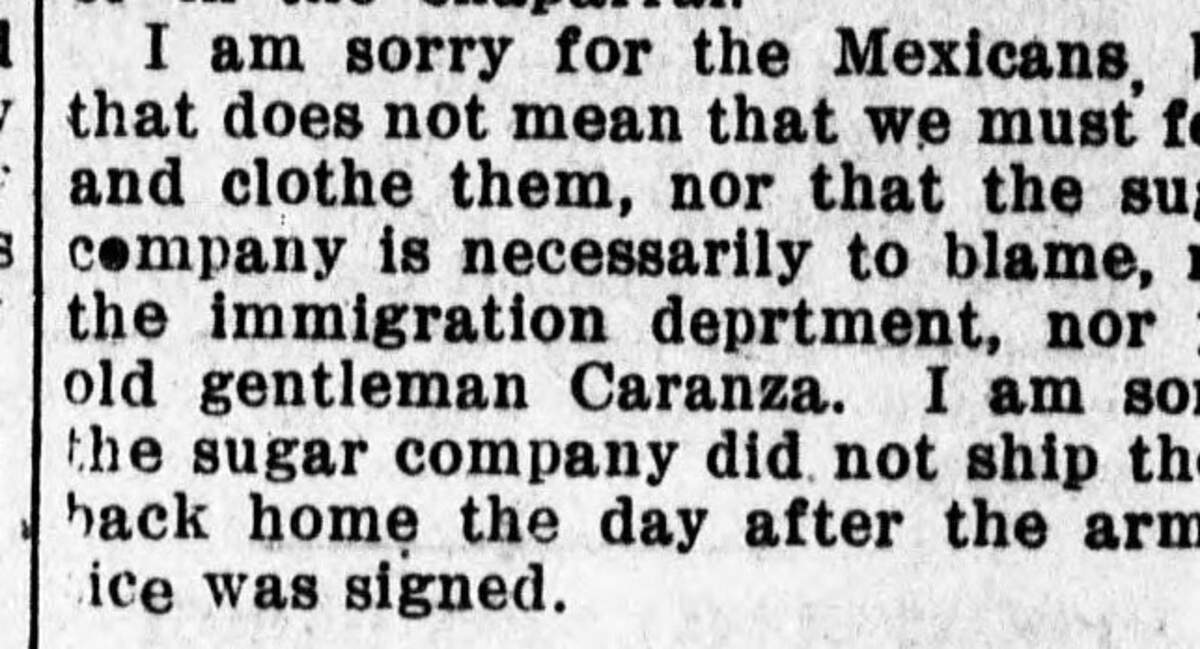
“I am sorry for the Mexicans, but that does not mean that we must feed and clothe them …” wrote Susie Byrd Trego, one of the co-owners and publishers of The Idaho Republican, in a Jan. 31, 1919, column on the incident. “I am sorry the sugar company did not ship them back home the day after the armistice was signed.”
The actual situation, Godfrey said, was likely a little more nuanced than the story posited by Idaho reporters. The Utah-Idaho Sugar Company contracted roughly 1,500 Mexican laborers for work across both states, with a sizable population based in the Blackfoot area during and after World War I. According to the terms of the contracts arranged with immigration officials, employers were usually responsible for providing housing for their workers and transporting them back to the Mexican border after their contract expired.
Shortly after their arrival, many workers sent to eastern Idaho began filing official complaints with Mexican consulate officials based in California, saying the wages, frequency of work, and housing facilities were not what they were promised by recruiters. Idaho’s state labor commissioner, William McVety, had been called to investigate labor conditions for Mexican workers in Twin Falls, Blackfoot and Idaho Falls in 1918, before Gresl made his reports about Blackfoot.
William J. McConnell, the former governor of Idaho, was even sent to examine the problem in Blackfoot, Godfrey said. While McConnell’s eventual report did highlight the intense racism the Mexican families faced in Blackfoot, Godfrey said the report downplayed the poverty of the families and blamed them for their own conditions.
“He said that there was overcrowding in the houses, but he said it was because Mexicans preferred crowding into one house rather than paying for the coal to heat two,” Godfrey told the Statesman.
Despite the numerous investigations into the living conditions of Mexican workers in Blackfoot and elsewhere in Idaho, Godfrey said historical accounts show nothing really changed for the Mexican families Gresl tried to help in Blackfoot. The families weren’t deported — like some local officials and residents had called for — but their living conditions didn’t improve much. Gresl was able to distribute 500 of the roughly 1,000 pounds of flour provided by the Board of Bingham County Commissioners.

Godfrey, who is a member of the LDS Church and also authored “Religion, Politics, and Sugar,” said the fact the Utah-Idaho Sugar Company was run by a religious organization didn’t mean it was immune to the area’s prejudices toward Mexican workers.
“They continued to use Mexican laborers, despite the racist attitudes that whites had about these individuals,” Godfrey said. “They considered them essential as a labor force. There weren’t many whites who were willing to do the backbreaking, arduous labor that was required.”
‘Safe or unsafe, go home!’
Other historical accounts of dismal living conditions similar to those Father Gresl discovered among workers in Blackfoot contradicts the Idaho Republican’s claim it was the fault of the workers themselves. It also wasn’t only a problem in Blackfoot.
Ana María Nevárez-Schachtell, a self-described “cultural activist” who collects the history of Latinos in Idaho, said many recruiters from Idaho companies made Mexican workers “wonderful promises” they did not fulfill.
“They all decided to take the risk and leave their families, their lands, and start a new life and come to El Norte, and they were greatly disappointed,” Nevárez-Schachtell said. “First of all, there was no respect for human rights and the companies that offered them housing and good salaries … it was all lies.”
In an oral history included in Voces Latinos, Felicitas Perez Garcia described how when she and her husband moved to Shelley, Idaho, to work at a sugar beet processing plant in 1910, it was nearly impossible to find a place to stay. Instead, she and her husband struggled to build their own house out of wood and boards from a nearby lumber mill in the midst of winter.
“I made my bed out of boards, and I made the covers out of corn sacks,” Garcia said. “I would sew four together. Then I got some grass, or whatever there was, and put it in the middle… I would do everything possible. We would find houses that were left empty and we would get things. I made curtains from the flour sacks.”
Another woman, Juanita Zazueta Huerta, described how during WWI, the sugar factory had little houses to house Mexicans in Lincoln, near Idaho Falls. Huerta was born in Shelley in 1918.
Still, not all experienced negative feelings from their neighbors. Huerta described how when she was a child in Firth, women from the local Relief Society would bring presents from Santa Claus to the house, and checked on her mother after her younger sister was born.
“They checked on my mother and asked if there was something they could do for her,” Huerta said during her oral history in Voces Latinos. “They asked if they could do our laundry. They were very kind to us. My mother did not speak English.”
Rick Just, an Idaho author who writes popular history columns for the Blackfoot Morning News and the Idaho Press, said the racist sentiments and patronizing language repeated in the newspaper articles about the Blackfoot incident weren’t unusual for the time or the state. Similar descriptions were used to describe Native Americans from Idaho tribes and Chinese immigrants who came to Idaho for mining jobs.
That the newspaper — run by respected community leaders like the Tregos — referred to the Mexican farmworkers as children or “childlike” showed they were likely treated as second-class citizens, Just said.
“They were condescending and resorted to stereotypes,” Just said.
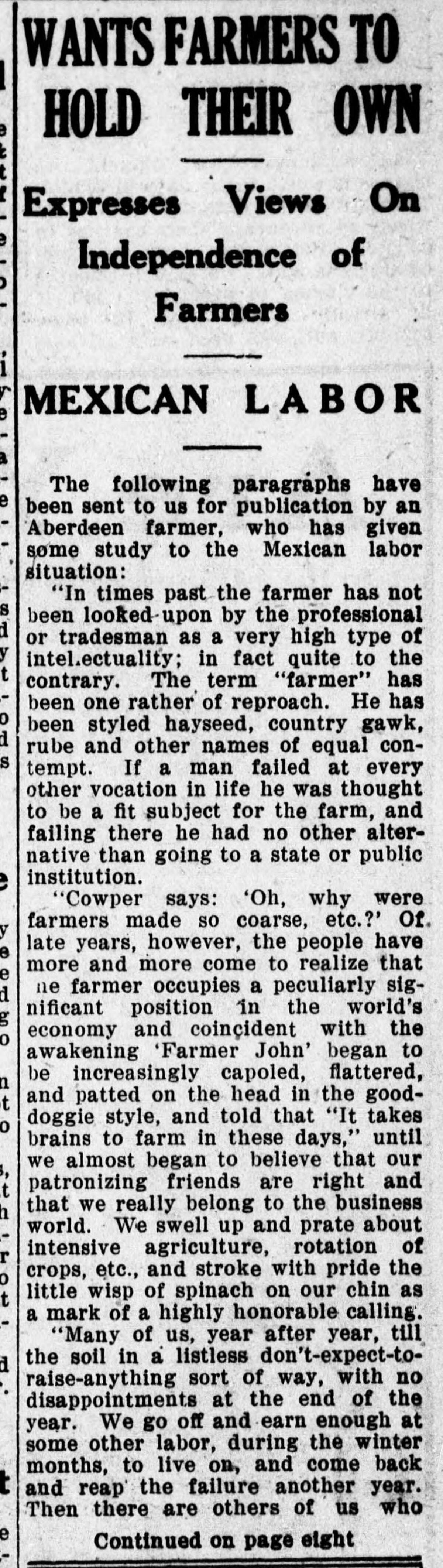
But even a plethora of reports, investigations, and interventions from advocates like Gresl doesn’t seem to have done much to change community attitudes toward the Mexican immigrants. In an Idaho Republican article published in October 1919 — several months after the incident — an anonymous Aberdeen farmer implored his fellow Idaho farmers to “hold their own” and fight back against Mexican laborers who, they claimed, were demanding ridiculously high pay. It also relied heavily on racist stereotypes.
“To have a score or so of Mexicans — some of who can hardly write their names and the best of whom, until they crossed the boundary line, a year or so back, were glad to get a paso (sic) a day, and a dish of frejoles (sic) and chilli (sic) was a luxury, and now I repeat, to humiliate ourselves by making these common Mexicans our masters!”
“Mr. Mexican, I wish you a safe journey home, but safe or unsafe, go home!”
Nevárez-Schachtell said despite the long history of Latinos in Idaho, their voices are often absent even from the stories in which they play key roles. Many state and federal officials who investigated labor conditions in Idaho, she said as an example, rarely interviewed the workers themselves, usually relying only on the word of the farmers. Through the Idaho Corrido Music Project, Nevárez-Schachtell uses music and songwriting to record histories, like the story of the Blackfoot workers, that would otherwise be forgotten.
“The Mexican worker is very much part of the state of Idaho, but regrettably the history was left out of the history books,” Nevárez-Schachtell said. “The Mexican worker has suffered a lot of discrimination and here we are, so many years later, still struggling. Because things are tough for the Mexican population.”
Nevárez-Schachtell and Godfrey said many of the sentiments expressed 100 years ago are similar to rhetoric about Latino immigrants today.
“... Here we are 100 years later and hearing some of the same arguments about why migrant workers shouldn’t be here,” Godfrey said. “(People claim) they’re violent, they spread disease and the community has to bear too much a burden. It’s interesting to me that the very same arguments made today were made 100 years ago.”
This story was originally published December 20, 2019 at 5:00 AM.