A radioactive gas fills many Idaho homes, but there are few protections. Why?

Mold. Dust. Houses sinking into the ground. Hazardous Homes is a 2025 occasional series by the Idaho Statesman on problems in new Treasure Valley homes that may affect human health and safety.
There’s an invisible killer in Idaho, and it comes from beneath our floorboards.
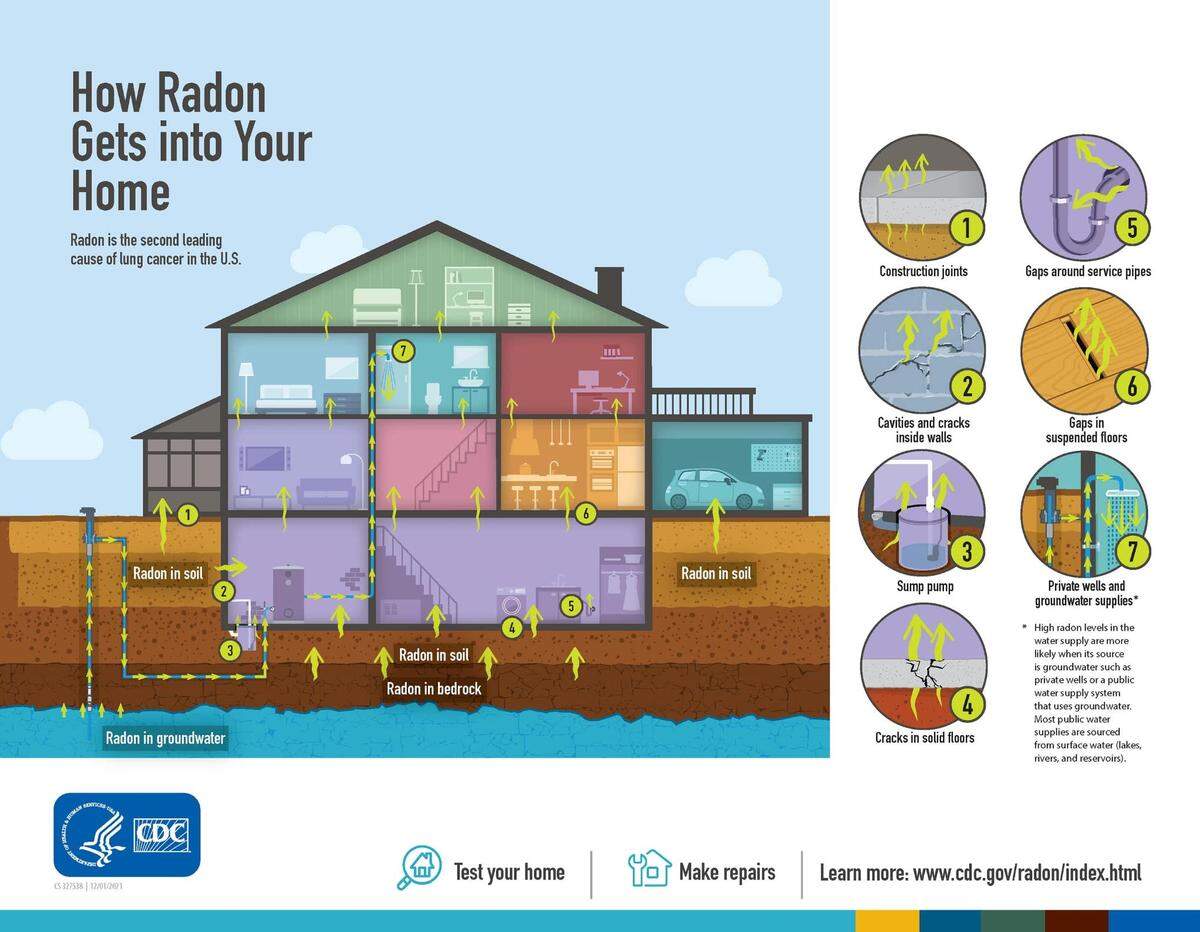
Radon, a colorless and odorless gas that comes from the breakdown of radioactive materials in soil, seeps upward through cracks and holes in houses and becomes trapped inside.
It is the second-leading cause of preventable lung cancer in the United States — behind smoking — and about 40% of all homes in Idaho have unsafe levels, according to the Idaho Department of Health and Welfare. An estimated 21,000 people die in the U.S. from radon-caused lung cancer every year, according to the Environmental Protection Agency. That’s nearly double the average 11,000 deaths caused by drunken driving every year.
Idaho sits on a geological bullseye, with some of the highest concentrations of radon in the nation. Yet there are no state rules, laws or regulations requiring radon testing or mitigation in private homes or public buildings, such as state offices or schools. None of the biggest cities in the Treasure Valley have any rules around radon, either.
Contractors and experts say this lack of protections puts Idahoans at risk.
“To be honest … it’s staggering,” said John Hoyne, founder of Boise abatement company Johnny on the Spot Environmental.
Hoyne said by phone that 40% or more of the homes he tests are “absolutely” over safe levels and that radon is almost a bigger public health hazard than asbestos.
The EPA says radon should be mitigated if air quality tests show four picocuries — a unit of radioactive decay — per liter, and people should start considering mitigation at two picocuries.
In Idaho, the average radon level tested in buildings is 7.3 picocuries per liter, according to Radon.com. That’s the eighth highest in the nation. Alaska has the highest at 10.7 picocuries, followed by South Dakota at 9.6.
According to the EPA’s radon map, all but five Idaho counties have a high or moderate risk of having elevated levels, with the highest risks found in mountainous areas like Custer and Kootenai counties and Sun Valley, McCall and Coeur d’Alene. This is because granite and metamorphic rocks prevalent in the areas tend to contain high levels of uranium.
One expert says the problem is worse than the EPA’s figures suggest. Brian Hanson, the director of Kansas State University’s radon programs and the operator of the National Radon Program Services Center, said the EPA first published the map in 1993 and has not updated it since.
“All of us who have continued to collect (data) have found that the EPA undercalculated the amount of radon in houses,” Hanson told the Idaho Statesman by phone.
State officials and local governments in the Treasure Valley have little to say on the subject. The Idaho Department of Environmental Quality and the cities of Boise, Meridian, Nampa and Caldwell referred a reporter to the Idaho Department of Health and Welfare for more information on radon activities such as monitoring, education, abatement and impacts on Idaho residents. But Health and Welfare refused to engage, and its spokespeople would not say why. They did not respond to several requests for information and comment.
Health and Welfare does encourage people test their homes for radon. It provides free tests by mail. Residents can test their indoor air for a few days, then send the test kits to a lab in a prepaid envelope. The lab shares the results with Health and Welfare, and residents can look them up online.
The department did respond to Statesman public-records requests. Its data showed that 13 of 43 tests in Ada County in January and February were at or above the four-picocurie standard, with nine more than doubling it. The highest result was 20.6 picocuries per liter, or pCi/L.
Yet even that is chump change compared with an address in Bonner County that tallied 165.5 picocuries per liter on Feb. 18, according to Health and Welfare data.
The highest recording since the start of 2023 is 820.3 pCi/L in Blaine County on Oct. 25, 2023.
The data are reported by county and zip code, with no specific addresses or neighborhoods disclosed.
Are Idaho children at higher risk of radon exposure?
According to Todd Rich, the owner of abatement company Idaho Radon, certain areas of the Treasure Valley, such as in the Foothills or Boise’s North End, are more at risk than others, thanks to their geological makeup.
“If the soil of the earth has a higher concentration of granite in it, your levels are potentially higher,” Rich said by phone.
In Boise’s 83702 zip code, which includes the Highlands, the North End and downtown, 39% of tests submitted to Health and Welfare as of December tested higher than four picocuries, according to Health and Welfare data.
In January, the Boise School District disclosed that tests had found high levels of radon in three North Junior High School classrooms. The district mitigated the radon to safe levels by increasing ventilation in the classrooms and committed to install monitoring devices in all schools and district buildings and to start a routine testing schedule, though none of that was required by local, state or federal law.
“We understand the importance of maintaining safe and healthy environments for our students and staff,” Deputy Superintendent Nick Smith said in a news release. “These additional measures reflect our commitment to addressing any potential issues and confirming the air quality at North Junior High and all of our schools and facilities.”
According to Rich, children are particularly vulnerable to radon and are at a higher risk of lung damage, because they sleep more, are developing, and are lower to the ground.
“Children have smaller lungs and they breathe faster than adults,” according to the University of Kentucky’s Breathe collaborative. “Thus, children may get a higher dose of radiation from radon exposure. In addition, children have immature organs that may be more sensitive to radiation and more susceptible to cell mutations, potentially leading to long-term health consequences.”
According to a still-widely cited EPA national survey from 1990, an estimated one in five schools nationwide had at least one room with short-term radon levels above four pCi/L.
“EPA’s national survey of schools produced some alarming results about concentrations in our children’s classrooms,” said Kathryn Whitfill, who was the National Parent Teacher Association president at the time. “We cannot ignore this problem.”
Decades later, little has changed in Idaho.
Aside from the Boise School District’s new policies, some of the biggest school districts in the Treasure Valley, including West Ada, Nampa and Caldwell, have no radon policies and no required or regular testing schedules or mitigation standards.
Niki Scheppers, spokesperson for West Ada School District, said the district regularly evaluates conditions and conducts testing “as needed or when recommended by qualified professionals to ensure a safe and healthy environment.” Scheppers did not say when the last time West Ada schools were tested.
Matt Sizemore, spokesperson for Nampa School District, said he was unaware of any radon monitoring program or testing schedule in place, but said the district works through a third-party for all its environmental testing.
“From what I understand, our buildings are not considered high-risk for elevated radon levels,” Sizemore said. “If radon were flagged as a concern by our testing partners, we would take immediate steps to assess and mitigate any risks to ensure the safety of our students and staff.”
According to Jessica Watts, spokesperson for the Caldwell School District, “Our district follows all guidelines set by the Idaho Division of Building Safety. Since there are no state, county or city requirements mandating radon testing in schools, we do not conduct regular radon testing but remain committed to meeting all applicable safety standards.”
Vallivue School District did not return a voicemail requesting more information or comment.
Areas covered by Nampa, Caldwell, Vallivue and West Ada school districts are farther from the granite-filled Foothills and tend to have lower rates of radon than in the Boise School District, according to Health and Welfare data. In most zip codes in Canyon County, fewer than 10% of test results exceed four pCi/L, however, there have been fewer radon tests.
Rep. Monica Church, D-Boise, introduced draft legislation in March that would require radon testing and mitigation in schools. That bill never made it out of committee.
Chasing Idaho’s radioactive ghosts
According to Hanson, radon exposure is difficult to measure — and it’s difficult to communicate the problem effectively.
“There is absolutely no clinical argument against… the long term lung cancer risks,” he said. “We know this. It is not in dispute … But we have confounding factors.”
One, he said, is that lung cancer risk doesn’t map perfectly with radon. That’s partly because Americans tend to move often.
“We’re a very mobile society,” he said. “We change residences routinely, so we don’t know what our past radon exposure was like.”
Unlike asbestos or lead-based paint which builders put into buildings, radon is a naturally occurring soil gas and is the byproduct of houses coming into contact with the soil, Hanson said. The No. 1 driver of radon prevalence is whether there is a pressure differential in the house that creates a “natural vacuum” that sucks radon into the living space.
“There isn’t someone that is responsible for putting the radon into the home,” he said.
Hanson said there are two important aspects of radon to note.
First, there is no building in the United States without some radon. The national average outdoor measure sits at about 0.4 picocuries per liter.
Second, there is no technically safe level of radon exposure. Any exposure raises lung cancer risks at least minimally, he said.
“All of us get at least a little bit of lung-cancer risk accumulated from that radon exposure,” he said.
Congress passed the Indoor Radon Abatement Act in 1988, which left radon policy in state hands rather than federal regulatory authority like with lead or asbestos. The act also helped fund the 1990 national survey, provided assistance to states to start radon programs, and helped create five radon training centers, including Hanson’s at Kansas State.
“This was done intentionally under the largely correct assumption that different states would have different issues with radon,” Hanson said. “(Congress) basically wanted the states to figure out how they wanted to deal with radon internally.”
But many states decided that it was a homeowner issue and took a hands-off approach, he said.
“Many states have done absolutely nothing,” he said. “Idaho is mostly in the nothing column.”
Though builders have continued to crank out newly constructed homes in the Treasure Valley since the pandemic, there has not been much testing, according to Rich. And because radon is invisible and hard to detect, homeowners often dismiss it.
“They’re suspicious as to if it’s really a problem,” Rich said.
People who are moving to Idaho from states where there are more stringent rules are more aware of radon, he said. But there’s not much awareness among long-time or native Idahoans.
In some states, building codes require builders to add at least a “passive” mitigation system that can be easily converted into one using fans if tests come back high, Rich said.
But he said it’s often cheaper, easier and more visually appealing to implement these systems during the construction phase, where crews can hide the pipes and fans. Adding a mitigation system to a single-family home while building generally costs around $1,350, while retrofitting costs around $2,000, depending on the home’s square footage, he said.
Even so, fixing radon on a large scale can seem like playing a carnival game of whack-a-mole as parts of Idaho continue to see dramatically high levels of the gas.
“Radon,” Hanson said, “is not a single fix.”
———
What you can do about radon
Sellers of a home are required by state statute to disclose if there are unsafe levels of radon but are not required to mitigate it. Nor are builders required to test new homes.
According to Hanson, the most common point for radon testing comes at the point-of-sale for a single family house, but it’s an option rather than a requirement.
“You have to know to ask for it or have a home inspector or (real estate agent) who is selling you the product,” he said. “That still tends to be a small percentage of total sales in the United States.”
Radon testing yourself, though, is relatively easy. You can pick up a professional grade kit online, at home improvement stores like Home Depot for around $100 or you can order a free kit from the Idaho Department of Health and Welfare.
If in stock, Health and Welfare will ship its free kits by mail to your home, which require you to leave it in a room for several days to collect an air sample. Once complete, simply ship the kit back in its prepaid envelope. Health and Welfare can email you a link to the test results, or you can find them online.
Other stories in this series:
This story was originally published April 22, 2025 at 4:00 AM.