Idaho author was excited to buy first home after new book. Then the emergencies started

Mold. Dust. Houses sinking into the ground. Hazardous Homes is a 2025 occasional series by the Idaho Statesman on problems in new Treasure Valley homes that may affect human health and safety.
Leslie Montgomery’s home on the eastern edge of Caldwell was supposed to be a safe harbor for her and her three children.
A deeply religious author who has written several books on Christianity, Montgomery used the royalties she made from her latest book, The Faith of Mike Pence, to buy her new house in June 2023.
Montgomery thought that the house would be her forever home and that she could pass it down to her children, all of whom have special needs, as an inheritance.
“When we looked at this house, I just remember being so happy and proud,” Montgomery said. “They were so happy.”
But the home she bought from Lennar Corp. — the second-largest home builder in the nation — has become sickening, she said. Montgomery said she made a down payment of about $270,000 on the home and pays $1,900 per month mortgage on the two-story, four-bedroom home in Caldwell’s Mandalay Ranch subdivision.
Shortly after moving in, Montgomery started getting allergy-like symptoms, despite no family history of allergies, she said. Soon, her two sons and daughter also began getting symptoms.
“We’ve all been sick,” Montgomery said.
Her son Elijah, 14, began getting abnormally sick in July 2024, she said. His heart rate would skyrocket and he’d nearly pass out, sometimes over 20 times per day. His cheeks developed redness. He was dizzy, had chronic fatigue, blurred vision and abdominal pain.
Montgomery said she has had to call 911 for an ambulance to rush him to the hospital several times. “It was really scary,” she said.
Doctors ran him through a battery of tests but couldn’t figure out what caused the medical issues. One doctor recommended environmental testing of her newly built home, she said. The results of the tests showed a bevy of issues, including high levels of mold spores and carbon dioxide on the second floor.
The environmental tester and doctors said the Montgomerys shouldn’t live in the house until they fixed the problems, she said.
According to medical records Montgomery provided to the Statesman, Elijah Montgomery had high levels heavy metals, environmental toxins and harmful mycotoxin compounds in his body from mold and fungi.
A doctor’s note excused Elijah from school in August because of medical concerns. He hasn’t been back since.
Montgomery said Lennar employees verbally agreed to fix some of the problems, but she has received nothing in writing. The company plans to test for more mold in the coming weeks, she said.
According to an emailed statement from Lennar: “At Lennar, the safety and well-being of our homeowners remain our top priority. We sincerely apologize for any inconvenience this has caused Leslie, and we have committed to her to complete the necessary work to address her concerns.”
A broken home in Caldwell
Building issues have plagued the family since they first moved in, Montgomery said. On move-in day, there were still painters and contractors working on the house. The inspector wouldn’t approve the home at first because of backyard flooding, which still happens, she said.
Reports from the environmental tester and follow-up inspections showed that the heating, ventilation and air conditioning system was undersized and blowing insulation into her son’s room, and five windows were put in upside down. The vapor barrier below the house, which helps prevent moisture buildup and mold, was cut up, and there were no air vents to allow circulation.
A test from Boise’s Wickstrom Service Co. found that the house had over 1½ times the amount of carbon dioxide than an average home and said “steps should be taken urgently” for it. The test also showed that the levels of chemicals and particulate matter were above health guidelines for the general public.
Carbon dioxide “builds up in the home when there is no mechanical ventilation for fresh outdoor air,” according to the test report. “Ventilation has a great impact on health.”
Some of these health concerns from carbon dioxide include lower cognitive function, increased risk of airborne diseases, eye irritation, a sore or dry throat, coughing, sneezing and congestion, according to Wickstrom. The particulate matter and chemicals present can also lead to asthma, trouble breathing, dizziness, skin problems and headaches.
Elijah had most of these symptoms, according to a note from his doctor that Montgomery provided to the Statesman.
Montgomery said contractors had also left rat poison strapped to a wooden beam under the house. Lennar, she said, had no explanation for the vapor-barrier cuts or why rat poison was left under the home.
“I’ve been waiting a year and a half,” Montgomery said. “Nobody’s done anything.”
The home, she said, is covered with mold, and the flooded backyard at times has been “like a waterbed.”
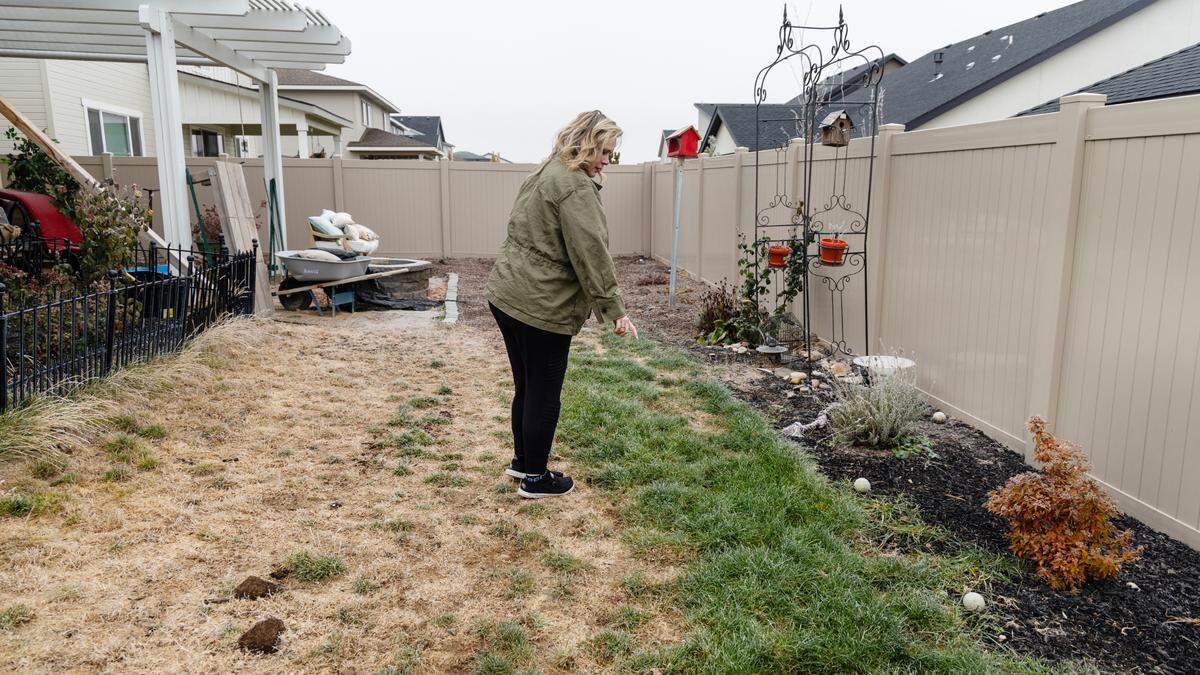
“We’re breathing mold, we’re breathing insulation (there),” Montgomery said. “All the vents … are filled with debris, nails, sawdust. We’re breathing that too.”
To fix all the problems in the house would cost over $100,000, she said.
“I want them to fix it,” Montgomery said. “That’s all I’ve ever wanted them to do, is fix it and make my house safe for my children.”
Running out of time, money
Montgomery said she put all of her life savings into a down payment on the house. Insurance won’t pay for anything, Montgomery said, because it was a “builder issue,” so she has paid out of pocket and used the rest of her money for environmental tests, medical costs, and living in hotels and Airbnbs since they were told to leave.
“It’s just a nightmare,” she said.
Montgomery has a friend who works for the Hilton who got her a lower nightly rate, but it was ripping into what little savings she had left.
“It adds up when you’re spending weeks at a time,” Montgomery said. “We’ve had to go back and spend a night here or there because I ran out of money.”
Others have helped, including her church providing $2,500 and an editor friend giving her a $200 WinCo gift card. For a time, she got a month-to-month lease in Meridian that cost $500 more than her mortgage. A friend started a GoFundMe page to help with the costs.
More recently, Lennar has paid for an Airbnb in Nampa for the Montgomerys but she’s still paying a mortgage on a house she can’t live in, she said.
“I don’t have the money. I can’t live in the house,” she said, her voice cracking with tears. “It’s just a horrible situation.”
Montgomery has been selling off her furniture and other household goods to get by — including a large picture of Jesus.
“My daughter came to me, and she goes ‘Mom … We can sell my (emotional support) dog if we need to,’” Montgomery said. “I’m like, ‘Baby, we’re not going to sell your dog.’”
Montgomery said she would have a friend come over in the mornings who would always leave feeling congested and sick, so her friend stopped coming over. Elijah’s therapist, who visits three times a week, leaves with a headache. Montgomery said she teaches a Bible study class on Tuesday nights but can’t host them at home anymore. Her children’s friends can’t come over anymore either.
“This has just ruined our whole life and depleted us,” Montgomery said. “I have been so depressed.”
People have told her to hire an attorney, but she doesn’t have the money to hire one with all her money invested in the house, she said.
“I don’t know what to do,” Montgomery said. “I feel like I’m barely holding on. I need help, but I don’t know what help I need.”
The emotional toll has affected her ability to write, she said, which is her primary income source.
“I have nothing anymore,” Montgomery said. “They have stripped me of everything.”
Other stories in this series:
This story was originally published January 13, 2025 at 4:00 AM.