Ada County is growing fast, but its landfill is filling up faster. And that’s a problem
READ MORE
Trash Troubles
Trash Troubles is a 2024 Idaho Statesman series on trash and recycling in the Treasure Valley. Inside are all nine stories in the series, plus three previous Statesman stories on the topic.
Expand All
For many contractors, cleaning up the rubble around a construction site is a matter of efficiency. Wood, drywall, tiles, roof shingles — all these items often wind up jumbled together for dropoff at the landfill.
“The technique … is just ‘doze it over, whatever it may be,” said Herb Cantu, director of the Ada County Landfill.
It’s a time-saving method, but it comes at a cost. Many of these materials could be repurposed, but not when they arrive at the landfill all mixed together.

Instead, they go into the landfill. And in the midst of the Treasure Valley’s population and construction boom, these materials are playing an outsize role in the waste that’s filling up the landfill much faster than expected.
From 1972 until 2018, the Ada County Landfill used the 108-acre Hidden Hollow Cell on North Seaman’s Gulch Road. The adjacent 281-acre North Ravine Cell, which is in use now, was engineered in 2005. It was meant to last 100 years. But the way things are going, officials say, it will last about half that long, likely needing to close in 2068.
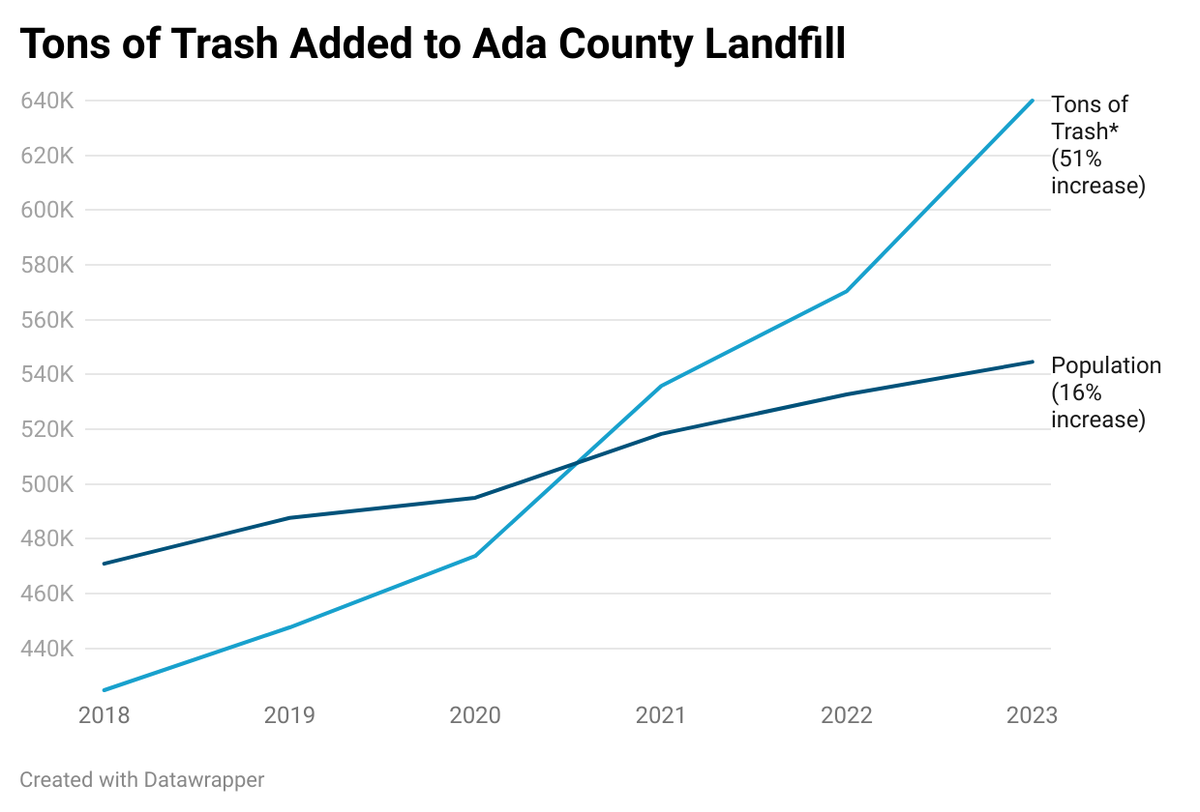
The area’s population growth is driving the surge, officials say. Ada County’s population has grown by over 50% since the landfill was engineered. In 2005, the county had about 361,000 residents; in 2023, that number jumped to nearly 545,000.
The truckloads of trash have grown in tandem, from about 425,000 tons in 2018 to over 535,000 in 2021. In fiscal year 2023, landfill officials estimate they will receive 640,000 tons. That is more than one ton of trash every year for each person in the county.
Left unchecked, the rapid filling of the landfill will be expensive. Finding a new landfill site in a county with ballooning property prices will be an unenviable task.
So officials at the landfill are trying instead to get creative — and they’ve got ideas that could potentially extend the life of the site an additional 15 years, Cantu said.
These could take many forms. Officials are considering slightly expanding the landfill’s footprint or increasing the pitch of its exterior slopes to make the most of the available airspace. They plan to try new techniques to compact the trash they receive, fitting more trash and less soil into each cubic yard — about the size of a dishwasher — using the “pancake method” of piling trash on a flat plane, rather than a slope.
In most cases, burying trash is the cheapest option — cheaper than recycling or diverting items from the landfill, Cantu said, though landfill officials did not have data available about the cost of burying or diverting waste. A study underway this year will determine the cost of burying trash, Rebecca Weeks, the landfill’s education and outreach manager, told the Statesman via email.
The landfill, which has an annual budget of about $20 million, supports itself by charging for waste dropoffs — $32 for each ton of trash. But given the high cost of finding a new site, many of the landfill’s efforts involve “diversion” — trying to keep waste out of the landfill altogether.
Already, workers pulverize “clean rubble” — asphalt and concrete — on-site to use for road construction. And for “mom-and-pop haulers,” the landfill is considering providing a location to dispose of materials and divert recyclable materials.
Most of all, landfill officials are focused on outreach and education of the public about what can stay out of the trash. This ranges from an existing flyer about what kind of waste the landfill accepts, to conversations with nonprofits, companies and cities, to the ongoing development of a new learning center at the landfill.
“It is kind of a funny thing to be focused on diversion at the landfill, because you know, our income is through the scales—people are paying to drop things off,” Weeks said. “But we have to always balance that with the expense of finding a new landfill and the expense of expanding the current landfill.”
A 2015 waste analysis at the landfill examined the quantity and composition of trash dumped at the landfill the previous year. It found that about 80% of the trash entering the landfill could have been recycled or diverted elsewhere, according to previous Idaho Statesman reporting.
The landfill will conduct a new waste analysis study sometime this fiscal year, Cantu said.
When it comes to diversion and recycling efforts, the math isn’t always simple. Cantu noted that he tries to factor in carbon emissions when weighing various proposals.
If trucks are hauling materials “several states away” for processing and recycling, “are we creating more greenhouse gas emissions by doing that?” he asked. “A lot of times programs are rolled out and they don’t look at the life cycle or carbon impact of that program … you’re putting out a recycling container, you think it’s helping the environment, but depending on the commodity, it may not be.”
This story was originally published March 15, 2024 at 4:00 AM.
CORRECTION: The original version of this story said that the 2015 waste analysis of the landfill was the latest available. Ada County officials published an additional study in 2020.