
Flock cameras, AI and drones. Technology transforming police work in Idaho
The October sun was beginning to set when Caldwell Police Sgt. Andrew Heitzman and his officers heard a barrage of gunfire on the other end of a 911 call. A witness said a man wielding two guns had just threatened them. Heitzman, already in a patrol car, was four blocks away from the Freeport Street address.
Arriving on the scene, he saw people fleeing in all directions.
“There were people running in the road, screaming that the vehicle went that way,” Heitzman said. “And before long we learned that the suspect had made it onto the freeway.”
Then, an alert came through to Heitzman’s onboard computer from Raven, an artificial intelligence tool used by the Caldwell Police Department for pinpointing the sound of the gunshots.
With the help of Flock cameras, an AI-enabled security system that captures high-resolution images of cars to monitor license plates and vehicle characteristics, Heitzman and his team were able to quickly triangulate the position of the suspect. After the shots were picked up by Raven, the network automatically alerted all Flock cameras in the area to try to find the gunman’s vehicle, using descriptions provided by the 911 caller.
Flock found the car within 15 minutes, and after a brief chase, the suspect crashed in a parking lot on Ustick Road, where he was arrested.
“Without these artificial intelligence systems supporting our officers in the field,” Heitzman said, “the situation could’ve continued until someone got seriously hurt. Thankfully we don’t have to worry about that.”
Raven and the Flock cameras are part of Flock Safety, a security technologies company based in Georgia that uses hardware powered by artificial intelligence to build surveillance networks that combine automated license plate readers, video cameras and audio detection to help solve and deter crimes.
Cities all over Idaho and across the country are using an array of mass surveillance programs, such as Flock cameras, AI-equipped license plate readers, audio detection systems for identifying gunfire and facial recognition software. The rollout of some of these technologies has been quick, and departments are beginning to confront the risks of abusing the technology and changing the way laws are enforced. Other Idaho police departments such as Pocatello, Twin Falls, Blaine County, and Jerome County, use the same Flock camera systems. The Meridian Police Department uses a similar technology for license plate reader cameras.
Such AI tools are quickly becoming a standard part of the policing toolkit. As of 2025, there were nearly 18,000 state and local law enforcement agencies across the country, according to a report by the National Council of State Legislatures. About 28% of them use Flock, according to reporting by NPR and Flock Safety’s own website.
But the use of AI, Flock cameras in particular, has come under intense criticism because of concerns about privacy and data sharing.
“We are always hesitant to allow people to forfeit their rights to privacy, their right to due process, and any other individual freedoms in the name of ‘community security,’” Rebecca De Léon, communications director for the ACLU of Idaho told the Statesman via email. “But in the case of Flock cameras, it has been proven that their use goes far beyond what initially justified them.”
How Caldwell uses cameras and drones
When Caldwell police first asked the City Council to approve the use of Flock cameras in 2023, Police Chief Rex Ingram made it clear that the need for the cameras was urgent, but there would be limits on how it is used.
“This technology, if approved, is not going to be used to spy on our people to look up license plates,” Ingram said at the time. “We don’t have some room in the police station where we have a bunch of cameras up just watching cars drive through the city.”
But that appears to be exactly what’s happening.
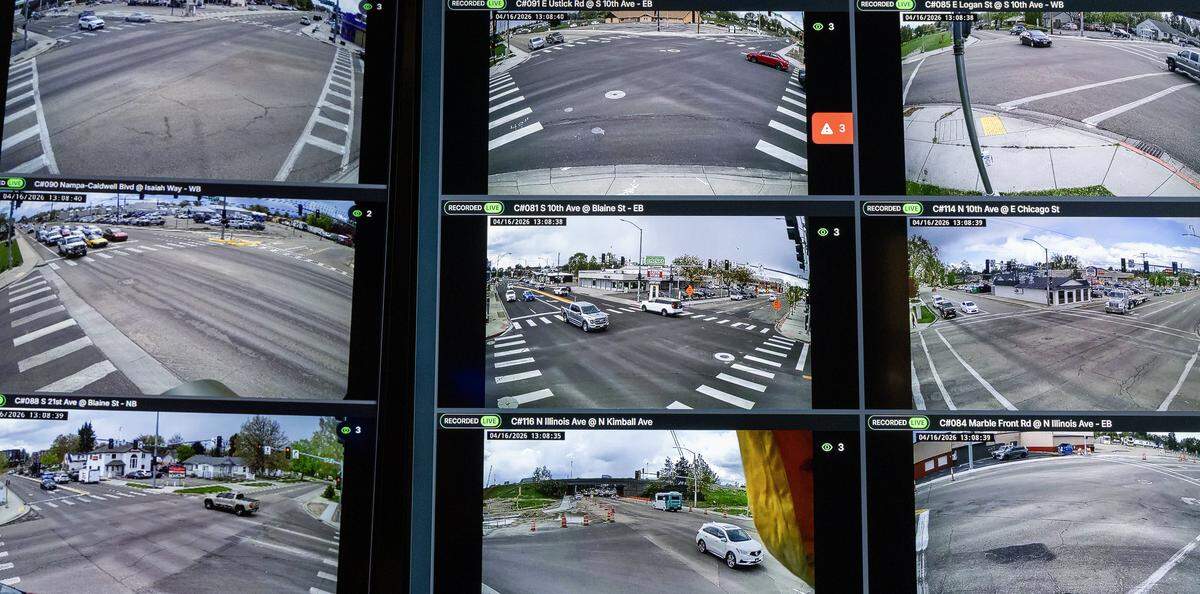
The Statesman this month took a look inside the Caldwell Police Department’s Real Time Information Center. The center lies just beyond a corridor of cubicles, past a locked door in a small, windowless room.
It is the hub for all the latest technology police officers in Caldwell use, including Flock cameras and other AI-powered tools.
One wall is covered with screens where officers can monitor all the Flock cameras the department has deployed around the city, as well as a map generated by Axon Fusus, an AI-enabled crime and incident map created by Axon Enterprises, another security solutions firm the city uses. In 2023, Caldwell Police had spent about $900,000 on a suite of tools from Axon, including the Fusus tool.
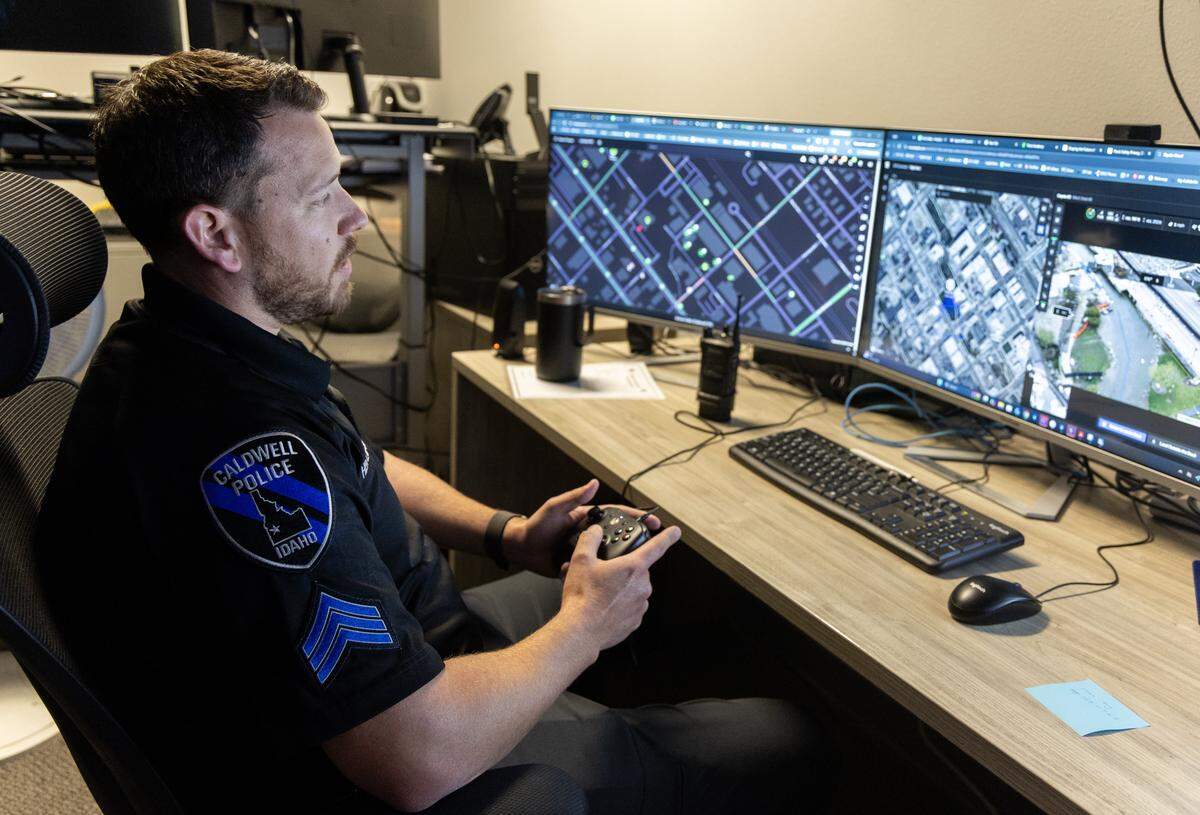
From his desk at the center, Heitzman showed the Statesman how his team deploys one of the department’s three drone first responders, or DFRs, in less than a minute.
“This helps our officers understand the level of response each call requires before having to leave their current position,” Heitzman said. “Whether it’s law enforcement or fire, getting to the scene means allocating significant resources, and if we can be more responsive while saving city departments money at the same time, it’s a win-win for our community.”
Along with the body cameras and Flock cameras the department uses, these drones help form the real-time maps Axon Fusus creates to guide the responses of human officers.
Three years after requesting Caldwell City Council allocate American Rescue Plan Act funds for the Flock system, Ingram said that although the physical hub for AI tools for local police may appear to be the image of public concern over mass surveillance, he and the department have stood by his promise.
“The thought of the Real Time Information Center materializing wasn’t even a thought at the time,” Ingram told the Statesman. “But my statement still remains accurate and true: We do not spy on our people. We don’t use the equipment to look people up, and we are not using it recklessly. This is why we have systems and controls in place. This is why we regularly audit how these tools are used by our officers.”
For Ingram, the positive impact of AI tools is apparent. Before using Flock cameras, he told the Statesman, Freeport Street in Caldwell had seven shootings in a six-month period.
“As of right now, we’ve had one shooting on that street since the implementation of Flock,” he said.
‘I’d rather have cops,’ Caldwell mayor says
Caldwell Mayor Eric Phillips said the creep of the massive surveillance array he inherited from his predecessor Jarom Wagoner has become a constant issue for citizens. Phillips, who was elected in November after much of the technology was already in place, made it an issue during his campaign.
“If I could take the cameras out of the city, I would take them out right now,” Phillips told the Statesman during a phone interview. “I definitely think there are advantages, and we have terrific officers working with these tools, but when we’re looking at the budget, these Flock cameras are not an expense that we need at this time.”
Caldwell City Council members in 2023 unanimously approved a three-year, $378,000 deal with Flock to set up 33 cameras in major traffic zones and key points throughout town. Since then, the city has committed to spending another $42,000 per year on 28 more cameras. Expenses provided to the Statesman by Caldwell Police show it spends more than $484,000 per year on Flock cameras and drones.
“I’d rather have cops,” Phillips said. “People want cops to come to their house and patrolling the street. They don’t want cameras patrolling their every step in their own town.”
Data sharing concerns
More than 95,000 Flock cameras are being used across the country, according to the open-source watchdog DeFlock.
A major issue for some of the communities that initially embraced license plate reader technologies like Flock is how data is being shared. At least 30 cities, such as Denver, Colorado, and Hillsborough, North Carolina, have ended their relationships with Flock due to the company sharing the data their cameras collect with federal agencies without consent, according to reporting by NPR.
De Léon, of the ACLU of Idaho, noted that records obtained by tech news outlet 404Media show that the information gathered by Flock cameras and other cloud automatic license plate readers are being shared with Immigration and Customs Enforcement to “fuel inhumane practices against innocent people, as well as target and surveille people suspected of traveling to another state to obtain a legal abortion. Data has also been shared with data brokers without the knowledge of the person(s) involved.”
In Jerome County in 2025, Deputy Sheriff George Oppedyk was pressured into an early retirement after an investigation found he used Flock cameras to track his wife’s car more than 700 times over a three-month period.
Idaho police are rapidly adopting AI-powered drones, too, and using them to monitor legal activities of civilians, according to Heitzman. Caldwell police say they’ve already deployed drones to two public protests against ICE this year to make sure people “are behaving lawfully.”
Drone first responders are joining the ranks of the Meridian Police Department, but they’re already arriving on the scene to emergencies elsewhere in the Treasure Valley, including with the Idaho State Police, Boise Police, Caldwell Police, the Ada County Sheriff’s Office and Caldwell.
While concerns over privacy and rapidly growing surveillance networks violating citizens’ constitutional rights continue to grow, the use of AI and surveillance technology is, for now, the new reality in policing.
“This is the frog in the pot of water,” Phillips said. “At first, you say you’re not doing something, and then we turn around and there it is. It makes me think about what we (told) the public when we started down this path, and they think we’re currently doing.”
This story was originally published June 1, 2026 at 4:00 AM.
CORRECTION: This article has been corrected to remove Meridian and Boise from the list of police departments using the Flock camera system. Meridian uses a similar license plate reader camera technology.