
Boise police haven’t fired a gun at a suspect in 18 months. Here’s what changed
AI-generated summary reviewed by our newsroom.
- Boise Police have gone 17 months without a police shooting since November 2024.
- Boise reports a 57% increase in less-lethal weapon use, an 18% drop in guns pointed.
- Use of pepper balls rose from two incidents in 2024 to 18 incidents in 2025.
On potentially dangerous calls, Boise Police Chief Chris Dennison says, three concepts are an officer’s friend.
The first is distance. Farther is safer, for police and the public. The second is time — time to think, time to talk, time to decide. The third is simple, unaccountable luck.
Distance can buy you time. Nothing can buy you luck — but the right approach can tip the odds. And for the past 18 months, Dennison said, luck has been on his department’s side.
Boise Police have gone nearly a year and a half without a police shooting, the last coming in November 2024. That’s down from six shootings in 2023 — four fatal — and six in 2024, a year when the city had as many fatal police shootings (three) as murders, according to city and state data compiled by the Idaho Statesman.
Over the past three decades, Boise had only seen two other years without the use of deadly force, 1998 and 2014.
Those numbers come from Lexi Whitmore, a data analyst with Boise’s Office of Police Accountability, a civilian oversight division set up by the city in 2021. Whitmore warns against drawing too much from one year’s worth of data, but sees 2025 as an encouraging step.
The sample size for police using force on a call is gratefully low, Whitmore said. Around one in every 2,000 calls between 2021 and 2025 ended with physical force, according to her data. That’s the second-lowest rate among 20 statistically similar cities she identified as Boise’s peers in a 2026 report.
Historically, though, those instances tended to escalate: From 2015 to 2025, Boise police had the third-highest rate of fatal shootings relative to the city’s population among those 20 peers, Whitmore found.
“There will always be an element of natural variation,” Whitmore told the Idaho Statesman in an interview. But since she started the job in the fall of 2024, the number of shootings has “beyond normalized,” she said — and, anecdotally, she has seen cause for optimism.
“It’s a small sample size, and we hope that it stays small,” she said. “But a drop, from six or so to none — I believe that means something. That’s a positive trajectory that we’re on.”
Not that Dennison or his officers want to talk about it too loudly.
“What do they say? When you’re in the zone, you don’t talk about being in the zone?” he told the Statesman in an interview. “That’s how we’re feeling.”
Tools, training key for Boise police
What Dennison will discuss are the components that have gone into the department’s recent run, much of which went into effect during the rough years preceding the last.
Nicole McKay, director of the Office of Police Accountability, points to “multiple factors coming together” that she thinks may have contributed to the dip in gunfire, namely training, tools and leadership. These are elements you wouldn’t see in the data alone, she said. But McKay’s office reviews every police report that includes the use of force and a sampling of shows of force — for instance, drawing but not firing a weapon. She chooses her words on the subject carefully, but notes that the reviews point to qualitative things the numbers might miss.
“The fact that we have access, can provide meaningful feedback, and have that feedback be heard — that’s not the case everywhere,” she said. “We’re in a unique situation here in Boise.”
In an interview, McKay said that she has noticed the department’s “scenario-based” training — officers play different parts to simulate real-world situations — show up in the field. The exercises drill communication and define specific roles, focusing on deescalation.
It’s about “slowing down the interaction between officer and suspect,” she said.
“The scenarios they’re doing are really impressive,” she added. “They’re getting a lot of touches. … It feels like puzzle pieces are coming together.”
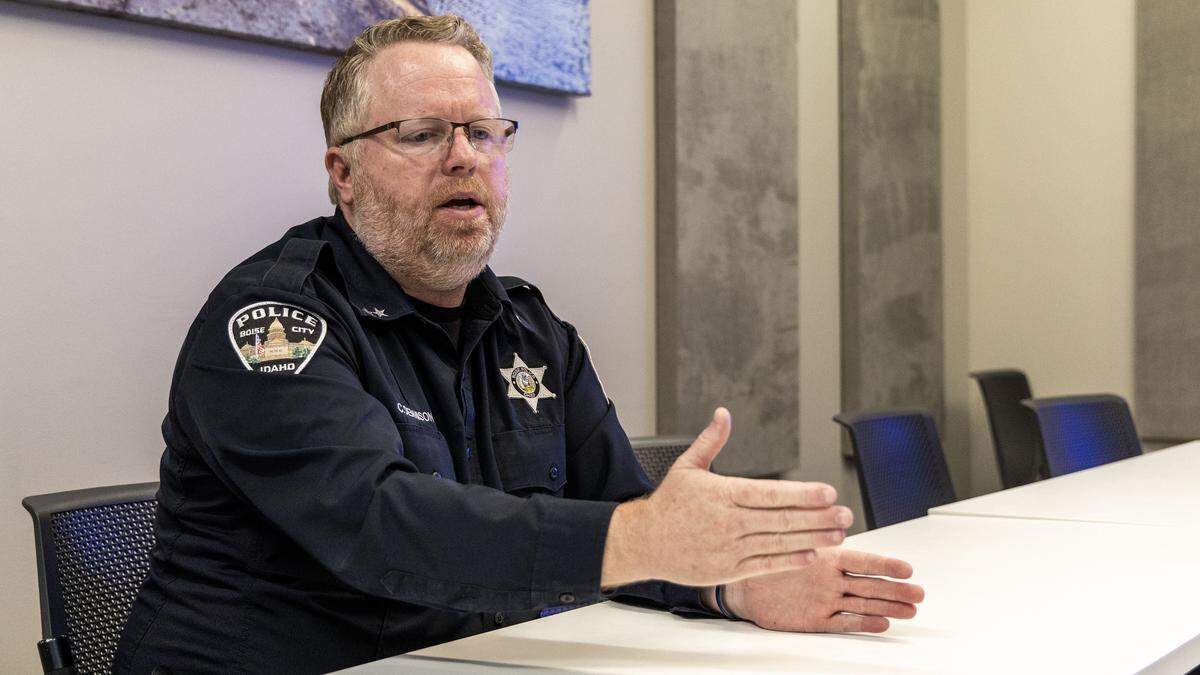
Dennison is clear that the program predates his tenure. Since his arrival, he has “doubled down” on the exercises. In his view, they can teach officers to “look at other ways to deal with the situation.”
“We really want to give officers time to have a reaction, and to bring other tools to bear,” he said.
“Tools” has a wide definition. Dennison mentioned deploying behavioral health teams to assess a suspect. (Boise has two, Whitmore said, and is in the process of adding a third.) He also cited drone flights, modernizing the city’s TASER arsenal, and the rising use of pepper balls, a chemical irritant — think powdered pepper spray — fired out of what looks like a paintball gun.
That latter tool has seen a marked uptick since Dennison took the job.
The chief “grew up with pepper balls” in the Tucson, Arizona, police, he said of the projectiles, which can refer to a brand name as well as be a general term. Before he became Boise’s police chief in September 2024, they were rarely used by the department.
Boise piloted the pepper ball launchers — which typically have bright yellow parts to differentiate from long guns — in 2024, before buying into a broader roll-out last year. As of late March, Boise Police had 26 launchers and 30 people trained to use them, according to BPD spokesperson Haley Williams.
In her annual audit, Whitmore noted a “significant increase” in the use of pepper balls, from twice in 2024 to 18 times in 2025. Whitmore is cautious not to draw causal links. “It has to be a holistic picture,” she said. But the timeframe corresponds with a 57% increase in the use of “less-lethal weapons” by Boise Police, 47 times compared to 30 the year prior.
Meanwhile, the number of times police pointed a gun at a suspect dropped 18% year over year, from 116 times in 2024 to 95 in 2025.
The launchers fire PAVA, powdered pelargonic acid vanillylamide, a synthetic alternative to the capsaicin found in chilis — and pepper spray — that makes them spicy. The paintball-like munitions burst open into a thin cloud of PAVA, which causes runny eyes and breathing trouble, said Dennison, who has felt the sting himself. His officers can fire pepper balls into an area to keep people from entering. Or, they can fire them directly at a suspect to subdue them.
The effects fade quickly, Dennison said, but “it really takes the fight out of someone.”
“The greatest thing that we see with the pepper ball system, it truly is less lethal,” he added. “Yes, it will cause pain to gain compliance, if needed. But it is a safe alternative, and it has a use, like any of our weapon systems that we bring to bear.”
‘Clear expectations, clear consequences’
Interest in “less-than-lethal” alternatives is growing among law enforcement around the country, according to Jordan B. Cohen, a firearms policy analyst at the nonpartisan Congressional Research Service.
“Some observers contend that (less lethal weapons, or ‘LLWs’) offer the possibility of minimizing risk of death and serious injury to citizens and officers while simultaneously providing law enforcement with an effective tool to incapacitate violent or noncompliant persons,” Cohen wrote in a 2025 report. “Nevertheless, there is evidence that LLWs may present a number of potential health risks, lending credence to arguments that LLWs are less-than-lethal in name, but that, depending on the circumstances of their use, they can be lethal in practice.”
Pepper balls as a method of crowd control have made headlines in recent months. In October, a judge in Illinois temporarily barred federal agents from using them against protesters after a clash outside an Immigration and Customs Enforcement Center in suburban Chicago, according to multiple reports at the time. Two months later, the American Civil Liberties Union of Oregon spearheaded a suit against the federal Department of Homeland Security for what plaintiffs saw as indiscriminate use of chemical munitions, including pepper balls, to control crowds around a Portland ICE office. That case is still working through the appeals process.
The ACLU of Idaho told the Statesman that it had not conducted an Idaho-specific analysis of how local police are using pepper balls across the state.
McKay reminds herself that, if she sees a report, the situation has by nature already escalated. Even using a less-than-lethal weapon — a pepper ball, a TASER, a baton — is serious. And, she says, these incidents are being taken seriously. McKay praised the police’s evolving policies on the use of force (updated by Dennison in July) and deescalation (updated in April 2024). The manual spells out “clear expectations, and clear consequences,” she said.
“I think it is very positive,” she said. “We are seeing good things. That is not to say that we don’t take a hard look at uses of force, because any use of force requires further review. But we’re calling out the good things, too.”
At City Hall West, Dennison was quick to defer credit — and to knock on wood.
“The training is impactful,” he said. “The officers are responding appropriately to the training. We’re seeing that demonstrated out in the field. We are bringing additional systems online, and we’re seeing appropriate use of those systems to minimize critical incidents.
“But at the end of the day, I tell everybody, the suspect gets a vote in this. We can do everything right. We can deploy our munitions appropriately. We can use all the right tactics, the verbal deescalation, and at the end of the day, a suspect gets a vote and how they’re going to respond. There’s a level of luck that does play into it — but we try to stack the deck the best we can in our favor.”
Reporter Alex Brizee contributed.
This story was originally published May 11, 2026 at 4:00 AM.