Boise murder suspect will go to maximum security prison without trial. Here’s why
AI-generated summary reviewed by our newsroom.
- Judge may transfer murder suspect to prison's psychiatric unit under Idaho law.
- Stevens remains unfit for trial after failed attempts to restore competency.
- Alleged assault on clinic worker prompted push for 'dangerously mentally ill' status.
Update on June 11, 2024: After a five-minute hearing, 4th District Magistrate Judge Adam Kimball ruled that there was “clear and convincing evidence” that Scott Stevens’ mental condition presents a “substantial risk of physical harm to other persons,” and that Stevens needs supervision, evaluation, treatment and care in a maximum security setting.
It’s unclear when Stevens will be transferred to the Idaho Maximum Security Institution, which is south of Boise. As of 5:30 p.m. Wednesday, he was still being held at the Ada County Jail, online records showed.
He’s scheduled for a competency evaluation review hearing at 9:30 a.m. Aug. 7 at the Ada County Courthouse, according to court records.
---
This is the original story, posted June 6.
The Idaho Department of Health and Welfare has tried for months to find a Boise man — accused of stabbing his roommate to death — competent enough to stand trial for his first-degree murder charge. Instead, the 35-year-old now could be going to prison without a criminal conviction.
That’s because under state law, someone with a severe mental illness and a history of violence can be transferred to a more secure facility for psychiatric care, which in Idaho’s case is housed at its maximum-security prison.
The Ada County Prosecutor’s Office asked 4th Judicial District Magistrate Judge Adam Kimball on May 29 to enter an order designating Scott Stevens as “dangerously mentally ill,” according to court filings obtained by the Idaho Statesman.
Stevens was charged with three felonies, including first-degree murder, in October after police said he stabbed his roommate, 39-year-old Gregory Schroeder, to death in their northwest Boise home. Schroeder was taken to Saint Alphonsus Regional Medical Center in Boise but died within an hour of the attack from his injuries, according to the Ada County Coroner’s Office.
Boise police called the incident an “unprovoked” attack and said they recovered the weapon at the scene. Stevens also faces two counts of felony aggravated assault for allegedly threatening two other people in the home with a knife when they attempted to intervene, according to a news release from the Police Department.
Within days of Stevens’ arrest, his attorney requested a mental health examination, which was granted and found him incompetent to stand trial, court records showed. Kimball determined that Stevens lacked the “fitness to proceed” and was “incapable of assisting in the defense of his case,” according to the filings.
He also lacked the capacity to make informed decisions about his treatment, the filings said. Stevens was transferred from the Ada County Jail to the supervision of Health and Welfare, pausing the criminal case against him.
Kimball extended Stevens’ civil commitment in April. He asked Health and Welfare to continue to evaluate Stevens’ mental condition and prepare a report determining whether he’s “fit to proceed” or whether there is a “substantial probability” he could be found fit to proceed in the near future, according to an order.
By mid-May, Stevens’ attorney said his client was still “unfit to proceed,” according to a filing.
Stevens faces new charges after alleged attack
Health and Welfare has tried to find Stevens competent for months, but now he’s facing new charges after he allegedly attacked a psychiatric technician at a local mental health clinic, where he was receiving treatment.
Court records showed that the technician needed seven stitches.
Stevens was charged with battery against health care workers and malicious harassment, both felonies, after he punched the technician with the intent to “intimidate or harass” him because of his race in May, according to a criminal complaint filed by the Prosecutor’s Office.
Interviews with staff members indicated that some of them “are still in fear of the incident,” Health and Welfare wrote in a filing, adding that staffers are fearful of Stevens and hesitant to return to work because of the “severity and unpredictable nature of the assault.”
Because of this incident, and his criminal history, Health and Welfare wrote in the filing that Stevens is an appropriate candidate for Idaho’s Security Medical Program, and recommended his placement to “a secure facility,” according to an affidavit supporting the prosecution’s request.
Psych patients treated in Idaho maximum security prison
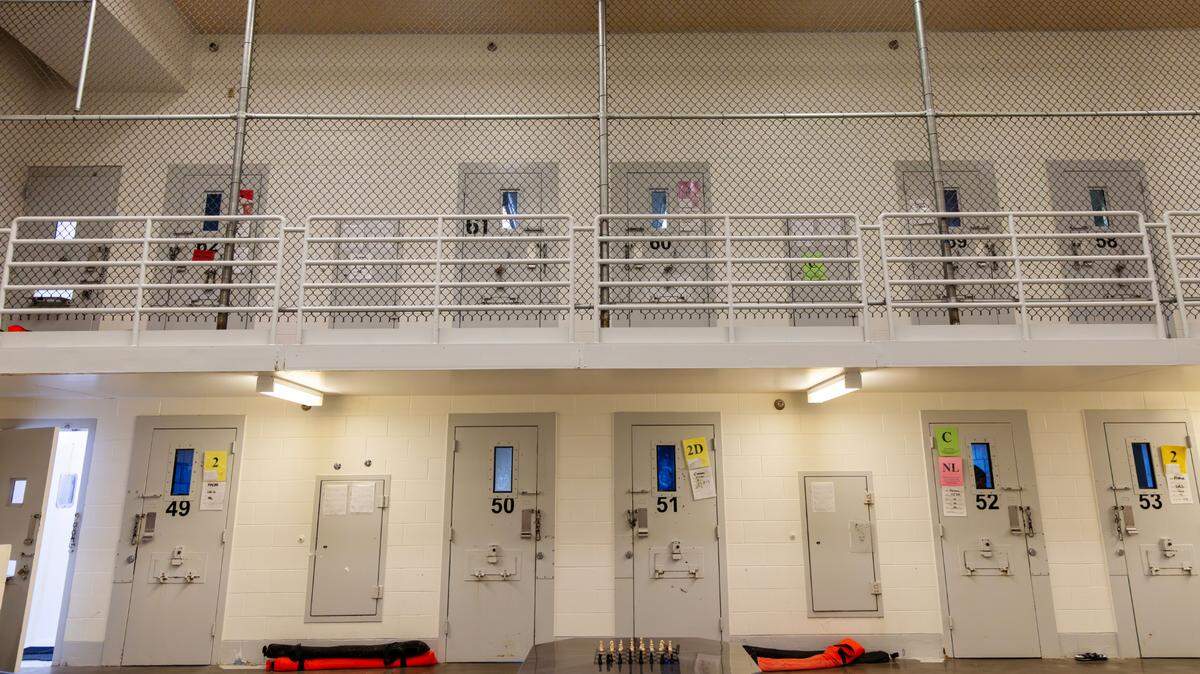
An Idaho law passed decades ago requires the state to house severe psychiatric patients within the maximum security prison because there weren’t any secure enough hospitals, ProPublica reported. Following the news outlet’s investigation, Idaho Gov. Brad Little agreed to allocate $25 million to construct a secure 26-bed mental health facility “for patients committed and determined to be dangerously mentally ill by Idaho courts.”
Construction on the facility is expected to begin in June 2026, with a goal of completing the project by 2028, Joan Varsek, a spokesperson for the Governor’s Office, said in an email.
Up to nine psychiatric beds are available at the Idaho Maximum Security Institution, the Idaho Capital Sun reported. For now, the most recent criminal case, and the prior charges against Stevens are on hold until his competency can be restored.
His next hearing is scheduled for 10:30 a.m. Wednesday at the Ada County Courthouse, where Kimball will decide whether to grant the prosecution’s request to designate Stevens as dangerously mentally ill, transferring him to the prison for treatment.
This story was originally published June 6, 2025 at 3:13 PM.