Closing Southeast Boise bridge, ACHD left to figure out ‘how did it get to this level’
The Ada County Highway District may be breathing a sigh of relief that a popular bridge in Southeast Boise that spans the Boise River has not yet collapsed.
Ryan Head, ACHD’s director, said at a press conference Friday afternoon that the Eckert Road Bridge could safely support a weight of about 3 tons right now.
In other words, not nearly enough.
“A larger personal pickup truck can exceed 3 tons,” Head said. “I also would say my minivan, fully loaded with people, may exceed 3 tons as well.”
The highway district ordered an emergency closure Friday after an evaluation revealed that the bridge, which connects Southeast Boise to Harris Ranch and the Barber Valley, had widespread decay in nearly half of the bridge’s pillars, which could result in a catastrophic collapse.
The bridge will remain closed for the foreseeable future.
The inspection found that 22 of the 48 bridge pillars had signs of moderate to severe decay, according to ACHD. On the center pier — a vertical support structure — five out of the six timber beams showed severe decay.
The bridge is smaller than most in the city, yet it acts as a significant gateway for thousands of people per day, including school buses full of children, residents in that growing section of the city and thousands of people in summertime who head over it to Barber Park, where they start the float down the Boise River.
According to Head, the bridge supports more than 7,000 trips per day and adds around 1,200 more in the summer months.
The agency plans to remove the bridge and build a new one, Head said. Until then, pedestrians and cyclists may use the bridge.
“While we do not yet know the exact timeline for reopening the bridge, declaring an emergency, which our ACHD Board of Commissioners did earlier today, allows us to accelerate the process,” Head said.
In the meantime, Head said the detour route would be to drive along Warm Springs Avenue to Parkcenter Boulevard, then to Mountain Way and Boise Avenue. More information can be found at achdidaho.org/eckertbridge.
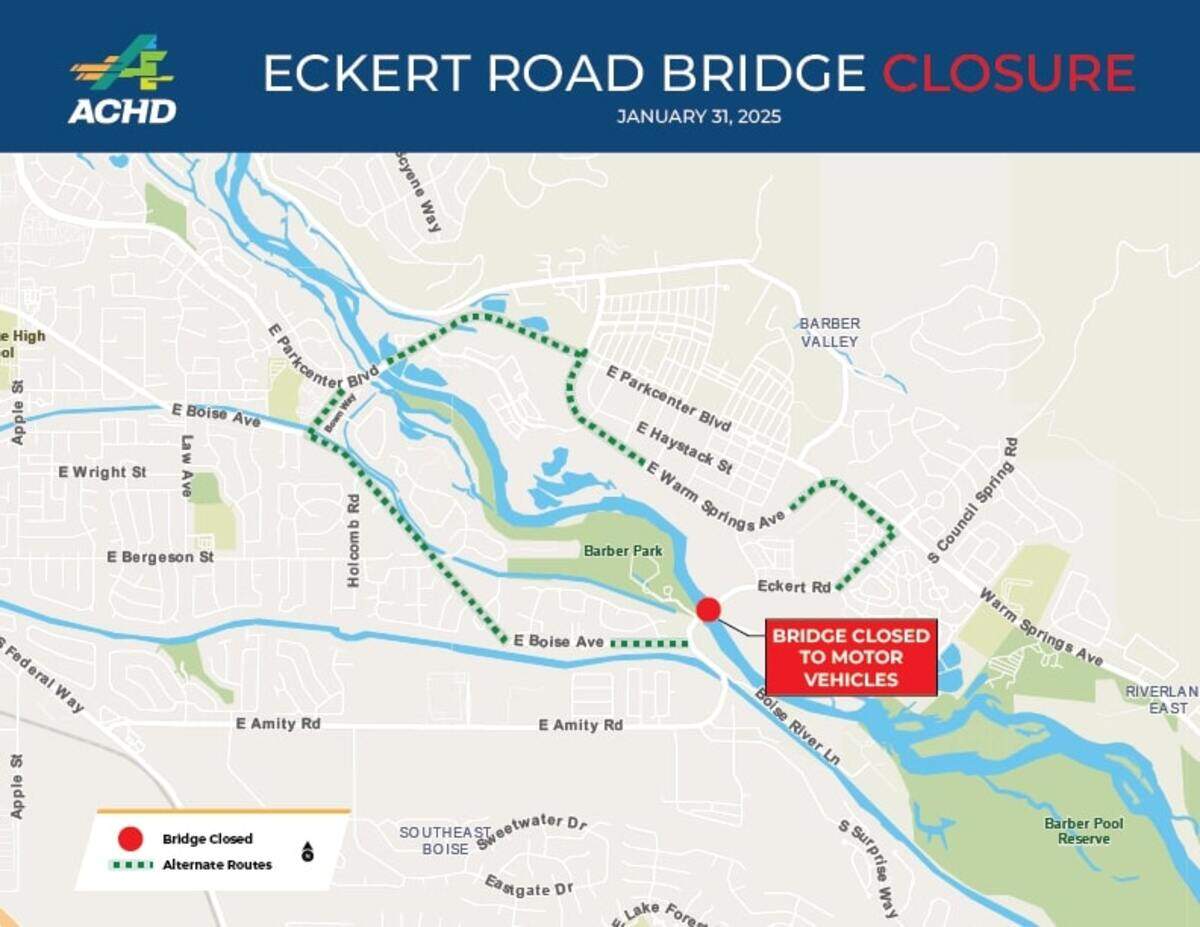
ACHD spokesperson Rachel Bjornestad said the decay was found only under the part of the bridge that crosses the Boise River, and not a segment that crosses Ridenbaugh Canal. Still, the whole bridge will need to be replaced.
The 1954-built bridge is unique in Ada County, Head said, because it uses wooden pillars for structural support rather than concrete, which is the usual material for bridges.
How did ACHD miss a dangerous bridge?
On Friday, members of the ACHD Board of Commissioners and staff questioned how they had missed the decay until it had become such a hazard.
“Was there anything missed in previous inspections?” Head said. “The answer at this point in time is no. We have done inspections as expected on an every-two-year basis. This is the same process (the Idaho Transportation Department) uses for all bridges throughout the state.”
Aside from those evaluations, the agency does more in-depth reviews for concept studies before beginning projects, he said. The last time it did such a review on this bridge was five years ago.
“How did it get to this level so quickly from our previous evaluations?” Head said. “We don’t know.”
The agency had planned to remove and replace the bridge in the next five to seven years, Head said. Staff had just started concept design and were evaluating what would be the best path forward, including what kind of timetable they anticipated, when the evaluation showed the massive decay.
According to ACHD’s five-year plan, the agency estimated that the planned removal and replacement of Eckert Road Bridge would cost $38.3 million. Head said he was unsure how the new findings would affect that cost.
“Ultimately, when you accelerate a project, there can be some additional costs,” Head said. “But there also can be some savings through this process as well.”
Head said ACHD had some funding reserves to tap to help with the project, but the agency also would look to see whether it could receive additional bridge-specific funding from the state.
“We also may have to look at reallocating or delaying other projects in order to address this,” Head admitted.
The bridge is less than 500 feet north of an intersection that commuters and nearby residents have said is too dangerous and needs to be fixed. That intersection with Boise Avenue comes on a tight, 35 mph corner with limited visibility.
Head said that the agency was aware of the concerns and that the concept study for Eckert was also intended to look at the intersection and access under the bridge for the Greenbelt. He said the agency was looking at how to align the road and intersection in a way that makes it the safest for the public.
“We’ll be exploring all options in terms of (not only) how do we get it reopened as quickly as possible, but how do we also make it the best long-term,” he said. “When you build a bridge, you build it for a very long time, and we want to make sure that this investment that we’re making at a much accelerated pace now is going to be good for the public for many years.”
This story was originally published February 1, 2025 at 4:00 AM.