Downtown Boise could get a new park soon. Will it come in time for giant Basque festival?
Update Wednesday, Jan. 22, 2025: Boise officials broke ground today on the park and named it Kaixo Corner. Kaixo, pronounced KY-sho, means hello in Basque.
If you want to follow Boise’s ever-changing, ever-growing cityscape, look no further than Grove Street.
One of the oldest streets in the heart of downtown Boise, Grove has had one of the largest transformations in the past several years and will continue to shift for the next few. A new fire station now fits in next to the western terminus of Grove Street by Rhodes Skate Park, while new hotels and apartments have continued to go up at the intersections of 12th and 13th streets.
The over-300-unit Broadstone Saratoga apartments building is creeping closer to the finish line just west of Matlack’s pub. The new 66-room Sparrow hotel and 122-room Hotel Renegade sit to the pub’s north. Both hotels include new food and coffee options, with Renegade also offering a rooftop bar.
Split by the Boise Centre, Grove Street then pops out onto Boise’s historic Basque Block and runs to the Ada County Courthouse — where there are plans to build a new pathway to Broadway Avenue and Dona Larsen Park.
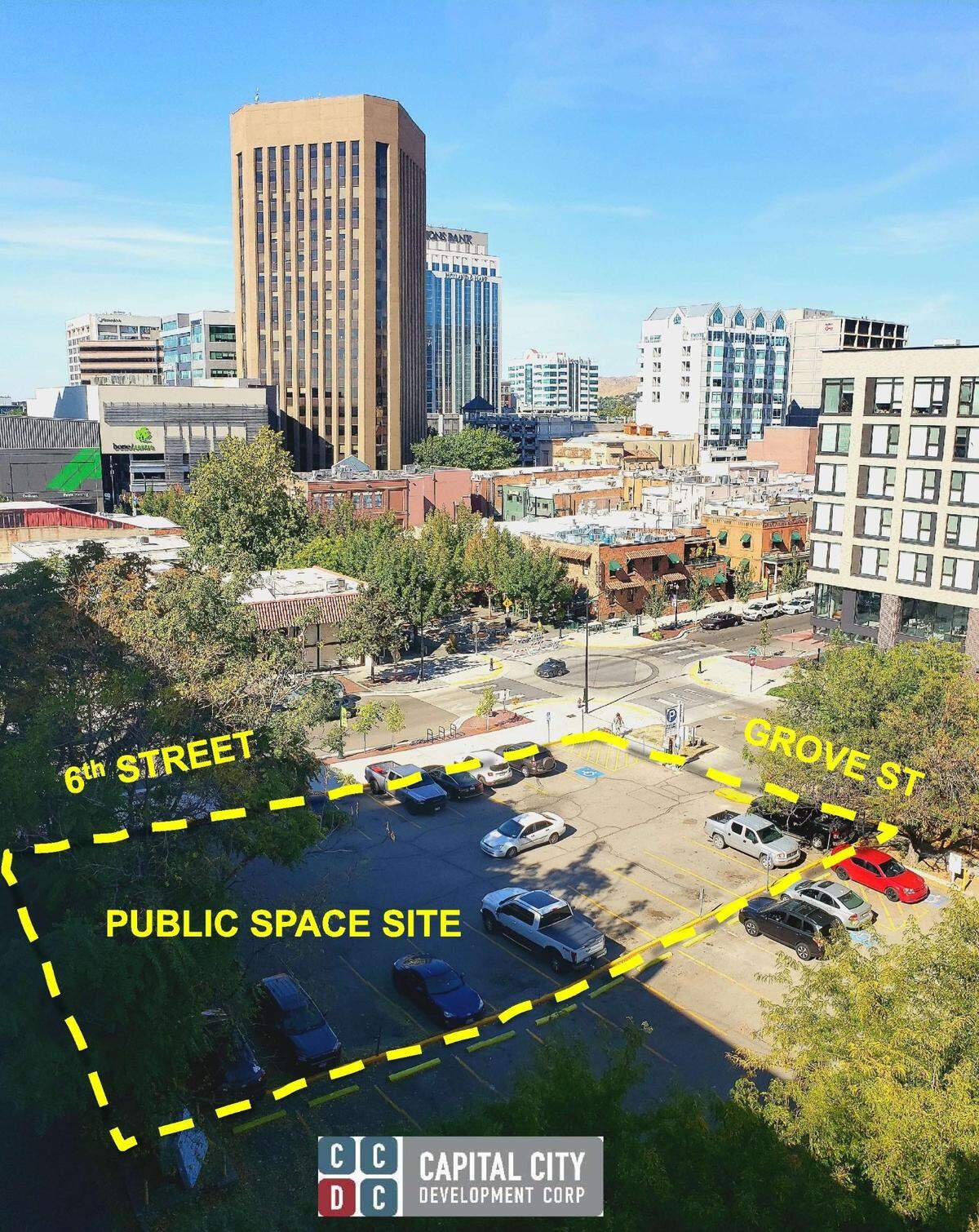
Now, crews are gearing up to start construction this month on the next step in Grove Street’s transformation: a downtown park and public space at 521 W. Grove St.
The site has been a parking lot since a boardinghouse owned by Basque immigrant Antonio Letemendi was demolished in the mid- 1900s to make room for a shopping mall that was never built.
The street was one of the first in Boise, and it formed the southern edge when the city’s first 10 blocks were platted in 1863, according to a letter from the city Department of Arts & History.
According to Toby Norton, a project manager for the city’s urban renewal agency, the Capital City Development Corp. or CCDC, the park would celebrate that history and the multicultural history of the city and the Basque block.
“The new public space is envisioned to provide an area where people can enjoy the outdoors, gather for community events and festivals, and learn about and connect with the history of one of Boise’s oldest neighborhoods,” Norton said during a CCDC board meeting Monday.
The 9,000-square-foot park would include open grass areas with synthetic turf, seating areas including curved sandstone-seat walls, and standalone seating pods, Norton said. It would also include Wi-Fi and an elevated area that could be used as a stage for events.
The city originally selected Cliff Garten Studio of Venice, California, in 2023 to design the public art, but had to change artists due to unforeseeable circumstances, according to Jennifer Yribar, spokesperson for the city’s Department of Arts and History. The city selected Huameng Yu and Louis Chinn of HUA Studio, a multidisciplinary artist team based in Murphys, California, to replace Cliff Garten after a competitive process.
According to Norton, the park would include four art elements that represent past, present and future. The first element would be five sandstone “ancestral pillars” that represent the cultures that shaped the neighborhood.
“The pillars will be etched with images depicting the immigrant groups’ contributions to Boise’s history and culture, including the industries they helped develop and historic artifacts and traditions,” he said.
The second element would take patterns from each pillar and lead people through the park, while the third element would be a blue river-like overhead canopy representing the present.
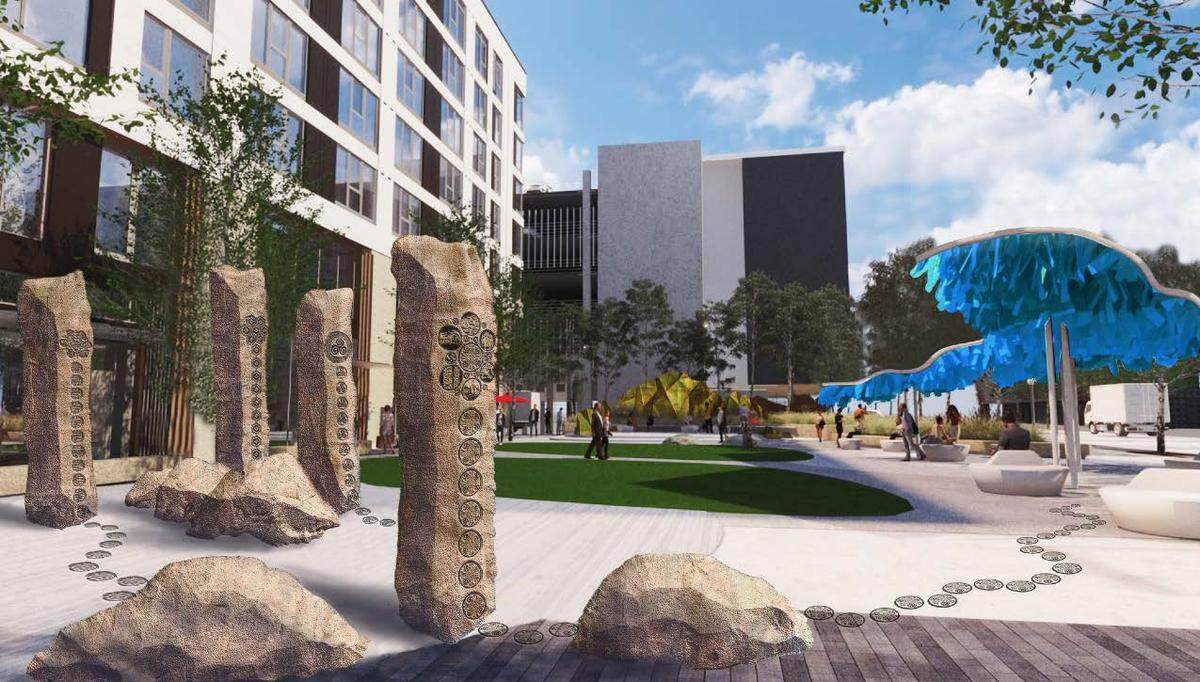
“That canopy is composed of thousands of aluminum flappers that move with the … breeze to represent shimmering water,” Norton said.
The fourth element would be a “dreamscape” that represents the future as a mountain landscape, Norton said. The landscape would act as a background for the stage and would help screen the building to the south.
The mountains would be layered with cultural patterns, laser cut into metals to create a sculptural screen, Norton said. They would be lit with colored lights from the front and back to create a sunset effect.
Eagle construction firm Guho Corp. is scheduled to begin construction on the park in January, Norton said, with the aim of having a usable park by July 29, in time for the long-awaited return of Boise’s Basque Jaialdi celebration.
Norton said that wrapping up work in time for the festival would be no small feat, but the park should be “substantially complete” and usable by then, though there may be some paperwork and small lingering items to do afterward.
According to the Basque Foundation of Boise, the celebration was first held in 1987 at the Old Penitentiary to celebrate the old and new, local and international aspects of Basque culture. Over 30,000 people attended the first celebration, and it returned in 1990 at the request of Gov. Cecil Andrus.
With one exception, the celebration has been held every five years since on the last weekend of July to coincide with the celebration of San Ignatius de Loyola, the patron saint of Basque people, according to the Basque Foundation. It is the largest Basque festival in the United States and includes performances, traditional sports, dancing, food and drink.
The COVID-19 pandemic threw plans to hold the seventh celebration in 2020 out the window, meaning this will be the first celebration since 2015.
The festival is scheduled from Tuesday, July 29, through Sunday, Aug. 3. Tickets, which can be found online at jaialdi.com, are expected to go on sale in January.
This story was originally published January 14, 2025 at 3:03 PM.
CORRECTION: An earlier version of this story incorrectly identified the final artist elected to design the Grove Street public space. The city selected Huameng Yu and Louis Chinn.