
National Guard learned bitter lessons from fatal 2014 helicopter crash near Boise
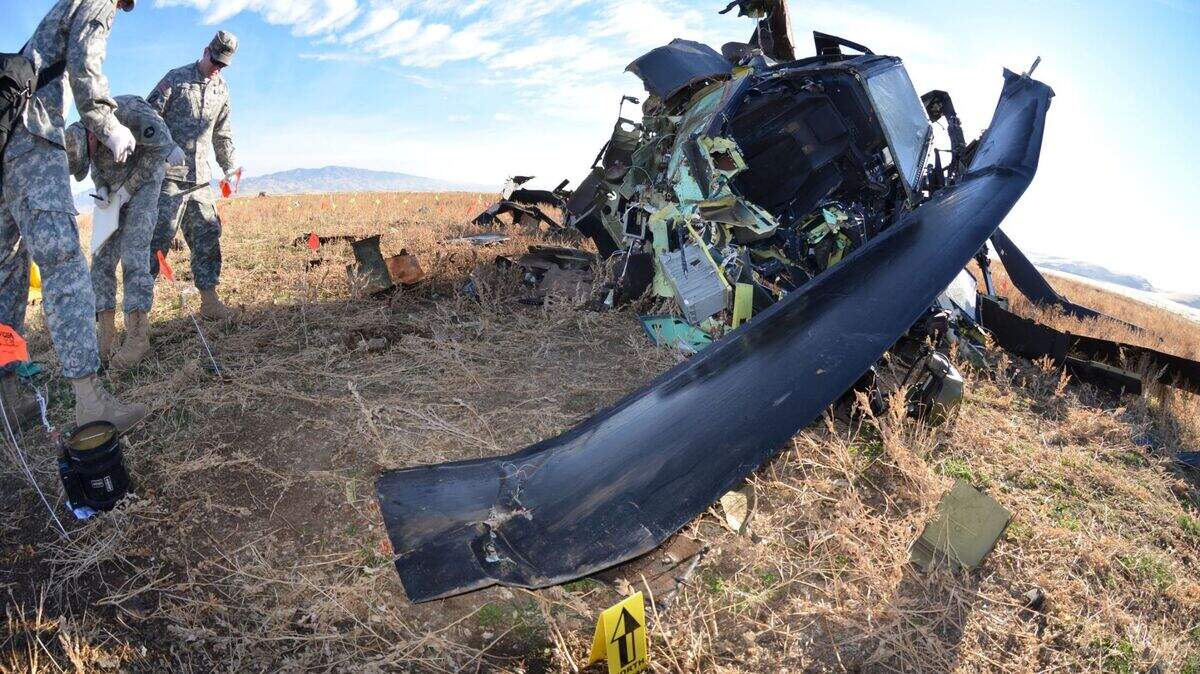
This story was first published March 29, 2015. It is republished here in connection with the Feb. 2, 2021 helicopter crash that killed three Idaho Army National Guard members near Lucky Peak.
The Apache helicopter operator’s manual contains a new warning to military pilots across the country.
The notation alerts them to the scenario that caused an Apache to crash Nov. 6, 2014, near Boise, killing Idaho Army National Guardsmen Jon Hartway and Stien Gearhart.
Also in response to the crash, the Idaho Guard is considering changes to altitudes and pilot rest schedules to make flights safer.
The Guard has briefed its aircrews and maintenance workers on the findings of the U.S. Army’s investigation, Idaho National Guard spokesman Col. Tim Marsano said. The Statesman obtained a copy of the investigation report through a request to the Guard.
The 240-page report includes hundreds of photos and dozens of videos taken by investigators in the days after the crash. It reveals new details, contributing factors and recommendations for avoiding a similar tragedy:
• A word-for-word transcript of the flight’s audio recording.
• A recommendation to fly training missions at higher altitudes, offering a greater margin of error.
• Concern about Gear-hart’s workload prior to the crash.
• Praise overall for Gearhart’s and Hartway’s Guard unit and its policies and procedures.
Gearhart, 50, of Meridian, and Hartway, 43, of Kuna, were on a training mission Nov. 6. Runaway RPMs triggered an automatic shutdown of both engines on the Apache helicopter they were flying at about 7 p.m. The helicopter crashed into a field south of Boise, killing both men.
Besides the pain of two pilots’ deaths so close to home, the crash shocked the public and baffled aviation experts. That’s partly a result of the qualifications of the two men at the controls. Gearhart and Hartway were, by all accounts, experienced, highly rated pilots. They served in combat in Afghanistan and were known as patient, knowledgeable instructors.
“They selflessly swore allegiance to the U.S. Constitution, served in many overseas combat deployments and were taken from their families and our organization in the primes of their lives,” Marsano said.
How could two pilots with such impressive resumes err so fatally? The Army’s investigation report identifies the technical factors but fails to answer the question of why they occurred.
As far as anyone knows, Marsano said via email, this is the only time an Apache has crashed due to this combination of factors:
1. Autorotation
Seconds before they hit the ground, Hartway and Gearhart apparently attempted a maneuver that, had it worked, could have safely landed the Apache.
“OK, Jon, auto,” Gearhart said, according to Army investigators’ transcript of the flight’s audio recordings.
Gearhart’s order appears to have been a command to perform an autorotation landing. This maneuver is used to land a helicopter that has lost all engine power.
No one knows for sure what the pilots were thinking, and “we dare not speculate,” Marsano said.
“But it would be common procedure for a crew to attempt an autorotation if both engines failed and the conditions permitted,” he said.
An autorotation uses a powerless helicopter’s downward momentum to save it from crashing. As the aircraft falls, air rushing by its rotor blades causes them to pick up RPMs. At the last moment, as the helicopter nears the ground, the pilot pulls the nose of the aircraft up.
If the blades are spinning fast enough, the lift they provide can slow the fall of the helicopter and allow it to avoid crashing.
Gearhart and Hartway were about 400 feet above ground level when their engines cut out. That allows very little time and distance to get the rotor blades moving fast enough for a successful autorotation landing, said Lon Calhoun, a helicopter mechanic who splits time between Boise and LaGrande, Oregon. The Idaho Guard hasn’t made its pilots, mechanics and other experts available for interviews, so the Statesman asked an independent mechanic to review parts of the investigation file.
Ideally, Calhoun said, they would be much higher when going into an autorotation, though he admitted he’s not familiar with military training procedures.
The Army recommended that the Idaho Guard look into an agreement with the Boise Airport and air traffic controllers that would allow military helicopters to operate at altitudes of at least 700 feet.
Marsano said the Guard unit is in talks with the Boise Airport and federal air traffic controllers about changing altitudes and other procedures on training missions.
2. The Mission
The purpose of the Nov. 6 flight was for Gearhart to perform an “annual standardization flight evaluation” of Hartway, according to the Army investigation’s findings. Specifically, Hartway was supposed to practice flying the Apache to safety on the power of one engine. Two engines drive the Apache helicopter’s main rotor, whose four blades provide lift and thrust.
To simulate the loss of an engine, the lever that controls it was supposed to be pushed past the “fly” position and momentarily into the “lockout” position. Immediately after going into lockout, the lever was supposed to be pulled back, reducing engine power to a marginal level to simulate the helicopter operating on the remaining engine’s power.
But for some reason — no one knows why — both engines were placed in the lockout position. Also, instead of being returned immediately to a low-power setting, both engines’ levers were left in lockout. Again, no one knows why. The recordings from the cockpit offer no explanation. Both engines’ RPMs accelerated enough to activate a feature that shut them down to keep them from burning up.
In February, the Idaho National Guard reported that the lockout position disconnects the engines from the transmission. That was incorrect: Rather, lockout takes control over the throttle — the amount of fuel going to the engine — away from a computer and puts it in the hands of the pilot.
If the computer that controls the throttle were to fail due to a lightning strike or some other circumstance, Marsano said, pilots could use the lockout position to keep the helicopter in the air.
The throttle is extremely sensitive in lockout position, Calhoun said. A slight nudge forward can push RPMs too high.
“When the power levers are moved forward past the ‘fly’ position for more than a brief moment, they’re being fed more fuel than the engines can handle and the engines will overspeed,” Marsano said.
Would Boeing, which manufactures Apache helicopters, or the Army recommend a feature or redesign for the Apache to keep the engines from reaching excessive RPMs in such cases?
Boeing referred the Statesman to the Army on this question. Army spokeswoman Sofia Bledsoe declined to respond because the investigation report “is still in staffing and not final.”
“Upon completion of staffing and based on the findings/recommendations of the board, the Project Office will determine what actions are appropriate to prevent a like accident in the future,” Bledsoe wrote in an email.
3. Overspeed
There appears to have been miscommunication between Gearhart and Hartway about which engine would be placed in lockout.
“I said (engine) number two, right?” Hartway said to Gearhart a few minutes after the flight began, according to the Army’s audio transcript. “Or did I say one?”
“You said one,” Gearhart replied. “I’m guarding two.”
“OK, going to one, got it,” Hartway said.
Five seconds later, the helicopter’s warning system announced: “Rotor RPM high.”
“Whoah,” Gearhart said.
Within four seconds of the “rotor RPM high” warning, the helicopter gave separate audio warnings that both engines had reached “overspeed” and automatically shut down. Seconds later, the aircraft announced that the engines were out.
The recording ends with this unfinished message from the Apache’s warning system: “Rotor RP-.”
The crash probably caused the warning system or audio recording to cut out, Marsano said.
4. ‘Cumulative effect’
The Army took issue with the number of hours Gearhart had logged in the days leading up to the crash.
“(Gearhart) was near the end of his second day in a row of 14-hour duty days for a total of 28 hours of duty in 48 hours,” investigators wrote in their report. “Although there is no indication that this crew member was fatigued during this flight, fatigue has a cumulative effect on (the) body and causes a reduction in alertness and reaction time of an individual.”
In response to this issue, Marsano said, the Idaho Guard is “reviewing crew rest procedures to ensure our pilots are well rested before their training missions.”
Army investigators found no evidence of “any negligence or willful misconduct.” In fact, their report commends the unit Gearhart and Hartway served in.
“The overall impression of the unit and facility maintenance personnel, policies and procedures are excellent,” according to the report. “It is apparent this is a unit that prides itself in their aircraft, maintenance, maintenance areas and fellow soldiers.”
In keeping with Army regulations, no independent review of the crash investigation or its findings will occur, Marsano said.
▪ ▪ ▪
Apache helicopters
Aircraft manufacturer Boeing delivered the first Apache helicopter to the U.S. Army in 1984. Today, as many as 2,000 Apaches are in use in 14 countries around the world.
Designed as an attack and surveillance aircraft, the Apache has gone through a series of upgrades over the past 30 years. The newest model was introduced in 2011. The Idaho Army National Guard Apache that crashed outside Boise on Nov. 6 was one of 16 based at Gowen Field.
Here are some more details on the model of Apache that crashed:
Length: 58 feet
Height: 16 feet
Maximum cruise speed: 165 mph
Source: Boeing
This story was originally published February 3, 2021 at 10:46 AM.