
Legislature may force Boise, Meridian voters to choose City Council members by district
State legislators are advancing a bill that would fundamentally change how Boise, Meridian and possibly Nampa elect their city councils, potentially leading to the replacement of some members of the Boise council.
The Idaho House on Thursday passed a bill to require that any Idaho city with more than 100,000 residents elect members of its city council to represent districts where the members live, not at large.
House Bill 413, introduced by Rep. Joe Palmer, a Meridian Republican, aims to foster more geographic diversity on the councils. Boise, Nampa and Meridian elect their mayors and council members at large.
Boise had 229,000 people in a 2018 Census estimate, and Meridian is expected to top 100,000 in the 2020 Census. Nampa might, too.
“All of us deal with 30,000 to 40,000 people,” Palmer told fellow representatives in the House debate. “Can you imagine trying to serve the community of 240,000 people? You don’t know who your representative is.”
Palmer ran unsuccessfully for mayor of Meridian in November.
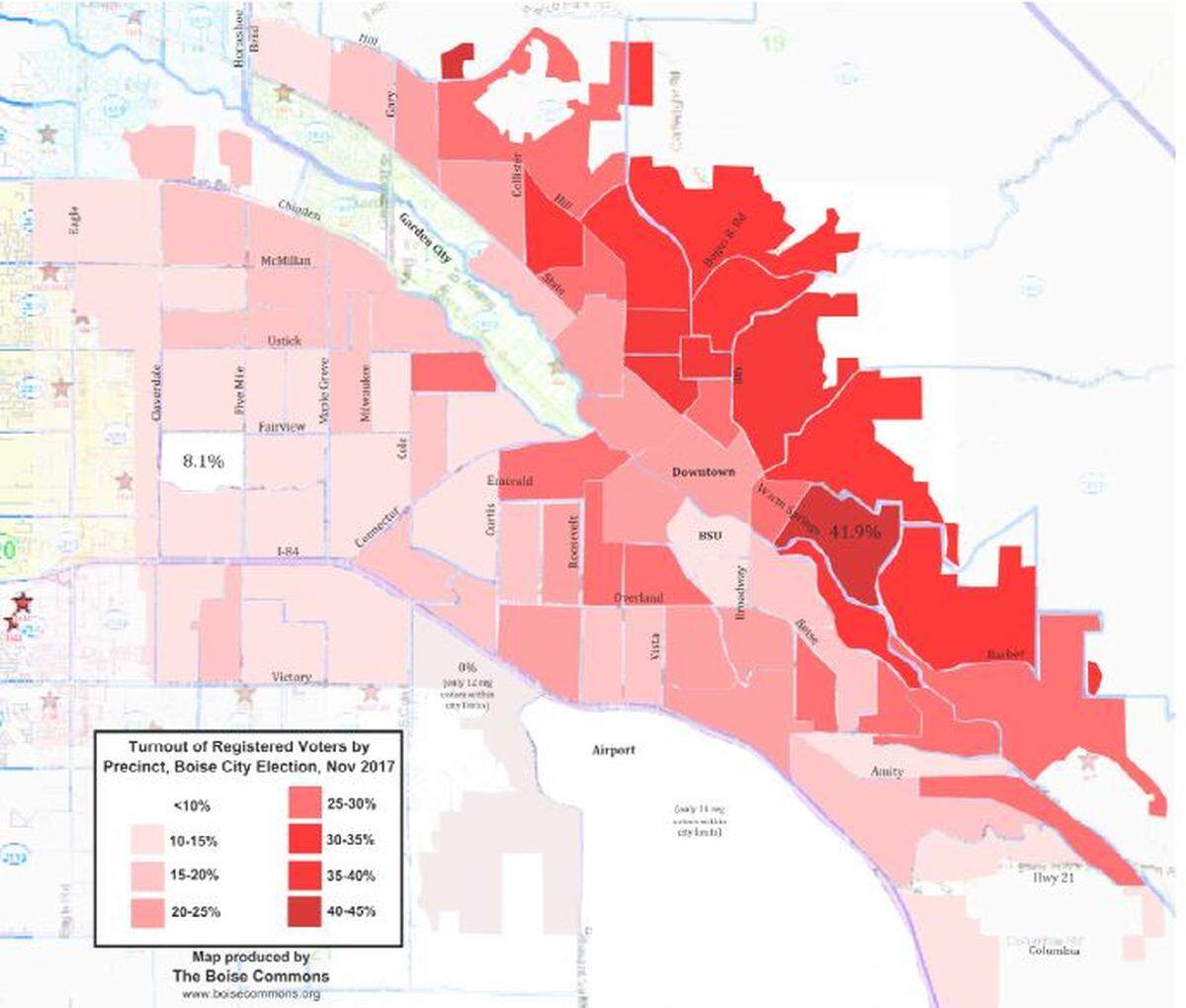
If Boise had districts, several current members of the Boise City Council could lose their seats. Three of the council’s six members — Patrick Bageant, Lisa Sánchez and Elaine Clegg — live in the North End. Holli Woodings lives in the East End, and Jimmy Hallyburton lives in the Highlands neighborhood.
Only one member lives south of the Boise River or west of 20th Street: T.J. Thomson, who lives in the Centennial neighborhood on the far west side of the city.
Plans to create districts in Boise
Karen Danley, who lost her bid for a seat on the Boise City Council in November, helped write the bill. It matches a plan she proposed during her candidacy to curb the concentration of elected officials in the North and East ends. (Mayor Lauren McLean lives in the North End, and former Mayor David Bieter lives in the East End.)
Danley said a state law is needed because incumbent city officials won’t want to surrender the system that put them in office.
“In that case, the people deciding the fate of elections are the same people in power,” she said in a phone interview. “This is why it often takes an outside force to break the monopoly of power.”
Some legislators and Boise elected leaders say Palmer’s bill is unneeded.
City Council President Elaine Clegg calls the bill “a solution in search of a problem.” Council Member Patrick Bageant, who won the seat Danley lost, said that the 100,000 threshold indicates the law was designed to target Boise.
“I’m disappointed,” Bageant said in a phone interview. “People should select their local government, and the local people should make the most important decisions about how they’re governed.”
Rep. Brooke Green, a Democrat from District 18, which includes southeast Boise, said cities should be able to make their own decisions.
“There’s no reason to come in with the heavy hand of the state to tell locals how to operate when they already have the privilege afforded to them to figure it out themselves,” Green said.
McLean — who, like other mayors, would continue to be elected at large — says she is open to considering districts. But she, too, wants the decision made locally.
McLean, who was on the City Council for eight years before being elected mayor in December, said it’s important for council members to “concern themselves with the business of an entire city.”
“I also understand that residents are seeking meaningful representation geographically, to have a designated advocate on city council,” she said through a spokeswoman. “I’d support the City Council addressing this issue, just as I support decisions about local government being made by local governments.”
What’s next for council districts
At a hearing on the bill on Monday, Bageant told lawmakers that he would consider a proposal from any resident who wanted the city to consider districting without the legislature mandate. Now, he says, the city is doing just that, because Danley submitted a similar proposal to him that evening.
In Boise, each of the council’s six districts would have about 38,000 people.
The bill passed the House 53-16, and now goes to the Senate.
Phil McGrane, the Ada County Clerk and the person in charge of administering Boise city elections, said the city would draw the district lines, but he isn’t sure how the bill would affect the council terms.
Gerrymandering, the idea of manipulating electoral district lines to favor a certain party or group, would likely not be a concern at the city level, McGrane said, because the districts would be required to follow voting precincts. Precinct lines are drawn by the state redistricting commission.
Some legislators say they wish the bill applied to smaller cities, too.
Rep. Greg Chaney, a Republican who represents Caldwell in District 10, said a city like his, which has about 50,000 residents, would benefit from greater council diversity. “There are stark differences in outlook, in socioeconomic difference,” that aren’t reflected on the council today, he said in Thursday’s House floor debate.
Business Editor David Staats contributed.
.jpg)