Idaho’s COVID-19 week: Omicron surge ebbs, but intensive care patients are on the rise
The wave of omicron infections that hit Idaho in recent weeks appears to have declined significantly. But health officials are unsure whether the brunt of the surge’s effects on hospitals is yet to come, and the number of patients in intensive care is rising.
The state surpassed 400,000 cases on Thursday, with over 35,000 positive tests still unprocessed in the state’s data system.
The backlogged data makes it difficult to understand the status of surges in the state. But key indicators tracked by the Department of Health and Welfare suggest that the level of infections in the state has been falling since late January.
The state’s test positivity rate, which registers the percentage of tests that come back positive, fell for two straight weeks. And an estimated seven-day incidence rate, which calculates the number of infections per 100,000 residents, indicates statewide infections were down by nearly two-thirds as of Feb. 7, according to data provided to the Idaho Statesman.
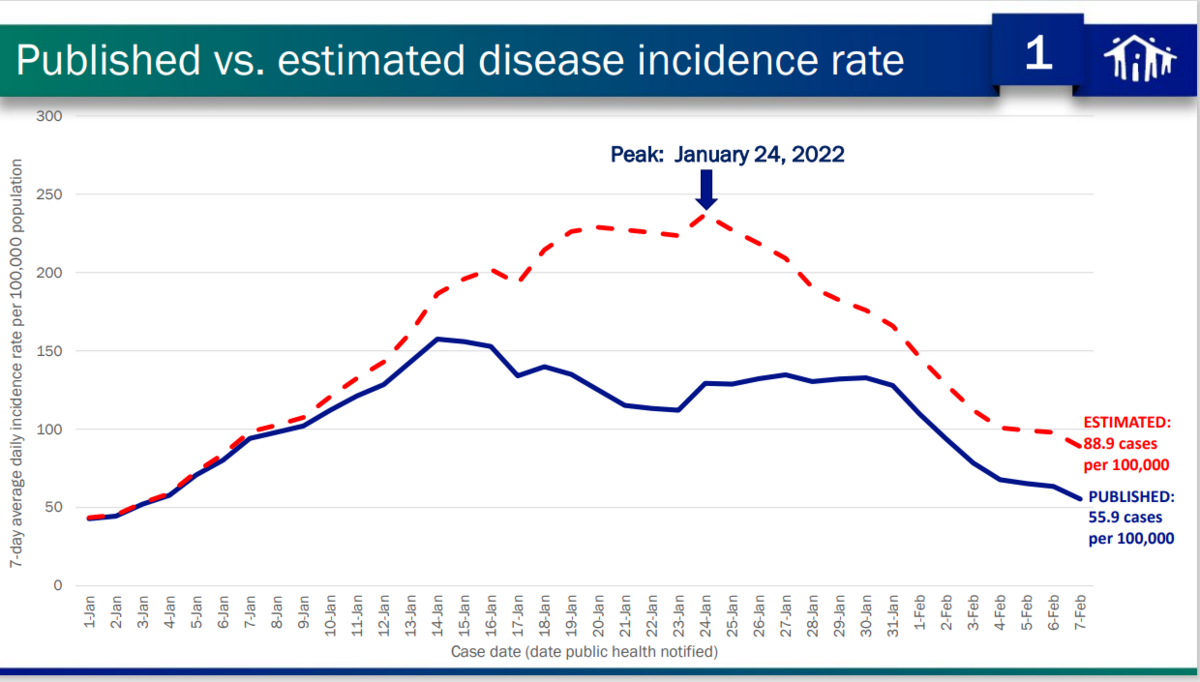
Like in other parts of the country and world, cases of omicron mounted quickly before dropping rapidly.
“It probably has kind of burned out for the moment,” Dr. Christine Hahn, state epidemiologist, said at a Tuesday press conference.
But while the state’s current level of infections appears to be lower than a few weeks ago, it is still high. The positivity rate for the week of Jan. 30, the most recent data available, was 25% — a record during any prior surge, but lower than the all-time record of 37.8% two weeks earlier. Health authorities aim for a rate of 5% or less.
And the strained situation at hospitals, where many employees have had to call out sick, and where a major blood shortage is testing supply, continues. Much of Southern Idaho remains in crisis standards of care.
“The number of new COVID cases remains very high, and the number of COVID patients hospitalized continues to also be very high,” Dave Jeppesen, director of Health and Welfare, said at the Tuesday press conference.
While cases have declined, hospitalizations tend to lag multiple weeks behind shifts in case numbers, he said.
After an infection, it can take days before sick people develop severe enough symptoms to require hospitalization.
State data shows that the overall number of patients hospitalized with suspected or confirmed COVID-19 fell since the end of January, while the number of COVID-19 patients in intensive care rose.
On Jan. 30, there were 614 hospitalized patients; on Wednesday, there were 522.
On Jan. 30, there were 104 intensive care patients; on Wednesday, there were 121.
“We’re not totally clear if hospitalizations have peaked yet or not,” Jeppesen said Tuesday.
Since Feb. 4, Idaho has recorded 12,333 new cases, but a backlog of 35,100 positive tests continues to distort the daily case data. The state has recorded 75 deaths over the same period.
Since the start of the pandemic, there have been 15,163 health care workers infected, 15,306 people hospitalized and 2,581 people admitted to intensive care.
There have been a total of 402,048 cases and 4,553 deaths recorded.
Idaho ranks 46th in the nation by the percentage of residents who are fully vaccinated, according to data from the Centers for Disease Control and Prevention. Health officials continue to emphasize vaccination as the safest way to protect individuals from COVID-19. Officials also recommend booster doses for those who are eligible, which they say provide a necessary, added level of protection against current and future variants.
“We worry that these low numbers leave Idahoans vulnerable to future outbreaks, hospitalizations and deaths,” Hahn said. “Especially compared to other states where we know that (vaccination) rates are higher.”
Since Dec. 1, people with boosters are 11 times less likely to be hospitalized from COVID-19 and are 20 times less likely to die than people who are unvaccinated, according to state data.
Around 43% of vaccinated Idahoans have received a booster dose, according to Health and Welfare.
Health officials have also said that, as the virus continues to infect more people, future variants are likely to crop up.
“We also want people to consider getting a booster to make sure they continue to have a high level of protection against this unpredictable virus as we continue to wait to see if we get future waves of it,” Hahn said. “Future variants are potentially very close to us.”
Long-term care
At long-term care facilities, 200 new cases have been recorded in the past week.
As of Friday, Health and Welfare reports there are 11,689 active coronavirus cases among 208 long-term care facilities. There are 152 facilities with resolved outbreaks.
To date, 1,047 people from 223 facilities in Idaho have died from COVID-19-related causes — two more than were reported last Friday. Long-term care deaths account for about 23% of the 4,553 in the state.
Below is a list of Idaho cities along with the number of facilities in each city that have active cases among residents and/or staff. For an outbreak to be considered “resolved,” more than 28 days must pass (two incubation periods) without any additional cases associated with the facility.
American Falls (1), Ammon (2), Ashton (1), Bellevue (1), Blackfoot (3), Boise (43), Bonners Ferry (2), Buhl (1), Burley (4), Caldwell (7), Chubbuck (2), Coeur d’Alene (10), Eagle (5), Emmett (3), Fruitland (1), Garden City (2), Glenns Ferry (1), Gooding (1), Grangeville (2), Hayden (3), Homedale (1), Idaho Falls (8), Jerome (2), Kellogg (1), Kimberly (2), Kootenai (1), Kuna (1), Lewiston (10), McCall (1), Meridian (13), Montpelier (1), Moscow (3), Mountain Home (2), Nampa (14), Orofino (2), Parma (1), Payette (3), Pocatello (13), Post Falls (4), Rexburg (1), Rigby (1), Rupert (2), Salmon (1), Sandpoint (4), Shelley (1), Shoshone (1), Silverton (1), Soda Springs (1), St. Maries (1), Star (2), Twin Falls (11), Weiser (1), Wendell (2), Winchester (1).
Weekly snapshot
Vaccine doses administered in Idaho: 2,266,745, according to Health and Welfare. Of those, 916,217 people have been fully vaccinated, which accounts for 53.5% of Idahoans age 5 and older.
Test positivity rate: Out of the 30,938 COVID-19 tests conducted for the week of Jan. 30-Feb. 5, 25.1% came back positive.
For a list of daily numbers in the Treasure Valley, visit our “What We Know” story.
This story was originally published February 11, 2022 at 6:43 PM.