COVID-19 cases in Idaho have fallen sharply but remain ‘crazy high’ in omicron surge
Idaho’s estimated COVID-19 incidence rate shows that infections from the coronavirus likely peaked in late January before falling quickly, matching a pattern that has emerged in other regions of the country.
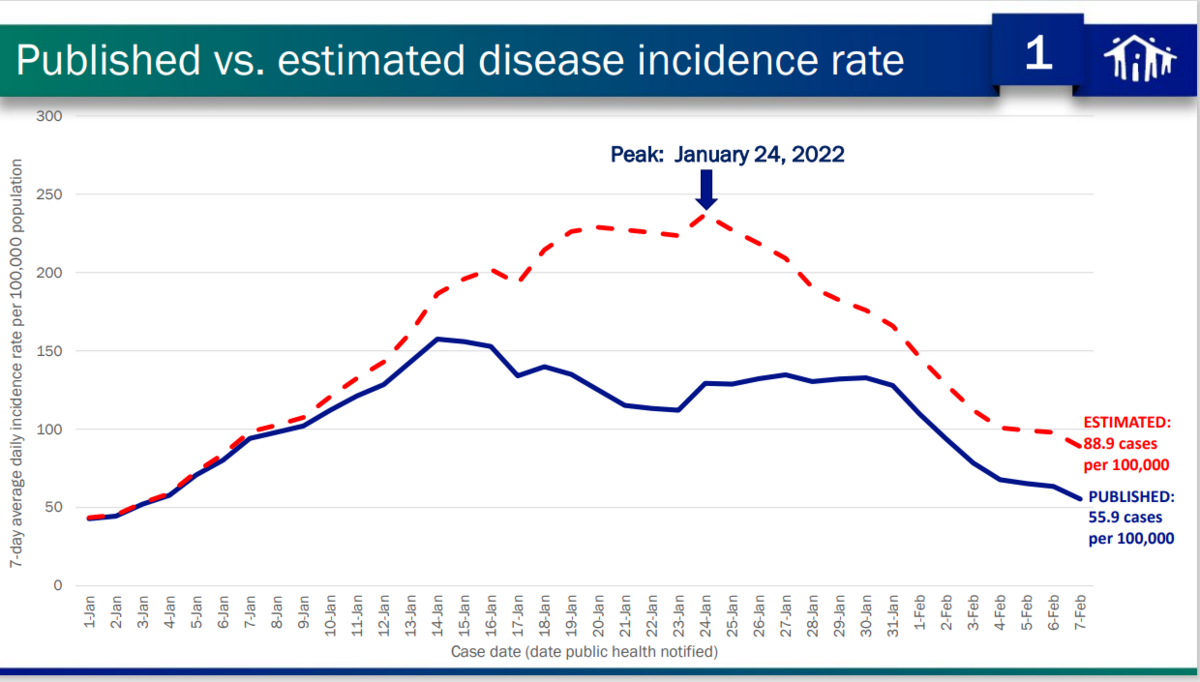
The Department of Health and Welfare estimates that Idaho’s case peak during the omicron wave was on Jan. 24, with a seven-day average of around 240 cases per 100,000 residents. The department calculates an estimate because the published data exclude tens of thousands of backlogged positive tests from over the past few weeks, which distort the numbers.
The estimated rate would mean Idaho’s infection high point was nearly 2.5 times the level at which a community is deemed to be experiencing “high transmission” by the Centers for Disease Control and Prevention. The state estimates that the numbers have fallen by nearly two-thirds since then, to 88.9 cases per 100,000 people as of Feb. 7, according to the data.
“We have hit our peak,” Dr. Kathryn Turner, deputy state epidemiologist, said at a Tuesday press conference. The estimated case data match the trajectory shown in the state’s test positivity rate, which began to fall the week of Jan. 23.
Though the causes for infection slowdowns can be elusive, state health officials believe the current trends are likely due to a combination of natural immunity, vaccine immunity, and mask wearing and social distancing by people who are sick.
“That will make it so that the virus isn’t getting transmitted and those cases start to come down,” Turner said.
It’s difficult for health officials to measure the true rate of infection, because many people don’t get tested and others use rapid antigen tests, which are not processed by a lab and therefore don’t get sent to the state. But based on previous estimates of asymptomatic and undetected cases, at least 35% of Idahoans have had COVID-19 during the course of the pandemic.
Dr. Christine Hahn, state epidemiologist, said that the baseline level of immunity, largely the result of vaccinations, is substantially higher than it was a year ago.
“It probably has kind of burned out for the moment,” Hahn said.
But health officials are quick to emphasize that prior infection does not preclude reinfection and that the current case numbers are still very elevated.
“The case numbers are crazy high relative to what they’ve been early on in the pandemic,” Turner said.
And hospitalizations and deaths tend to lag behind case numbers, meaning that the number of severely ill patients could continue to rise, said Health and Welfare Director Dave Jeppesen.
Turner added that 14% of the cases reported to the state over the past two months have been reinfections and that the vaccines have been found to be not as effective at stopping omicron transmission. Research also has shown that a third — or booster — dose of a vaccine helps revamp the vaccines’ highly effective protection against hospitalization and death.
“With every new variant that we get, the situation changes a little bit,” she said.
Health officials have long said that widespread transmission will leave the virus with more opportunities to mutate, increasing the chances that other variants will emerge.
Idaho is one of the least-vaccinated states in the nation, which health officials say could lead to more severe COVID-19 illnesses.
“We worry that these low (vaccination) numbers leave Idahoans vulnerable to future outbreaks, hospitalizations and deaths, especially compared to other states where we know that (vaccination) rates are higher,” Hahn said.
So far, 76 COVID-19-related deaths have been reported in Idaho in February.
As of Feb. 2, every county in Idaho is facing high transmission, according to the CDC.
This story was originally published February 9, 2022 at 6:47 PM.