Idaho quietly softens criteria for state to advance through governor’s reopening plan
For the past nine months of the coronavirus pandemic, Idaho Gov. Brad Little maintained a list of criteria that the state needed to meet before it would advance to the next stage of reopening. Those metrics included getting below a certain number of daily hospitalizations and ICU admissions.
But by Wednesday afternoon, the requirement to meet those metrics was scrubbed from the governor’s Idaho Rebounds website.
Little’s site on Tuesday said all of the listed criteria — including dipping below a certain number of COVID-19 hospital admissions — must be met before the state could advance to the next stage of reopening.
Now, the same online site reads that the governor has changed those metrics, and can continue to change them in the future. It also says the governor considers other factors, including “the economy and education,” when making decisions about Idaho’s stages.
The website changes occurred after Little announced Tuesday morning that Idaho would advance to Stage 3 of his plan despite failing to meet certain criteria.
The governor’s office didn’t provide any notice to the media about the change, nor did Little address it Tuesday.
Little’s spokesperson, Marissa Morrison, wrote in an email to the Statesman on Wednesday night that all state websites are continually updated to reflect the most current information. She said the governor’s office updated the Idaho Rebounds website “to more accurately reflect the variety of factors the governor considers in his decision-making” about the stages.
“Those factors include public health metrics and impacts on the economy, education and families,” Morrison wrote.
The changing metrics leave unanswered questions about what the state will use to determine the level of public health restrictions during the pandemic, especially as the Republican governor faces mounting pressure from legislators in his own party and loud cries from sectors of the public to lift restrictions.
“To advance to the next stage, all criteria must be met,” the site said in bold for months. “If the criteria indicates trends are beginning to move the wrong direction, or if there is evidence that a stage has adversely impacted rates, stages may have to be extended or reversed.”
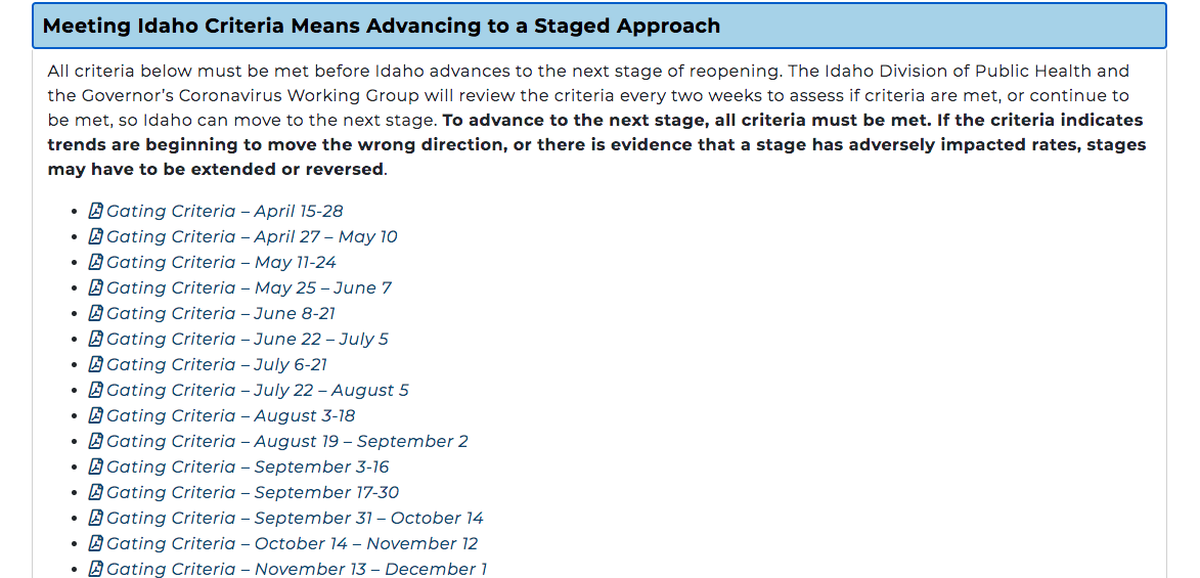
The same part of the site now says that the governor makes decisions based on several factors.
“Throughout the COVID-19 pandemic in Idaho, Gov. Little has made decisions about moving in and out of stages in the Idaho Rebounds plan by evaluating multiple factors, including virus activity and current impacts on Idaho’s health care system,” the site said Wednesday. “This web page includes detailed information on the current metrics and criteria the governor evaluates related to public health. Idaho criteria and metrics have changed and may continue to change based on new information about COVID-19.”
Idaho hasn’t met all of the criteria he outlined to remove more stringent COVID-19 restrictions since advancing to Stage 4 on June 13. The criteria, which were unveiled in late April, have been altered occasionally to bring in metrics the state found more relevant, and remove ones that were proving unreliable.
One metric added in September required Idaho to average fewer than 25 confirmed COVID-19 patients in ICU care over the prior 14-day period. The state’s most recent average is 62. Idaho’s hospital admissions of confirmed COVID-19 patients were supposed to drop below a threshold of eight per day. The average was more than 30 as of Jan. 25.
Those metrics were included in a gating criteria document dated Jan. 28, but the ICU metric has been removed from the criteria listed on the Idaho Rebounds website. The governor’s office did not provide an explanation for that change when asked by the Statesman. The hospital admissions part also has changed and become more difficult to meet — dropping from eight admissions per day to four.
But those metrics weren’t the best measure of health care capacity, said Dr. David Pate, former CEO of St. Luke’s Health System and a member of Little’s coronavirus working group. Pate said hospitals are no longer overrun by patients or overwhelmed as they were at the end of last year, and that isn’t reflected in the numbers seen now. Reported positive COVID-19 cases have dropped in recent weeks.
Little announced Tuesday that Idaho would lift some restrictions and move back into Stage 3 in its reopening plan — most notably allowing indoor gatherings of up to 50 people and outdoor gatherings at 25% capacity. The restrictions don’t apply to political events, religious gatherings, educational activities or youth sports events.
The announcement came just as Republican legislators were attempting to lift those restrictions through resolutions. Sen. Steve Vick, R-Dalton Gardens, on the Senate floor Wednesday said legislators were in a “chess match” with the governor. Senators pulled one resolution, which specified restrictions related to Stage 2, off the floor on Wednesday and introduced a new resolution in a committee.
Pate said he believes the governor would not have moved the state forward if Little thought the hospitals were struggling with capacity. But Pate is worried the lifted restrictions will send mixed messages to the public — just as new variants of the coronavirus begin to spread. He expects those variants to make it to Idaho, if they aren’t here already.
“People are going to be quite surprised when things get really bad, and I believe they will,” Pate said.
When asked what would qualify a return to Stage 2, Morrison on Tuesday wrote to the Statesman that Little would watch for “health care capacity.”
“An increased risk to health care capacity could prompt a move to Stage 2 of the Idaho Rebounds plan,” Morrison said via email.
This story was originally published February 3, 2021 at 5:23 PM.