Historic Boise street to be redesigned, redeveloped as new downtown community hub
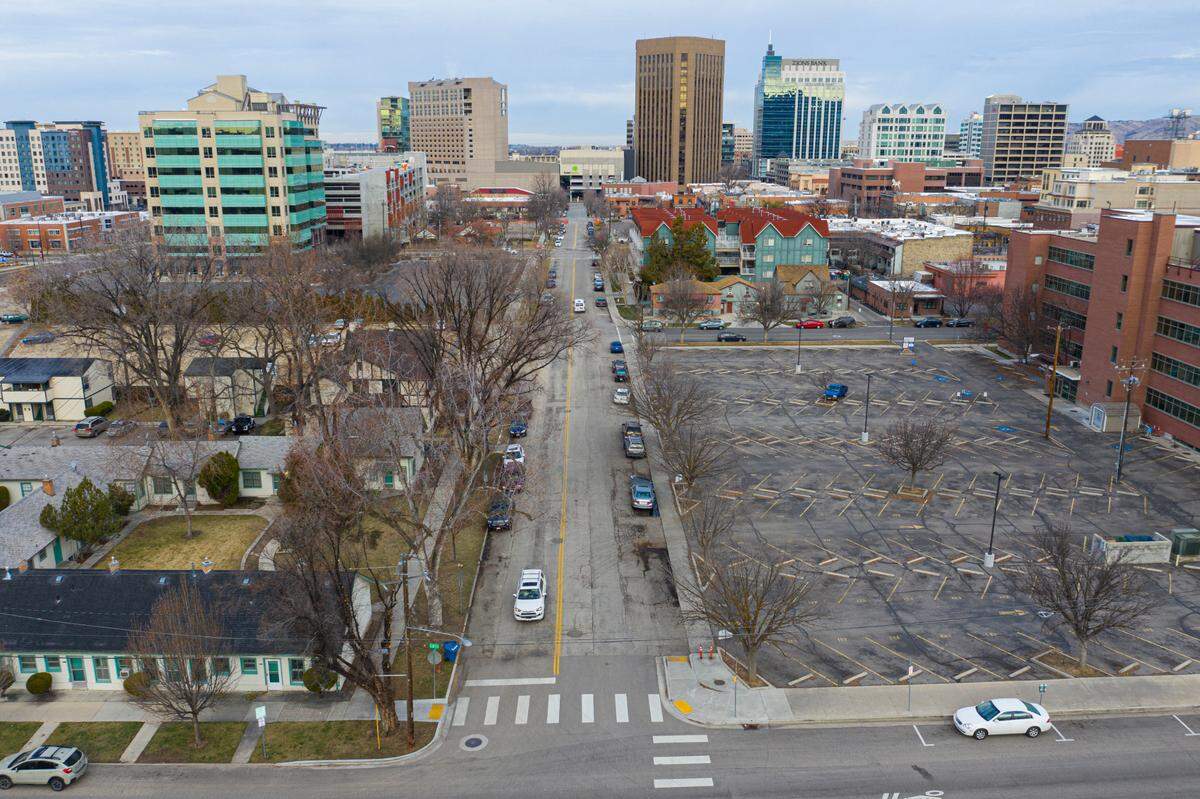
The last three blocks of Grove Street’s east end have long been overshadowed by the popularity of the neighboring Basque Block. An ambitious new plan to redesign the area between 3rd and 6th streets could soon change that.
While less frequented today, these historic blocks were once famous for their lush beauty. One of the oldest existing maps of Boise, from 1884, marked the street’s canal as the city’s southern limit. A series of wheels and flumes carried water from Grove Street to gardens across the city.
“For many years Grove Street was unique in the world, with its open irrigation ditch, filled with creaking, moss-grown water wheels, the banks abloom in June with briar roses …” the Idaho Statesman wrote in 1920. The quote was included in a recent city report.
Today, the three blocks feel a bit behind the times. Unlike other streets in the neighborhood, Grove Street has only a handful of active businesses with storefronts. Parking lots cover 43% of the adjoining land. It sees none of the festivities or foot traffic of the Basque Block and Grove Plaza to the west.
“If you walk down Grove Street, it’s all beautifully developed now except for this one missing tooth in our beautiful downtown smile,” Dana Zuckerman, chair of the Capital City Development Corp., said at a June meeting.
The city wants to “restore a sense of place” to Grove Street with a major redesign. The Capital City Development Corp., Boise’s urban renewal agency, in partnership with city planning and other local groups, has been working for more than a year to create the Grove Street Redevelopment Strategy that would pump more than $15 million in public money to spruce up the blocks and entice private investment.
Developers eye the area
A significant portion of the street is expected to be redeveloped in coming years, said Karen Gallagher of the city’s comprehensive planning team. Property owners on every block are engaged in redevelopment discussions. Planners want to repurpose most, if not all, Grove Street parking lots. They hope to see the blocks restored to a mixed-use area with apartments, restaurants, shops, parks and plazas.
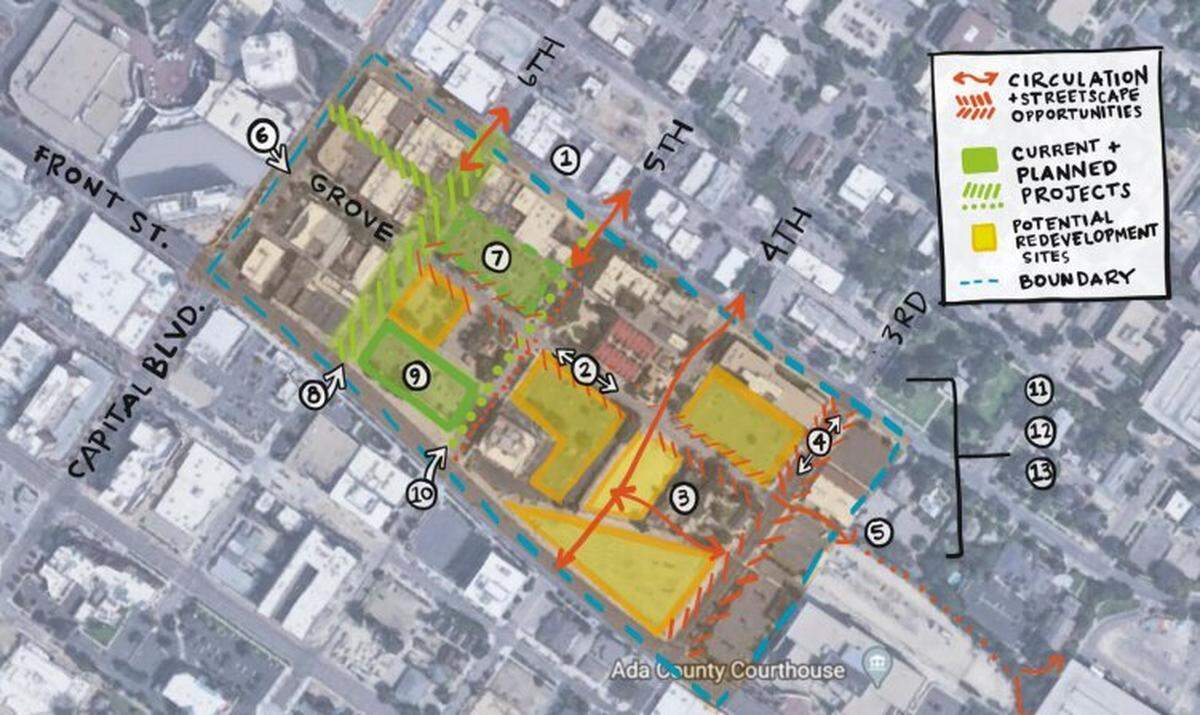
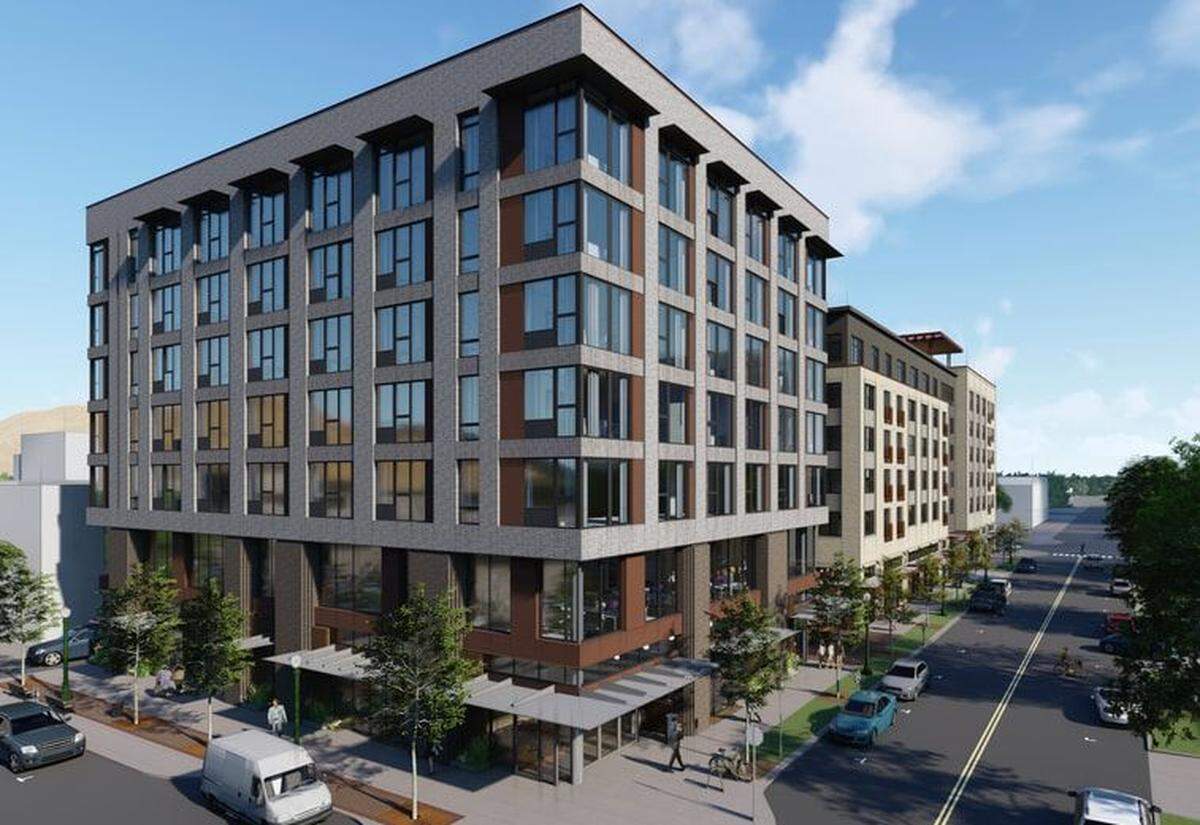
A few projects are already in the works. Developers Clay Carley of Boise, Chance Hobbs of McCall, Dean Pape of deChase Miksis in Boise, and Bill Truax have partnered on two Grove Street apartment projects:
▪ The Lucy, a six-story building with 114 apartments with a food hall on the ground floor at 512 W. Grove St. Fifty units will be “workforce housing” with rents targeted toward median-income earners.
▪ Next to it, at the corner of Grove and Sixth, will be the seven-story Thomas Logan building with 60 apartments. Forty-five will be rented to to people making between 30% and 60% of the area median income. Both buildings are scheduled to be completed by the end of the year.
“I think it’s just notable that already the interest in this area seems to be correlating with active redevelopment conversations,” Gallagher said at a recent City Council work session.
Developer interest is partly owed to reimbursements they would receive as part of an urban renewal district, said Gallagher. The Capital City Development Corp. is reimbursing developers about $1 million for The Lucy and $600,000 for the Thomas Logan for eligible public improvement expenses. Private property owners include Carley, Ken Howell of Parklane Management Company, Jim Kissler of Norco, Tim Wilcomb of Jordan-Wilcomb Construction, Mark Heath, and Mary Stadstad of Stadstad Apartments.
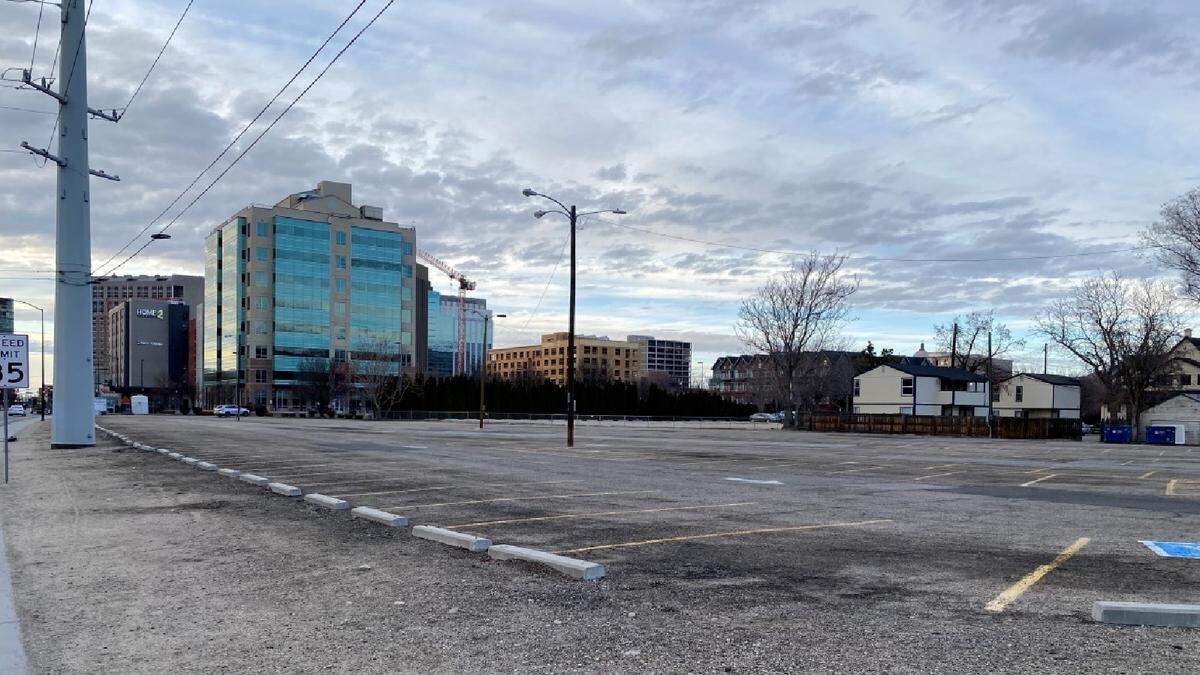
Stalling some developers has been the fate of the 2.1-acre parking lot owned by Ada County at the corner of Third and Front Streets. The Capital City Development Corp. tried to buy the land for $6.9 million earlier this year. But Ada County commissioners have decided not to move forward with the sale until the county’s strategic real estate master plan is complete, CCDC Development Director Doug Woodruff told the Statesman by email.
The commissioners’ biggest concern is lack of parking for county employees. Zuckerman, who hopes to build housing on property, said the urban renewal agency would be willing to build a parking garage for county employees as part of new development.
“It’s almost disturbing to see how much open land there is right there in a really exciting, developing area within our downtown,” Zuckerman said in the June meeting. “...I know (the sale) has taken a long time, but it’s worth it.”
Several Grove Street properties back up to the parking lot, and its unique triangular shape makes it difficult for owners of adjacent lots to build. If the urban renewal agency bought the land, it would be open to working with owners to adjust lot lines.
Wilcomb said he is considering building a theater and possibly housing that includes artist-in-resident apartments on his empty Grove Street property adjacent to the parking lot.
“We would love for CCDC to take ownership of (the parking lot) to help catalyze action on this,” Wilcomb said at the meeting.
Incorporating history and community
The Capital City Development Corp. hired a historic research team to dig into the history of these blocks. They studied old census data, maps and Statesman archives for ideas on how to incorporate Grove Street’s history into the new design.
Team members conducted 22 interviews with stakeholders, including local businesses, downtown residents, cultural agencies and property owners, held four public meetings and conducted two public surveys with more than 600 respondents.
Grove Street’s history as home to Boise immigrants was one of the most important features of the street’s history. Gallagher said she personally interviewed many of those immigrants’ descendants.
“People, from China, from Japan, from Spain, from Greece, from Basque country, all over the world came to this place and helped create it, and they’re still doing that, and I think that’s a really important part of the story that we can tell in this place,” Gallagher said.
Those residents lived there until they were pushed out by developers who turned most of the area into automobile-related businesses by 1953, according to the CCDC project report. Part of honoring the blocks’ history will be to bring back a sense of community that many older generations still remember, according to the project planning documents.
“When I was a child, growing up on Grove Street, there was a real mix of cultures – Italians, Chinese, Basque – and it was nice and quiet,” one respondent said in a CCDC report. “The street had a warm feeling, of being very safe. Like everybody on the street was a grandma to you. I would like to see it have that feeling again.”
Using the canal
The canal that runs along Grove Street was essential to the existence of early Boise.
“Canal water irrigated numerous orchards in the surrounding area and allowed the groves of trees that gave the street its name to flourish,” the CCDC report said. “...The ditch, known today as the Boise City Canal, provided valuable support for infrastructure, and the Boise Fire Department often used its water to extinguish fires with potential to decimate the area.”
The canal later became a problem when people started dumping things in it.
“Casual pedestrians dumped trash and sometimes political refuse in the ditch, as they did with a Republican newspaper press following one journalist’s scathing review of the Governor in 1899,” the report said.
As a result, most of the canal was covered by pavement by the 1930s. A restored 1910-era irrigation water wheel at the C.W. Moore Park pays homage to that past. The city is considering adding a second water feature that uses the canal, which still runs under the street.
“I don’t want to see any more architect-designed water features,” City Council President Elaine Clegg said. “If we’re going to do a water feature, let’s have an artist contest and get one that’s a real benefit that, in addition to the water, creates public art.”
A streetscape built for people
One of the biggest changes would be the street design. Planners want to see Grove Street look much more like the Basque Block. They recommend the 4-foot sidewalks be widened to 18 feet. Basque Block sidewalks are 15 feet.
Wider sidewalks would provide space for sidewalk cafes and outdoor markets, as well as fixtures like benches, streetlights and plants.
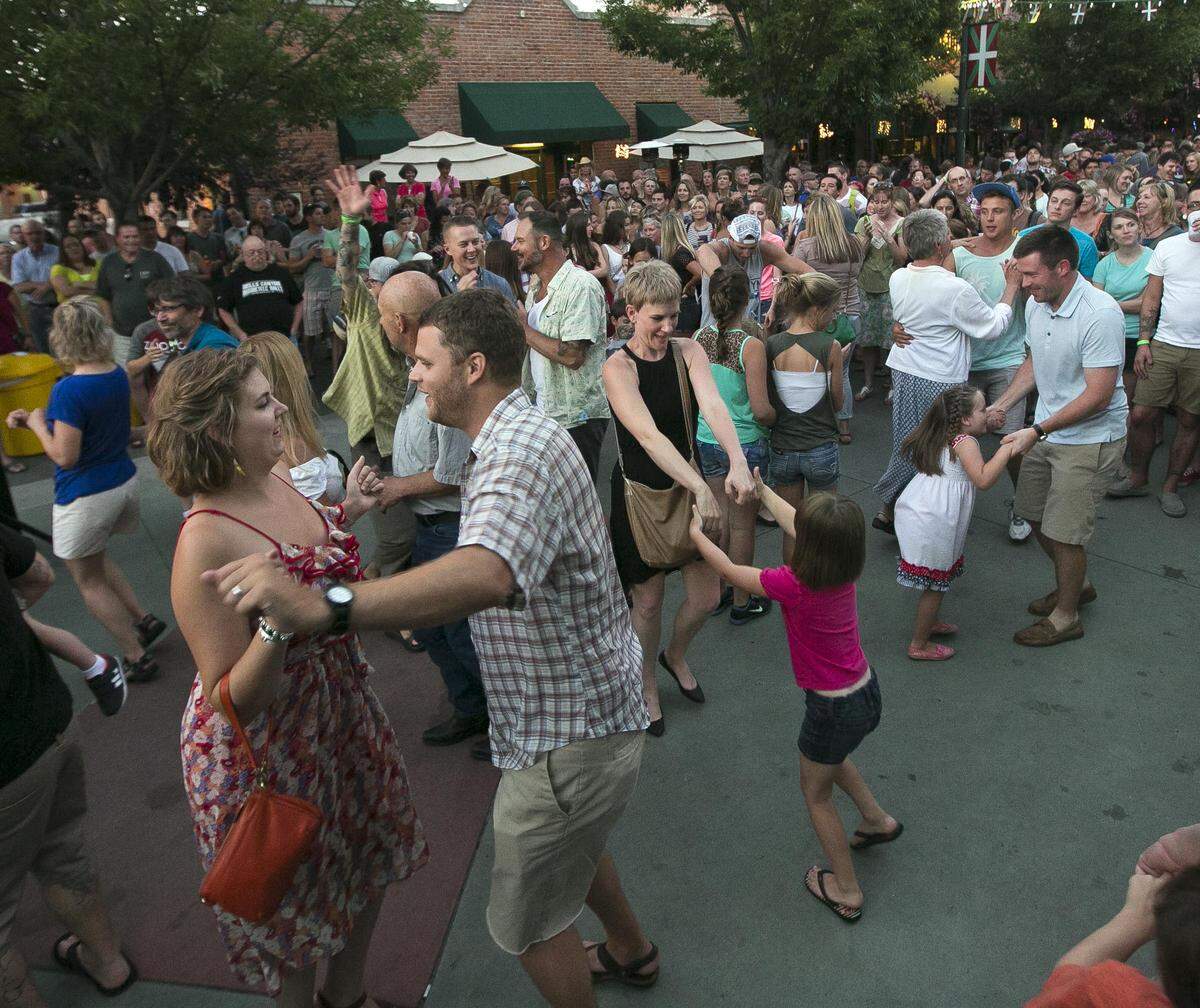
Planners recommend the street be be made into a “festival street” so it can take on some of the event activity from the Basque Block. It would have hardware and electrical connections that could be used to add temporary overhead lighting, coverings, art, a stage and pop-up event area.
“We heard from folks that use the Basque Block, including folks on the Basque Block, that it’s a little tight in there,” Gallagher said. “We’re growing, and it’s a popular place to have events.”
Planners are also considering bike lanes, different types of street parking and loading areas.
Tree canopy controversy
The large Norway maples on Grove Street became a lengthy discussion point at the work session. While some will be retained, planners worried that leaving the trees across from the C.W. Moore Park in place would mean the two sides of the street would have mismatched elements.
City Council members said shade was more important than symmetry. Mayor Lauren McLean didn’t want to see the blocks become a “barren cement-scape” like Broad Street that makes people want to “run into a store because it’s so hot.”
“It’s terribly hot in that part of the city,” Council Member Lisa Sanchez, who once lived on Grove Street, agreed. “Anything we can do to preserve any sort of coolness would be great, especially for the folks that call that area home.”
Once the City Council returns from its recess, it plans to resume Grove Street discussions. Project members will unveil the final design to City Council this month and hope to begin construction by spring.
The city’s project budget is $5.3 million including all design, permit, utility and construction costs. The Capital City Development Corporation has dedicated an additional $10 million.
Sally Krutzig covers Treasure Valley growth and development. Have a story suggestion or a question? Email Krutzig at skrutzig@idahostatesman.com.
This story was originally published August 8, 2021 at 4:00 AM.
CORRECTION: Ken Howell of Parklane Management Company owns property on Grove Street, not Ken Howell of Hawley Troxell.