Eagle is evolving fast. What’s changing (and what it’ll cost if you want to live there)
Take a spin through Eagle and it’s easy enough to see a changing city.
Fresh, new homes dot neighborhoods, while empty dirt and sand-filled lots promise more incoming growth in town. But even more development is slated for farmland and open space in the western and northern sides of the city.
It’s only the more obvious if you take a gander at the agendas of the Eagle City Council, Design Review Board and Planning and Zoning Commission — which are filled with proposed subdivisions close to town, in neighborhoods and on the edges of the city.
Since April, the City Council has discussed, approved or heard changes to over a dozen subdivisions working their way through the city’s entitlement process, which allows owners to develop property. These don’t include the planned communities of Avimor and Valnova, which would bring over 15,800 homes when complete.
Construction has yet to begin on many of the possible subdivisions, but according to Mike Williams, deputy planning and zoning administrator for the city, there were already 14 approved subdivisions that builders had started work on in early May — including Avimor and Valnova to the northeast and northwest.
Williams said about 230 single-family attached and detached houses were in the pipeline in early May. Detached houses stand alone, while attached homes include duplexes, triplexes and town houses.
Some of the subdivisions Eagle City Council has heard since the beginning of April include:
The 34-home, 172-acre Rocking A Ranch from Boise’s Alscott Real Estate, which Joe Albertson cofounded in 1976. His grandson, former NASCAR driver Brian Scott, is now the company’s vice-president of real estate.
The 52-home, 33-acre Farmstead Landing from James Hunter and his company Boise Hunter Homes.
The 69-home, 35-acre Carp Ranch from Gemshore Eagle RE, whose ownership could not immediately be determined.
The 74-home, 39-acre Kingswood from Boise developer Todd Campbell’s TBC Land Holding.
The 94-home, 31-acre Flats Sixteen from Spokane’s Jordan Tampien, Highway 16 Spokane and Star Chelan.
The 301-home, 170-acre Terra View South from Wyoming-based TV44.
Terra View’s 3 subdivisions
When finished, the entire Terra View subdivision — on the northeastern corner of Highway 16 and Beacon Light Road — would fill 287 acres and include space for 722 homes, according to its website. For comparison, that’s about 0.04 square miles bigger than the city of Melba in southern Canyon County.
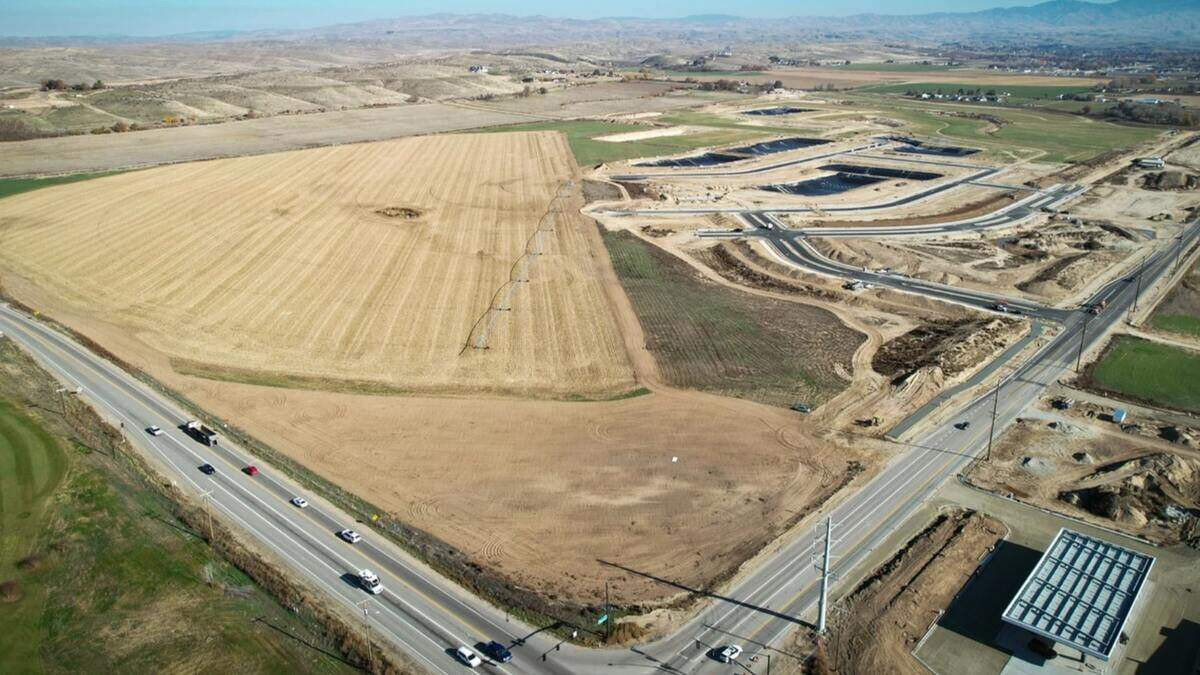
The northern portion of Terra View is already under construction with plans for 392 homes, said David Sterling, project manager with engineering firm Ardurra.
There’s also the Terra View Commercial Subdivision, which includes larger lots along Highway 16 and Beacon Light Road, Sterling said. That subdivision includes 192 apartments.
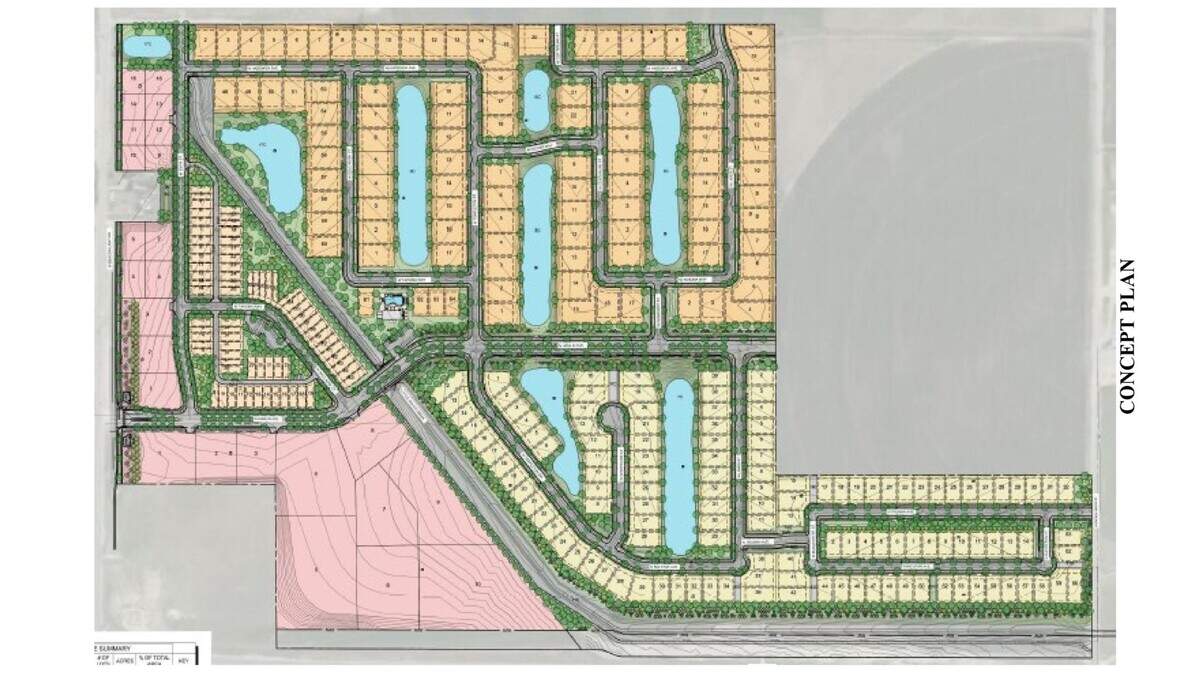
The 301-home Terra View South subdivision, which is cornfields now, would be developed over nine phases, Sterling said during a City Council meeting Tuesday, where he asked for approval to annex 80 acres for the project. Construction on the first phase would start in the middle of the site with a clubhouse, and the developer would build commercial businesses concurrently with the homes.
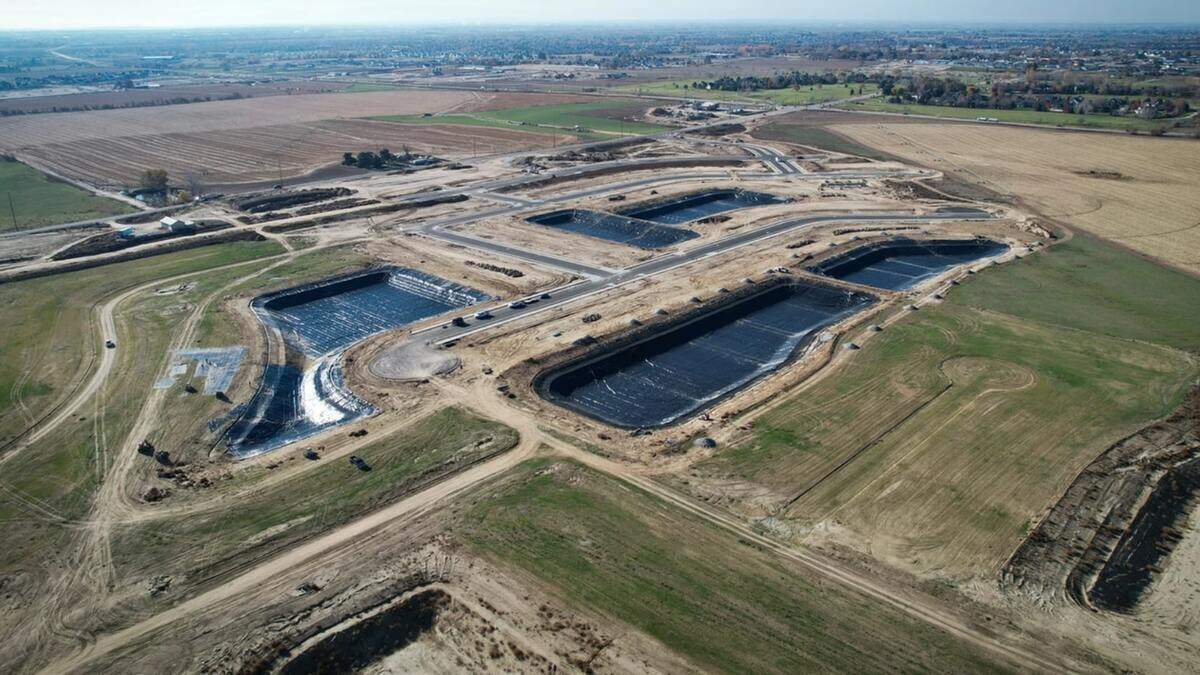
The proposed construction timeline for Terra View South stretches until 2030, with two potential commercial phases running until between 2028 and 2035, according to an Eagle staff report.
Terra View South is surrounded by other incoming subdivisions, including the 316-home Millstone, the recently approved 613-home Torrente Secco and 231-home Arvory Crest subdivisions, Sterling said.
“Our project kind of blends in with those,” Sterling said.
The Eagle City Council asked TV44 and Sterling to redesign some parts of the site plan Tuesday to increase the buffer between some homes and a road and to make space for an active area such as basketball or pickleball courts.
Western Eagle closes in on Star
Terra View and the surrounding developments fall in the western portion of Eagle, growing closer and closer to Star.
Most of the land in that area is already spoken for — it just depends on when developers want to pull the trigger and build on it, said Eagle Mayor Brad Pike.
“It’s all based on the economy, on developers and how they want to use the land they purchased,” Pike said by phone.
But he said that the area, which is mostly rural farmland, wouldn’t become a “wall of homes,” because the city requires all subdivisions to contain 20% open space.
“We’re very conscientious about open space,” Pike said.
A southern subdivision
The Eagle Planning and Zoning Commission spent nearly three hours Tuesday discussing a new subdivision on the southern end of Eagle, south of Idaho 44 and east of the Two Rivers neighborhood, called Wildernest River.
The commission recommended approval of the 108-home, 88-acre subdivision with conditions for Boise’s KM Engineering firm, which is working on the project, to come back with a modified site plan after numerous residents voiced concern over lot sizes, setbacks, roads and emergency access
The subdivision would transform the area directly north of the West Boise Water Renewal Facility and south of the Williamson River Ranch Subdivision on Eagle Island.
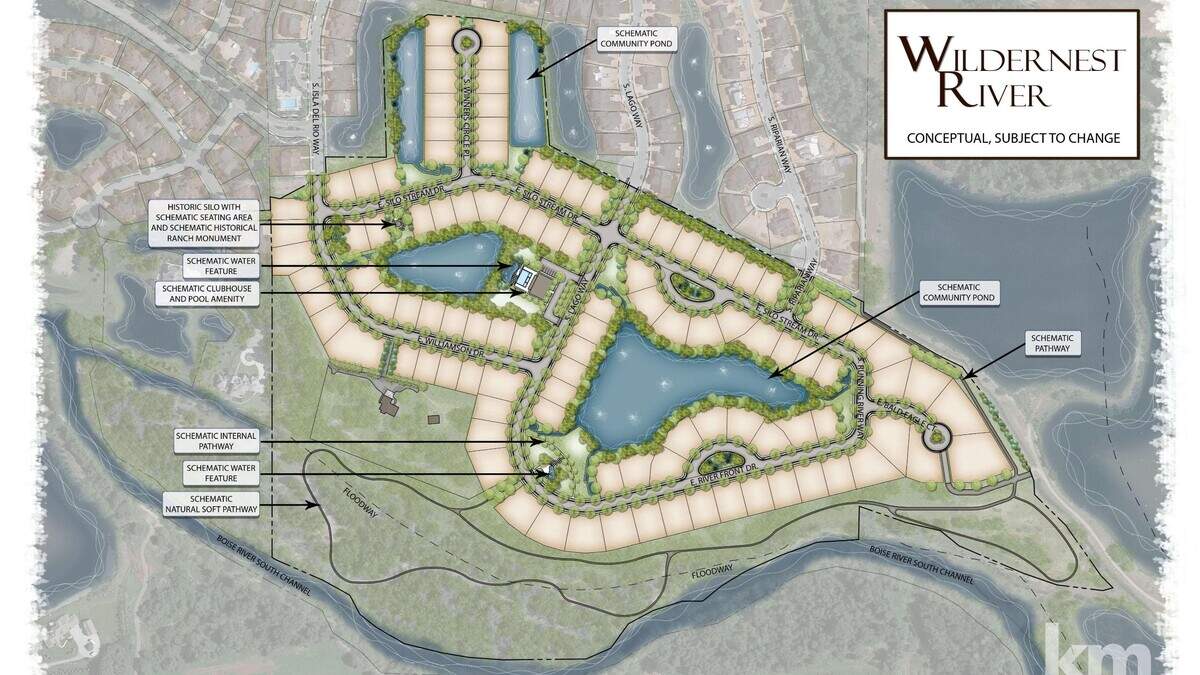
The land is owned by Toby Williamson, whose family has farmed in Eagle for decades. A chunk of the land is on a floodway, with the south channel of the Boise River filling the southern boundary of the property.
The project would support preservation of the floodway while expanding open space areas around natural features, according to a letter from KM Engineering.
“The design of Wildernest River Subdivision (protects open spaces) by clustering single-family residential lots north of the Boise River and out of the floodway and other environmentally sensitive areas,” according to the letter.
The city previously designated the eastern edge of the property as the “head of Eagle Island” and aimed to protect environmental and natural features and wildlife, according to the letter.
“The preservation of approximately 21.52 acres of the overall property along the southern portion of the property and ample open space throughout the development fulfills the intent of the ‘head of Eagle Island,’” according to the letter.
The project would also preserve a historic silo that has been on the property for over a century on the northwestern portion of the site.
Eagle homebuilding slows down
In the decade between 2012 and 2022 — the most recent numbers available — the city grew from just shy of 20,000 residents to nearly 31,000 residents, according to U.S. Census Bureau data.
The pandemic supercharged the growth. From 2019 to 2024, the city gained over 6,000 residents, according to population estimates from the Community Planning Association of Southwest Idaho.
But building permits are slowing.
“(Developers) are still putting applications and permits in,” Pike said by phone. “(But) they’re kind of trickling in now.”
According to Nichoel Baird Spencer, director of long-range planning and projects for Eagle, the city averaged 510 residential permits per year over the nine years from 2015 through 2023.
“The last two years, and it looks like probably in 2024 as well, will be well below that,” Baird Spencer said at an April 29 meeting. “We targeted about 350 permits but we’ve come in at just under 300 the last two years.”
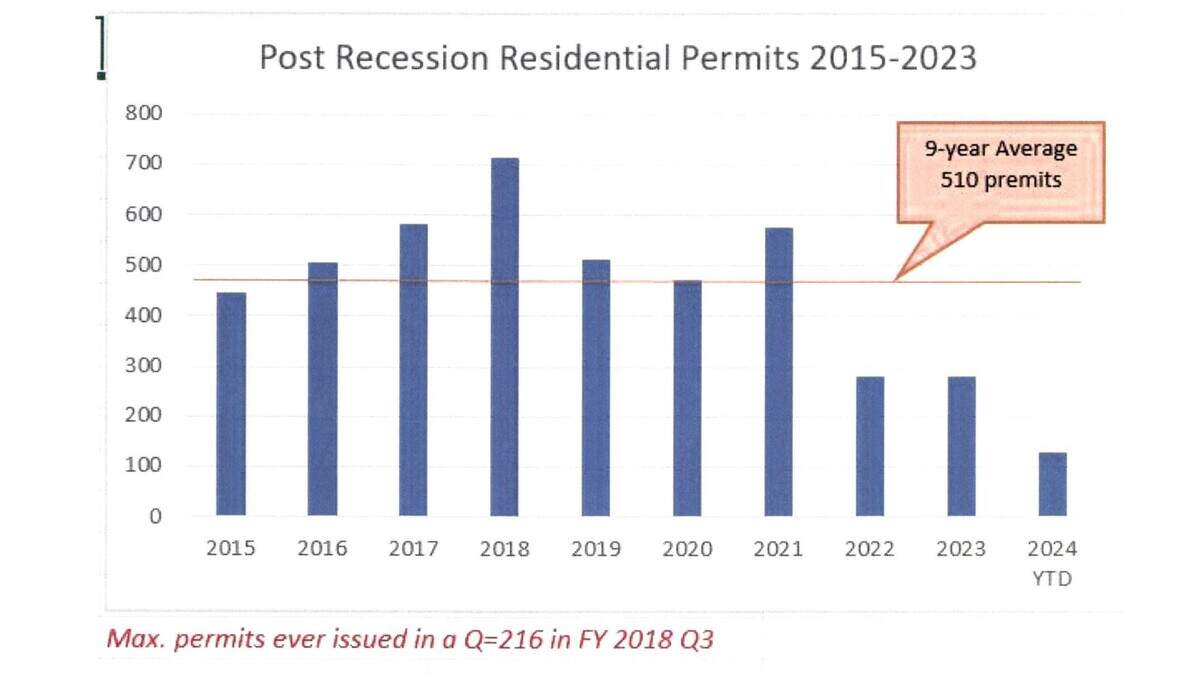
Building permits peaked in 2018 and have decreased every year since except 2021, she said. But the city is on track to hit 350 this year, which she said is a sustainable pace for building permits.
“I know it feels like there’s a lot of growth going on, but building permit-wise we actually are trending downward,” she said.
Baird Spencer and Pike don’t have specific answers as to why building permits have gone down. Baird Spencer said it could be from high interest rates, limited lot availability, and Eagle’s relatively high housing costs.
Much of the work now happening is from projects that are finally coming to fruition, Pike said.
Aside from Avimor and Valnova, there aren’t any massive, 10,000-home subdivisions getting built, Pike said. It’s mostly incremental projects that are breaking through such as the Auberge, or Molinari, subdivision in downtown Eagle.
“I think we’re doing our fair share (of homebuilding), but we’re not going crazy, and we’re not behind,” Pike said. “I think we’re in a good balance right now.”
What it costs to buy a house in Eagle
If you’re looking to buy one of these newly constructed homes, you’ll need to make more than the average income in Ada County.
The median price of a newly built home in Eagle in the first quarter of 2024 was $730,000, and the median price of an existing home was $800,000, according to the Intermountain Multiple Listing Service.
The comparable countywide medians were $560,000 and $505,000.
Only newly built homes in Northeast and Northwest Boise and in Garden City cost more than in Eagle. For existing homes, Eagle takes second place for most expensive in Ada County after Northeast Boise.
According to the most recent numbers available from the U.S. Census Bureau, the average household income in Ada County was $87,774 in 2022.
At that income — if you only spend 30% of your income on housing as recommended — you may be able to purchase a house for roughly $330,000 with a $30,000 down payment and $0 in monthly debts, according to Zillow’s mortgage calculator.
This story was updated June 4, 2024, to include the section titled “A southern subdivision” after the Eagle Planning and Zoning Commission heard public comment on a new 108-home subdivision.
This story was originally published June 2, 2024 at 4:00 AM.