
Housing plans keep stalling on State Street. Can Boise get them back on track?
AI-generated summary reviewed by our newsroom.
- CCDC is offering a $1.7 million land rebate to develop apartments on West State Street
- High construction costs, falling rents are stymying new building in West Boise district
- Long-term plans call for better transit, pedestrian infrastructure along state highway
The construction climate has stymied a streak of housing plans along State Street in Northwest Boise — but the city’s urban renewal agency is banking on investment and one big incentive to flip the headwinds around.
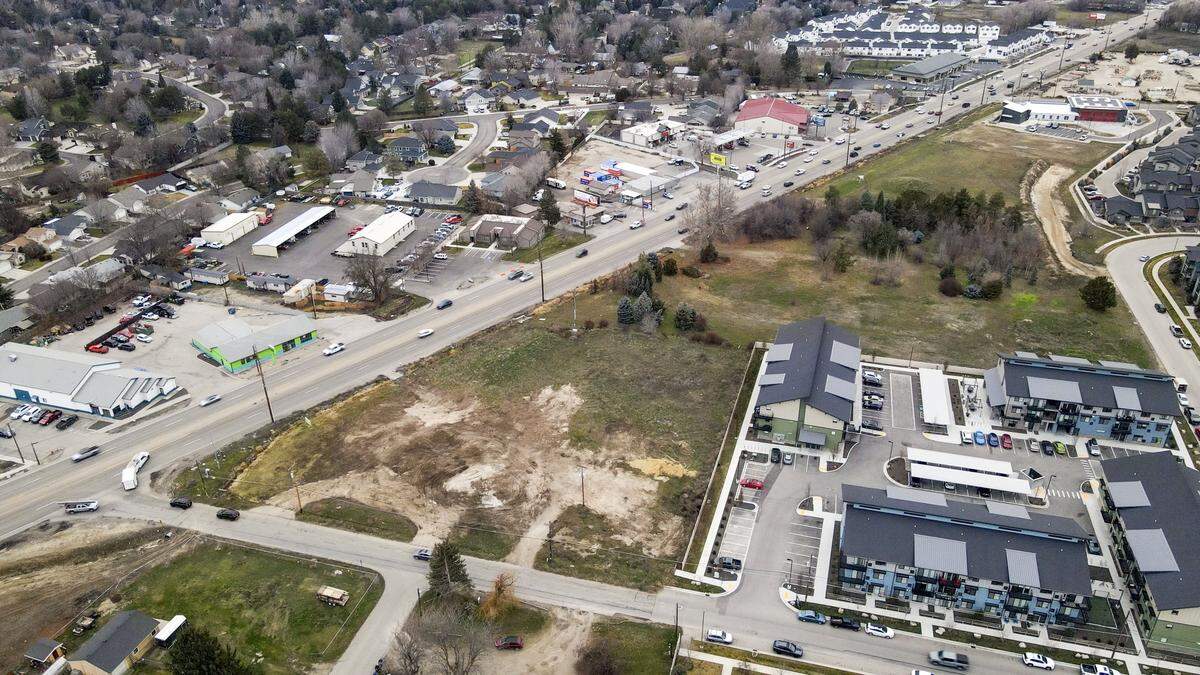
The Capital City Development Corp. is seeking proposals to build an apartment complex at 8306 W. State St., near the border with Garden City. The winning developer would buy the land at its appraised value, build the apartments, and would be refunded the full cost of the land when it’s done —$1.75 million, according to Lana Graybeal, a spokesperson for the agency.
On Jan. 12, CCDC commissioners and planners shaped the request for proposals, which as drafted would require a developer to build at least 70 units on the corner of State and Roe. These apartments would have to be deemed affordable to tenants earning 100% of Boise’s area median income for the life of the State Street Urban Renewal District, which lapses in 2042. For now, that monthly rent translates to $1,905 for an individual earning $76,198 per year and $2,705 for a family of four collectively earning $108,800, per city guidelines.
That’s the baseline. Responses to the request, which staff members expects to publish in March, will be scored on a rubric. Developers can earn extra points for adding apartments — the lot is zoned for up to 120, according to CCDC Project Manager Corrie Brending — or by lowering the rent cap to accommodate people making less than the area median.
“When considering the RFP, what stood out was a desire to challenge the status quo,” Brending told the board. “We see this as a chance to show that State Street can have quality urban design … We’re interested in using this to hear from the development community what they think is possible in this environment.”
Builders sour on State Street prospects
The environment Brending sees is one of rising construction costs and falling rents, a combination hostile to the dense, large-scale housing development CCDC envisions for the State Street district west of downtown.
Conditions have stalled progress on hundreds of homes nearby. Silvercloud 2, which is permitted to bring 120 apartments next door to CCDC’s State Street lot, is yet to break ground. The same is true for/ Westlock Village, which in 2022 was approved for 224 apartments less than a mile up the road.
The property CCDC is now promoting at 8306 W. State was itself a failed apartment project: In April 2025, CCDC bought the land for $1.75 million after a 70-unit apartment building called Limelight 2 languished after the Boise Planning and Zoning Commission approved it, Graybeal said.
For a city pursuing housing supply, today’s conditions are a mixed blessing— better for renters, bad for builders. Brending told the CCDC board that market-rate rents in the State Street district west of downtown are, by city standards, “naturally” affordable for renters earning 60%-80% of Boise’s area median income. That translates to monthly rent between $1,124 and $1,499 for an individual or $1,605 to $2,140 for a family of four, per Boise affordability guidelines.
With that in mind, several commissioners urged CCDC staff to consider lowering the rent ceiling on the apartments. Ultimately, though, applicants will have to see what pencils on the property — and how it scores on the CCDC rubric. The board’s decision on which plan to pursue will likely come in June, Brending said.
Why West State Street?
Economics are a problem for builders on State Street, but so is the street itself. West State is a portion of state Highway 44, maintained by the Idaho Department of Transportation. It’s big — five lanes, not counting shoulders — and it’s busy.
Traffic concerns led Boise officials to require a stoplight spanning State before Westlock Village can be occupied — a condition the developer has yet to negotiate. Earlier this month, Meridian builder Corey Barton’s Challenger Development asked the city to rezone an adjacent plot of land for a planned 292-unit subdivision called Bonnybrook. P&Z recommended the same condition and urged Becky McKay, a representative of Challenger, to work with neighboring Westlock to split the bill.
The new light would go at the intersection of State Street and Ulmer Lane, meaning the developers would have to purchase rights to land in both Boise and Garden City. McKay, who owns Engineering Solutions in Meridian, questioned how a condition could require applicants to work on property they don’t own to get that done.
“To put the burden my client — I’ve never experienced this in 35 years,” she said. “To me, that’s over the top, when we’re trying to build quality, diverse housing for the city of Boise. I’m dead in the water. I can’t do anything. They may sit there for 20 years – I don’t know.”
But traffic is the chief reason why development patterns on State Street needs to change, according to CCDC, and why the city has earmarked it as a priority for public transit.
“[T]he road cannot be widened enough to keep pace with that growth in predominantly single-occupant vehicle travel,” CCDC states on its website for the State Street Urban Renewal District. “A significant investment in and shift to public transit is essential to maintain traffic flow and quality of life along State Street.”
That investment has yet to bear fruit, according to Boise City Councilman and CCDC Commissioner Jimmy Hallyburton.
“We keep putting in all these large multifamily developments — as we should, it makes a lot of sense,” Hallyburton said. “But at what point is the infrastructure going to catch up?”
Not yet, according to CCDC Commissioner Drew Alexander, who said that the corporation’s lot is “on an island,” cut off by busy thoroughfares.
Long-term, Boise’s comprehensive plan envisions this portion of West State as “activity center,” in Hallyburton’s words. The idea calls for a dense mix of apartments and storefronts along a “best-in-class transit corridor,” according to CCDC.
For now “we have a state highway that looks like a state highway,” Hallyburton said.
What’s next?
“The State Street Urban Renewal plan is part of a broad community vision to transform this major east-west route into a more walkable, mixed-use corridor with housing, better transit options, and needed public improvements,” Graybeal said, “things the market alone hasn’t delivered on its own.”
Some plans to that effect are in the pipeline. A multi-agency consortium is working on covering a portion of the Boise Valley Canal to build a multi-use pathway along State Street, Graybeal said. The project, which would connect homes to current and future public transit stops, is expected to begin in fall 2027, she said.
“CCDC’s work in the State Street Urban Renewal District is about supporting long-term revitalization of the corridor, not just individual sites,” Graybeal said. “Urban renewal helps address infrastructure gaps, encourage redevelopment of underused or deteriorated properties, and make the area more attractive and viable for private investment over time. By aligning public improvements with future development, CCDC aims to create conditions that make projects more likely to succeed rather than just adding more activity without support.”
This story was originally published January 26, 2026 at 4:00 AM with the headline "Housing plans keep stalling on State Street. Can Boise get them back on track?."