Idaho’s female wrestlers deserve a fair shot. It’s time for the IHSAA to recognize that.
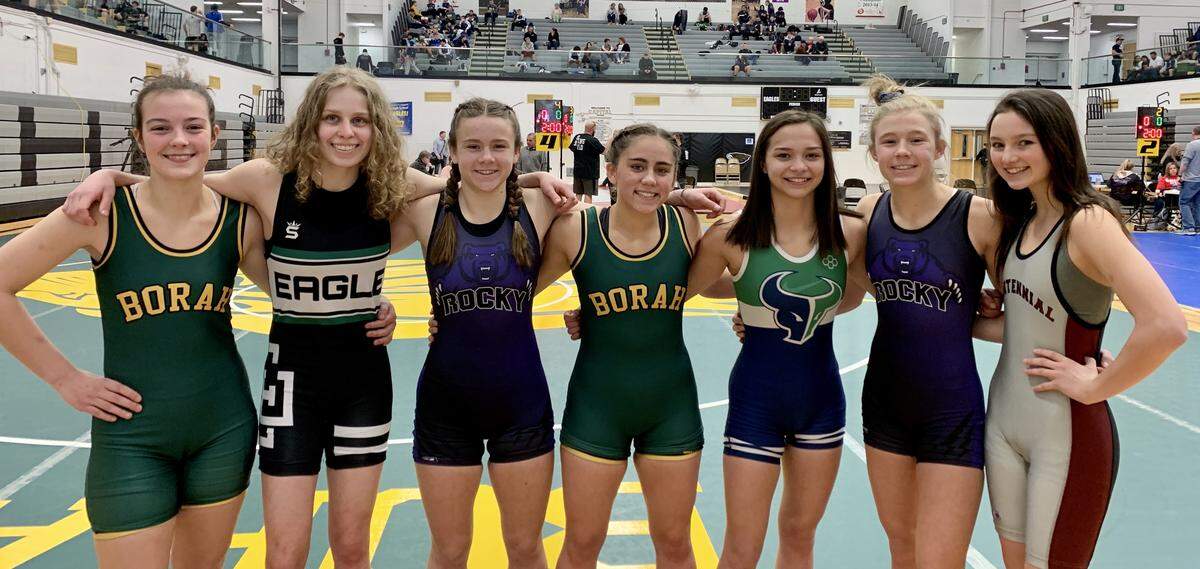
A record 13 girls qualified for Idaho’s high school wrestling state championships this weekend.
Those girls, their families and their schools should celebrate the accomplishment. Those pioneering young women cleared a host of hurdles to make it to the Ford Idaho Center and compete for a state championship.
But they shouldn’t need to.
Idaho has dragged its feet for years on sponsoring a separate state tournament for girls wrestling, a sport that has exploded across the country and has official support from 22 states and nearly every one of Idaho’s neighbors.
The message is clear: Idaho’s girls don’t deserve the same opportunities as its boys. And that message gets harder to defend, and even harder to refute, each passing day.
Annie Foster, the women’s director for the Idaho USA Wrestling club, travels the state building the sport from the youth level, and she hears the same heartbreaking questions from young girls over and over again.
The girls do everything the boys do. They attend every practice, just like the boys. They lift weights, just like the boys. They represent their school with pride, just like the boys. They manage their weight, keep their grades up and raise money for the program, just like the boys.
Yet they get left out in the cold at the end of the season.
“What they get upset about is they’re not getting treated the same,” Foster said. “Why can’t they have the same thing as the boys? … How come they’re not important enough?”
Girls can qualify for the Idaho state tournament, as this year’s crop of 13 proves. But they must navigate a road Idaho doesn’t require any other female athlete to travel.
Idaho doesn’t ask any female sprinter to beat a boy in a 100-meter race. It doesn’t ask any female swimmer to line up next to a boy in the pool. And it doesn’t ask any female basketball player to guard a stronger, bigger and more athletic boy.
All 13 of this year’s state qualifiers come in the lower weight divisions, 126 pounds and down. That’s no coincidence.
“The reality is other than a lighter girl, where the physical differences aren’t as great — meaning strength — it gets harder and harder for girls to be able to qualify for the state tournament at those upper weights,” Columbia coach Todd Cady said.
Idaho’s lawmakers have twisted that same argument for their conservative cause of the month — banning transgender females from competing against girls. Lawmakers justify it as preserving athletic opportunities for young women. It would be unfair for a girl to compete against someone born as a boy, they say.
Of course, that has never happened in Idaho. And they’ve yet to make a single peep about the scores of high school girls required to face boys on the wrestling mat every year.
The drumbeat for a girls state tournament officially started three years ago. The Idaho High School Activities Association balked at the time, asking schools to grow the sport from the bottom up and not the top down.
That’s a fair ask, and a consistent stance from the IHSAA. But the sport has met that ask and then some. Forty girls wrestled in 2017. Approximately 200 did this year, a five-fold increase in just three seasons. (Final numbers won’t be available until after the season.)
That growth puts the IHSAA behind its peers. Fifteen states have added or voted to add a girls wrestling state tournament in the past two years. And 11 of those 15 did it with fewer than 200 female wrestlers at the time.
Frustrated by the IHSAA’s pace, Pocatello coach JB Plato and Aberdeen coach Jordan Johns took it upon themselves to prove Idaho can support a girls state tournament. They started an unofficial state championship last year with 52 wrestlers. It nearly doubled to 103 two weeks ago.
The difference between an official and unofficial state tournament may exist only on paper. But that recognition matters, and it will only flame the fire of a growing sport — as every other state that has taken the step has learned.
Take Missouri for example. It had 176 girls in its weight management program in 2018. After state sanctioning, that number ballooned to 976 a year later, a 451 percent increase.
“If you build it, they will come,” Foster said.
Ty Jones, executive director of the IHSAA, said his organization has noticed the growth in Idaho. It sent out a survey to the state’s coaches, athletic directors, principals and superintendents in January asking their level of support for girls wrestling.
The results of that survey won’t be final until the activities association’s April 8 board meeting. But Jones said about 80 percent of the initial responses favored sanctioning it as a separate sport and 90 percent favored a separate state tournament.
Jones cautioned fully sanctioning would mean all girls must wrestle girls, and schools would need to support the program with the same number of meets or tournaments as their boys team, a tall task in the state’s rural areas.
That distinction remains a sticky issue, one that would lead to more costs as schools hire more coaches and travel more miles.
“There are a lot of other questions that need to be answered,” Jones said. “But it’s definitely not a five-to-10-year process anymore. We’re down to a year or two — potentially. And I will say potentially.”
That potentially should turn into a certainty. The 13 girls battling at this week’s state tournament should be the last group to navigate Idaho’s unjust landscape.
When the IHSAA board meets in April, it should remember the nonprofit’s mission statement: “... to coordinate, supervise, and direct interscholastic activities which enhance and protect the total educational process of all student participants.”
All doesn’t mean some. All doesn’t mean just the boys.
All means all.