Blue turf provided ‘limelight.’ Boise State created dynamic home-field edge
Editor’s note: This is the final story of three in a series marking the 40th anniversary of Boise State’s trademark blue turf.
At the southwest corner of Boise State’s Albertsons Stadium, the Allen Noble Hall of Fame welcomes fans from near and far to walk through 5,400 square feet of championship trophies, sports memorabilia and stories of the athletic programs’ most important figures down the years.
However, if you make your way past the cabinets of silverware, it’s what’s at the back of the Hall of Fame that keeps people filing through the doors. Looking out of wall-to-wall, floor-to-ceiling windows, you see what some college football fans call the “Smurf Turf” and others the “Bronco Bluegrass.”
To Boise State fans, it’s simply called The Blue.
Over 21,000 names per year from every state in the union are scrawled inside the visitors book at Boise State’s Hall of Fame, all to step beyond those glass doors and to stand right on the edge of a blue field that’s become a one-of-a-kind symbol in sports over the past four decades.
“It makes Boise State unique,” legendary quarterback Kellen Moore, now the head coach of the New Orleans Saints, told the Idaho Statesman in an interview. “It gives something that everyone can rally around and really embrace together.”
Moore is one of the stars who’s had the chance to call The Blue their home since it debuted in 1986. And he never lost there, going 25-0 at home as starting quarterback from 2008 to 2011. And he’ll become a part of the field’s lore this summer when Boise State replaces the turf ahead of the program’s move to the Pac-12 Conference.
Boise State will paint the 11-yard hash mark orange to honor Moore, who wore that number while going an astonishing 50-3 with the program in four years. Former running back Ashton Jeanty will join him, as the 2-yard hash mark for his jersey number will also be painted orange, thereby recognizing the Broncos’ only two Heisman Trophy finalists.
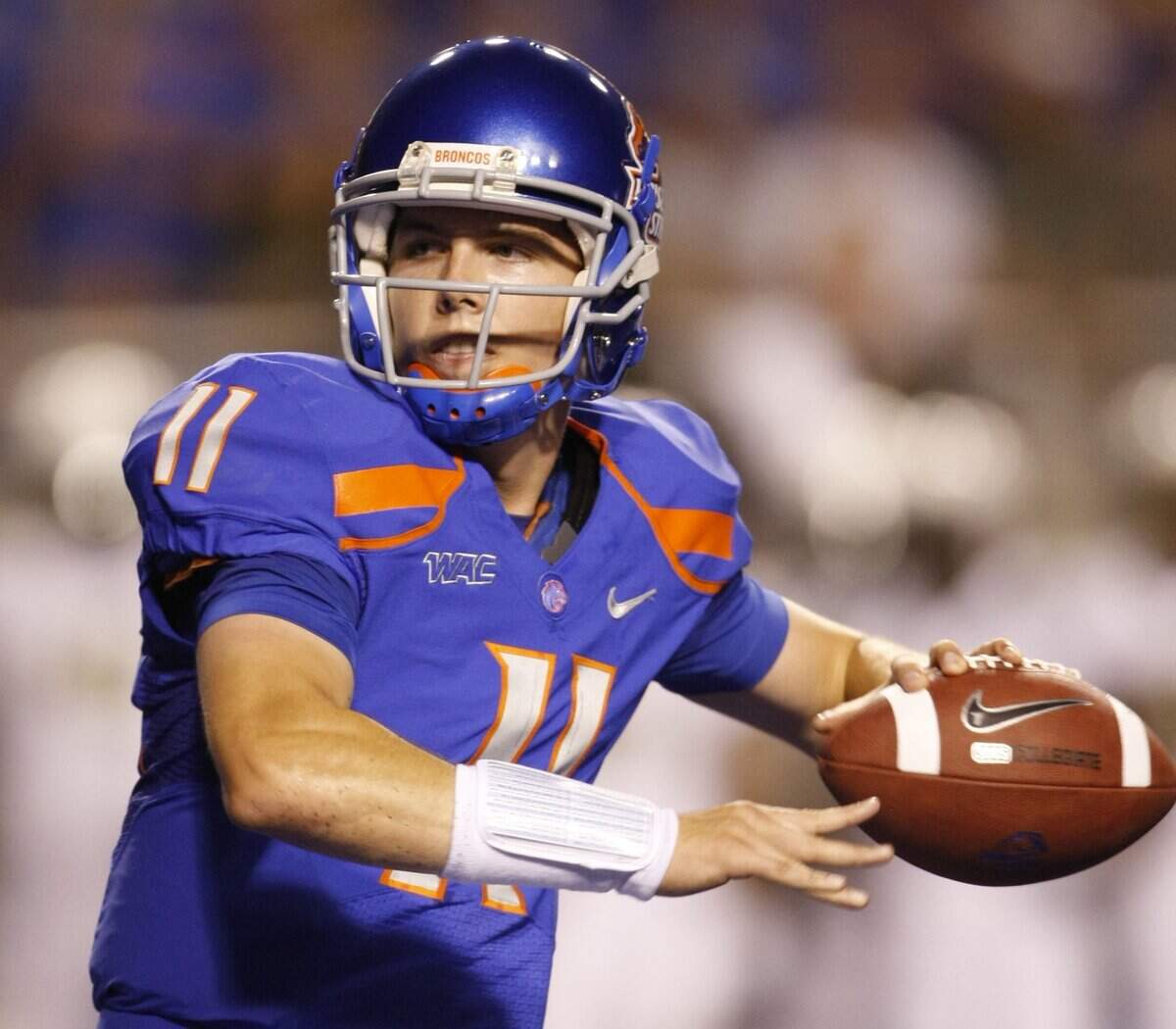
“I’m just representing an era of Boise State football, of a bunch of guys who helped build something really special,” Moore said.
The field understandably holds a special place in Moore’s heart, but he’s far from the only one to harbor such feelings for a patch of blue turf.
And quite naturally, others aren’t quite as fond of Boise State’s “gimmicky” field — including opposing coaches and players over the years.
As The Blue enters its 40th year, here’s what it means to some of those who have had the chance to play on it.
Protecting The Blue, which helped sell Boise State to recruits
Coming out of high school, Ryan Dinwiddie wasn’t short of options. A standout at Elk Grove High School in California, Dinwiddie was courting offers from the likes of UNLV and Hawaii, among other schools.
But there was one school on that list that had something the other schools didn’t have: that blue field.
“The deciding factor for me was that people are gonna be talking about Boise State,” Dinwiddie told the Statesman recently. “Obviously, you want to get in the limelight a little bit as a player nationally. And that was my outlook and why I made the decision.”
Dinwiddie went on to break numerous school records between 2000 and 2003, and led the Broncos to their first road bowl win in the Fort Worth Bowl in his final season. He’s now the head coach and general manager of the Ottawa Redblacks of the Canadian Football League.
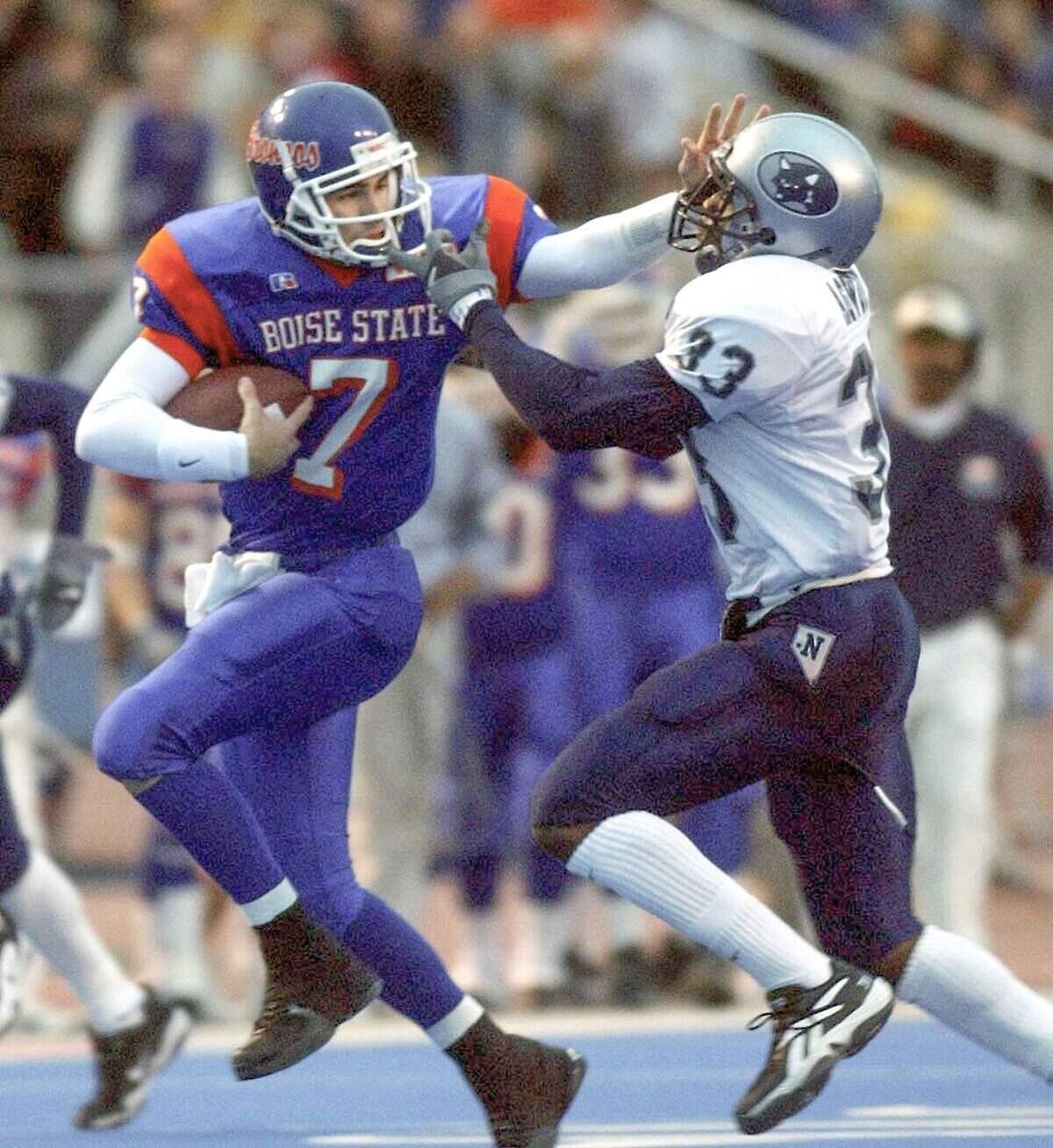
Dinwiddie’s story is not unusual. The Blue has been used as a recruitment tool since Athletic Director Gene Bleymaier and then-President John Keiser first introduced it to the world in 1986. Bleymaier told the Statesman in an interview that even his own coaches weren’t too fond of playing on a blue turf when it was first unveiled, but their opinions changed once they hit the recruiting trail.
“The football coaches came back after a couple of months,” Bleymaier recalled, “and they go, ‘Hey, this is great. The kids know who Boise State is. They’re excited about it.’”
About two decades later, The Blue would play a part in bringing in the player who would rewrite the college football history books.
There were multiple reasons why Moore, a sparsely recruited, undersized quarterback out of Prosser, Washington, chose Boise State. The budding relationship with then-head coach Chris Petersen played a big role, as did the “blue collar” attitude around the program. But having grown up watching Boise State regularly on local television, Moore found it tough to ignore the atmosphere that was building around the program.
“I’d known about (The Blue) for a while, it was catchy,” Moore said. “I think the now-Albertson Stadium atmosphere was catchy, and certainly the field was an important part of that.”
Between the efforts of Petersen, Dinwiddie, Moore, Jeanty and countless others down the years, Boise State’s blue turf has become more than a simple attraction. Since 2000, Boise State has gone 153-19 at home, and the program’s home winning percentage in that span, 89%, is only narrowly beaten out by Ohio State (89.1%).
Such a level of success at home has sparked the motto “Protect The Blue” in recent years. It’s a rallying cry among the team and the fans, who regularly pack Albertsons Stadium with sellouts.
“This is everything for us. I mean, just being here, just knowing the culture, just everything about Boise is just we have to ‘Protect The Blue,’” former Boise State cornerback A’Marion McCoy told the Statesman last October. “At the end of day, this is the most important thing to us. This is our home.”
A competitive advantage in Boise?
Flipping open the newspaper back in 2002, Chris Petersen did what all self-respecting football coaches would do — head straight to the sports section.
The future College Football Hall of Famer had just finished his first season as offensive coordinator at Boise State. His players were covered from head to toe with rashes and burns after a season of playing on a field that Petersen not only thought was a little “gimmicky,” but also felt like playing on a “cheese grater.”
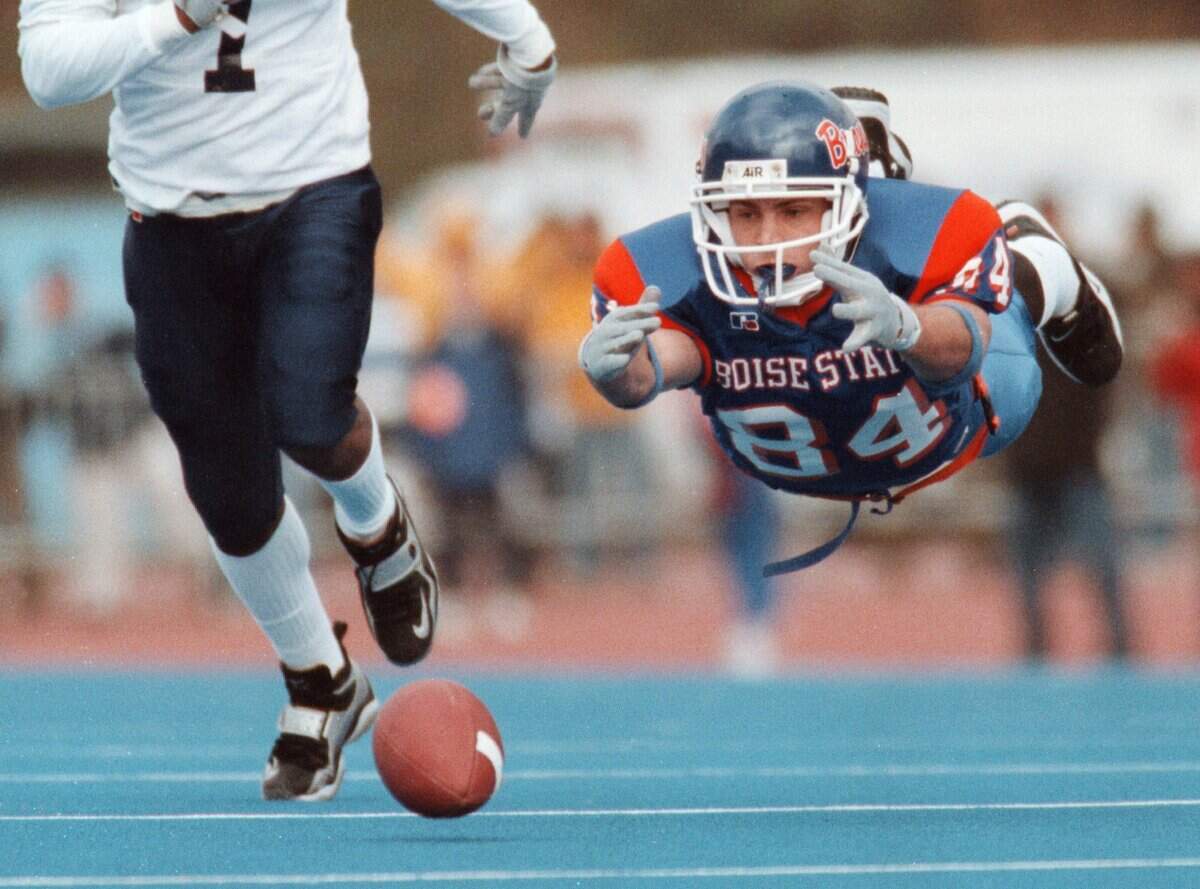
It had been seven years since Boise State replaced the blue turf, and Petersen was thinking it might be time to head back to green. But then he saw a poll in the Statesman — about 95% of fans wanted to keep the turf blue.
“Right, OK. That’s not even an option,” Petersen thought to himself at the time.
“So I never thought about it again during my career,” he told the Statesman.
After spending 13 years with Boise State, the latter eight as head coach, Petersen fully understood the importance of The Blue — and it helped, of course, that the turf’s quality improved over time.
But not everyone came to appreciate, like or even accept the blue turf.
“I think they ought to get rid of that blue turf. I think it’s unfair,” former San Diego State and New Mexico head coach Rocky Long said in 2011.
“People think I’m crazy when I say this, but it takes a visiting team awhile — maybe a quarter or so to get used to it. You track the ball differently and everything else.”
Is that true? Likely not, according to Moore and Dinwiddie.
Dinwiddie was initially concerned about how the turf might affect his depth perception, but ultimately said it was a non-issue. Moore expanded on that, saying that although it looks like just so much blue on TV, when you stand on the field and look out over it, the Boise State players in blue do not blend in the way people claim.
“I heard from opponents that they felt like our uniforms blended in with the field, they thought that was a competitive advantage for us,” Dinwiddie said. “I don’t know if there’s anything into that, but I think just that being in their heads, it was a competitive advantage.”
On at least one occasion, an opposing team painted its practice field blue ahead of a game in Boise. It was 2010, and ahead of No. 24 Oregon State’s trip to No. 3 Boise State, the Beavers used 440 gallons of paint to transform their field. The Broncos made sure it didn’t matter, cruising to a 37-24 win, with Moore throwing three touchdown passes.
“We don’t lose on The Blue,” Bleymaier told the Statesman. “... This is our home, and we’re going to protect The Blue. This is ours, and we’re going to win.”