‘There were the naysayers’: Former Boise State AD never forgets blue turf’s birth
Editor’s note: This is the first in a series of three stories marking the 40th anniversary of Boise State’s trademark blue turf.
Boise State Athletics will replace the turf at Albertsons Stadium this summer as part of the preparations for the switch to the reborn Pac-12 Conference.
The new turf will feature several elements that make Boise State unique, from marking the kickoff at the 35-yard lines with images of the state of Idaho to painting the 2- and 11-yard lines orange in honor of program legends Ashton Jeanty and Kellen Moore.
Of course, the old Mountain West Conference logos will be replaced, too.
But there’s one thing that’s not changing, and likely never will change:
The color.
The Blue.
For 40 years, Boise State and its blue football field have become synonymous with one another. It’s tough to mention one without the other.
From the first televised Humanitarian Bowl in 1997 to Boise State’s most recent Mountain West title victory on national television, The Blue has become one of college football’s most iconic symbols.
But for a short while, people thought the idea was, well, ridiculous.
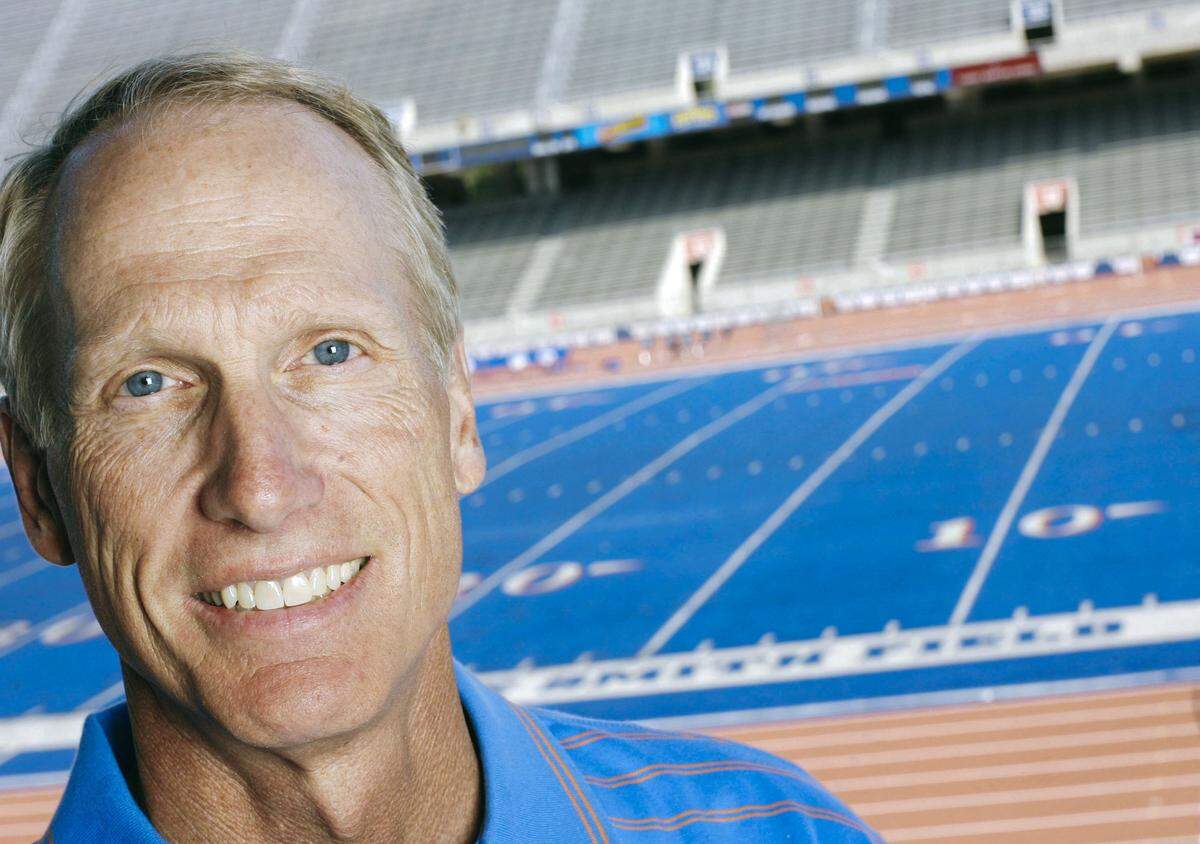
“I knew it was a wild idea, and one that would probably be laughed at and mocked,” Gene Bleymaier, former Boise State athletic director and blue-turf visionary, told the Idaho Statesman in a recent interview.
But that didn’t stop him. Here’s how a decision made over four decades ago has helped the university in Idaho’s capital city build one of the most recognizable brands in college sports.
‘We can’t tell anybody about this’
Every sports fan has done it before. Cruising thousands of feet above the ground, peering out of the airplane window at the world below, and pinpointing all of the green football, baseball and soccer fields sprawled below.
That was the position Bleymaier was in when he first had the idea for the blue turf.
The calendar had just ticked over to 1986, and Bleymaier was jetting off to a Big Sky Conference meeting. It had been about 15 years since the green turf at then- Bronco Stadium was installed, and despite it having been resurfaced a couple of times since then, it was in dire need of replacement.
As those plain green fields flashed by far below, the thought hit Bleymaier: There’s absolutely no reason why the turf needs to be green.
“People know it’s not grass, it’s artificial turf,” Bleymaier reasoned. “And so why don’t we do something different? Why don’t we do it in our school colors instead?”
Bleymaier was well aware of the approximate $1 million cost — about $3 million in today’s money — to replace the turf. But this wasn’t a money decision. He simply thought it was a fun idea and a way to garner some press around a program that, at the time, was in Division I-AA — the modern-day Football Championship Subdivision.
Upon his return to Boise — and after building up the courage to ask — Bleymaier approached Boise State President John Keiser with the idea. Knowing how outlandish the suggestion of a blue turf was, Bleymaier didn’t want an immediate answer. He simply asked Keiser to chew on the thought and get back to him in a few days.
Keiser returned with the “yes” he was hoping for, and Bleymaier gives much of the credit for implementing the blue field to the former school president, who passed away in 2016. He was president at BSU from 1978 to 1991.
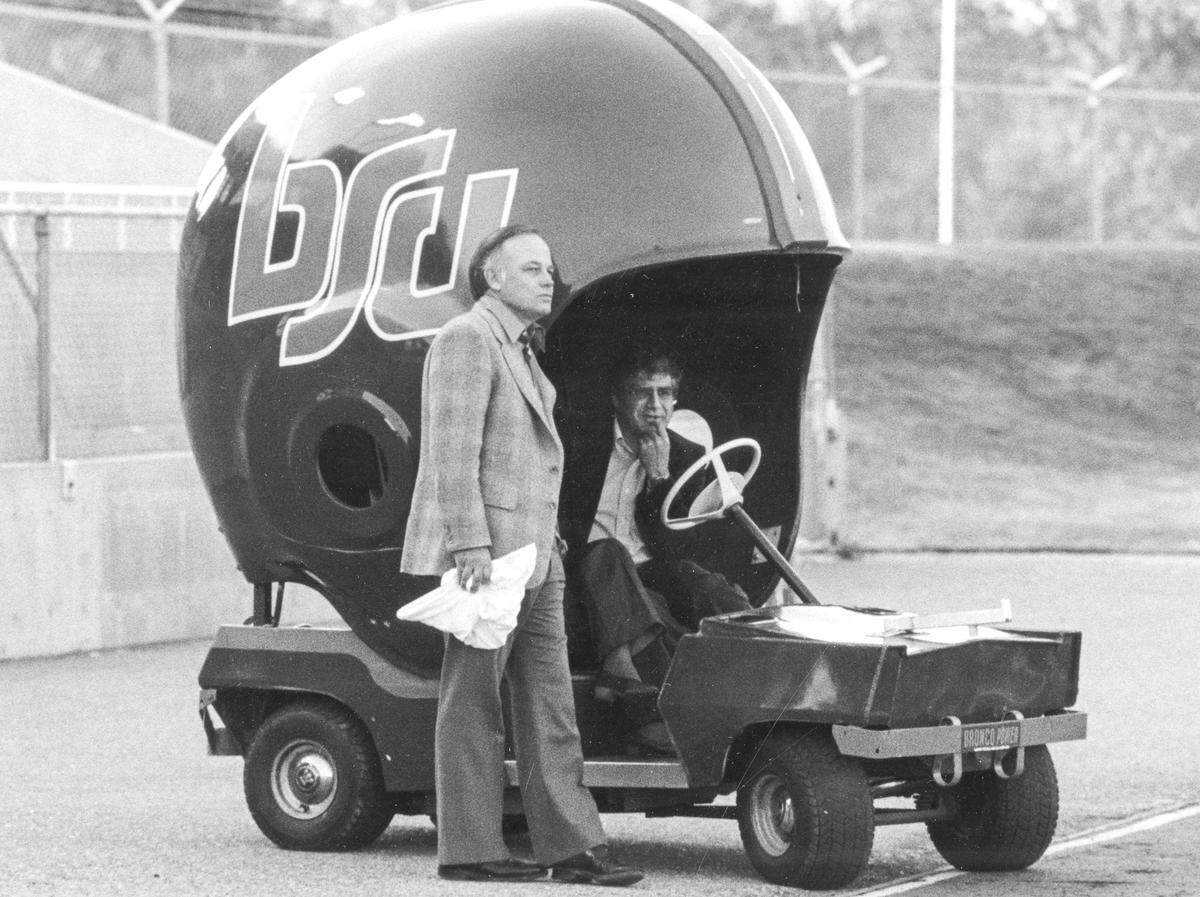
“Doc, now you understand, we can’t tell anybody about this, because if the word got out we were thinking about doing this, it would get blown out of the water,” Bleymaier told Keiser at the time. “People would criticize it, there’d be naysayers, and people would just come up against it.”
The pair immediately went to work in January 1986 to tie down a contractor willing to install blue turf. Their first call was to AstroTurf, the Atlanta-based company that had quickly vaulted itself into the limelight with stadium contracts across the country.
Even AstroTurf was hesitant at first, because it had never created a turf outside of classic green. The company quickly folded when Bleymaier and Keiser threatened to work with another outfit, but even then, much remained up in the air. And key among the questions was how the turf would look when physically in place.
“They were worried about it,” Bleymaier told the Statesman. “They said, we can’t guarantee what this is going to look like, or how it’s going to wear, and even the color with the sunlight.”
Between the concerns over fan reactions and the less-than-optimistic words from AstroTurf, Bleymaier and Keiser decided there was only one real solution: to call a press conference in April announcing the turf would be blue that summer.
No turning back.
“There were a lot of jokes, and there were the naysayers,” Bleymaier recalled once the press conference had taken place. “But this was all speculative because they had never seen it.”
A lasting legacy for blue turf
A couple of months after that press conference, fans finally got their first look at the blue field.
And, well, the jokes didn’t stop.
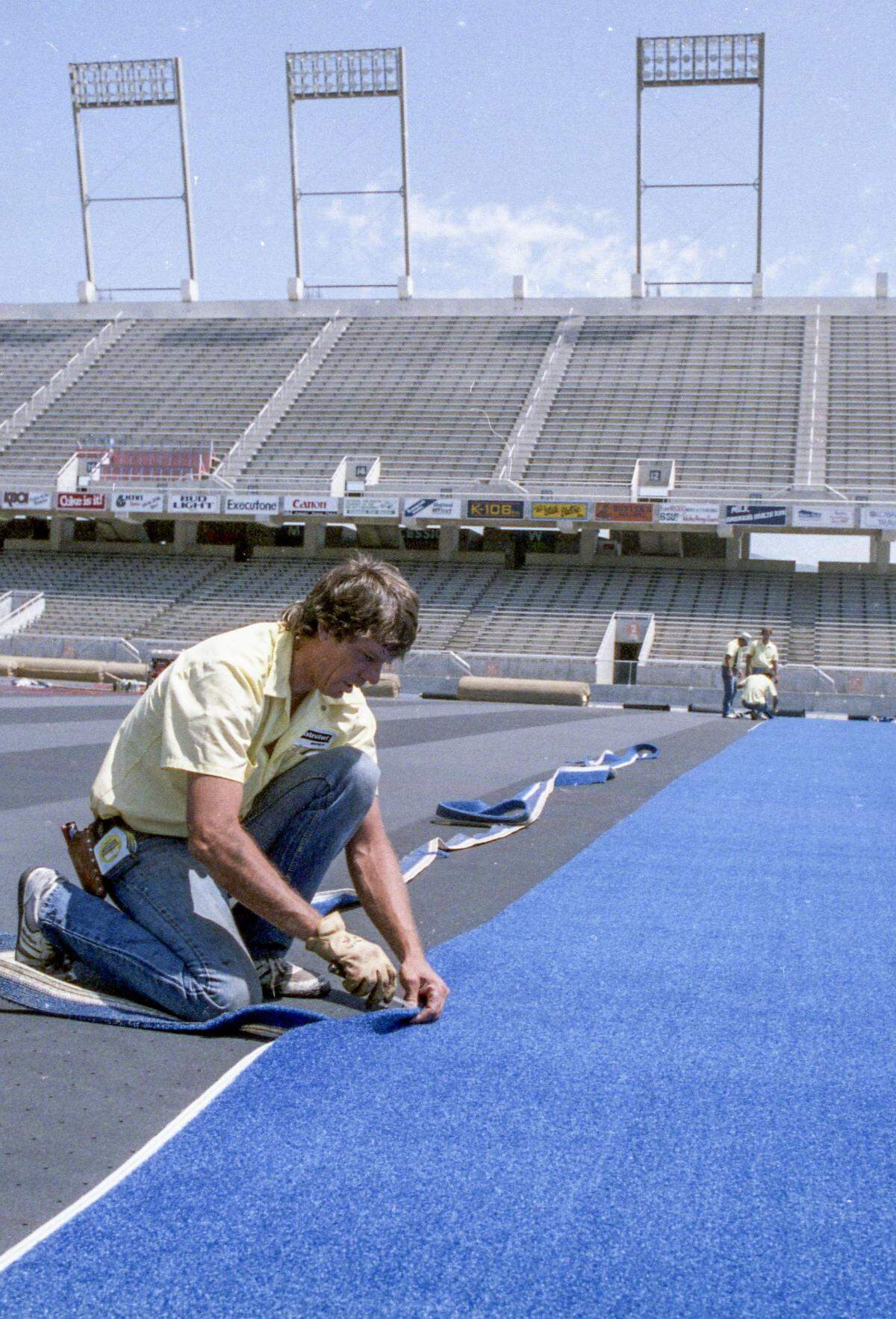
The turf arrived and was installed without any field markings. That meant, for about a week, the inside of Bronco Stadium resembled a deep blue lake. And with that began the decades-long myth that ducks would crash land on the field.
“I can neither confirm nor deny that report,” Bleymaier told the Statesman with a chuckle, although he did say it’s a story that someone made up within the first week.
From the outside looking in, even future head coach Chris Petersen thought the idea of a blue field was “gimmicky,” he told the Statesman. Petersen was a fresh-faced 21-year-old at UC Davis at the time, but would go on to coach at Boise State from 2001 to 2013, with the final eight years as head coach.
Once the hashmarks, Boise State logo and end zone markings found their way onto the field, many of the jokes faded. Especially as success quickly followed the turf’s installation.
Over its first 13 seasons on The Blue, Boise State posted eight winning seasons and qualified for the Division I-AA playoffs on three occasions, including a national runner-up finish in 1994. Since 1999, the Broncos haven’t endured a single losing season.
“The coaches and the players deserve a lot of credit,” Bleymaier said. “Because had we not had a good football team, and we were losing, people would have blamed it on the blue turf, and we would have had to get rid of it.”
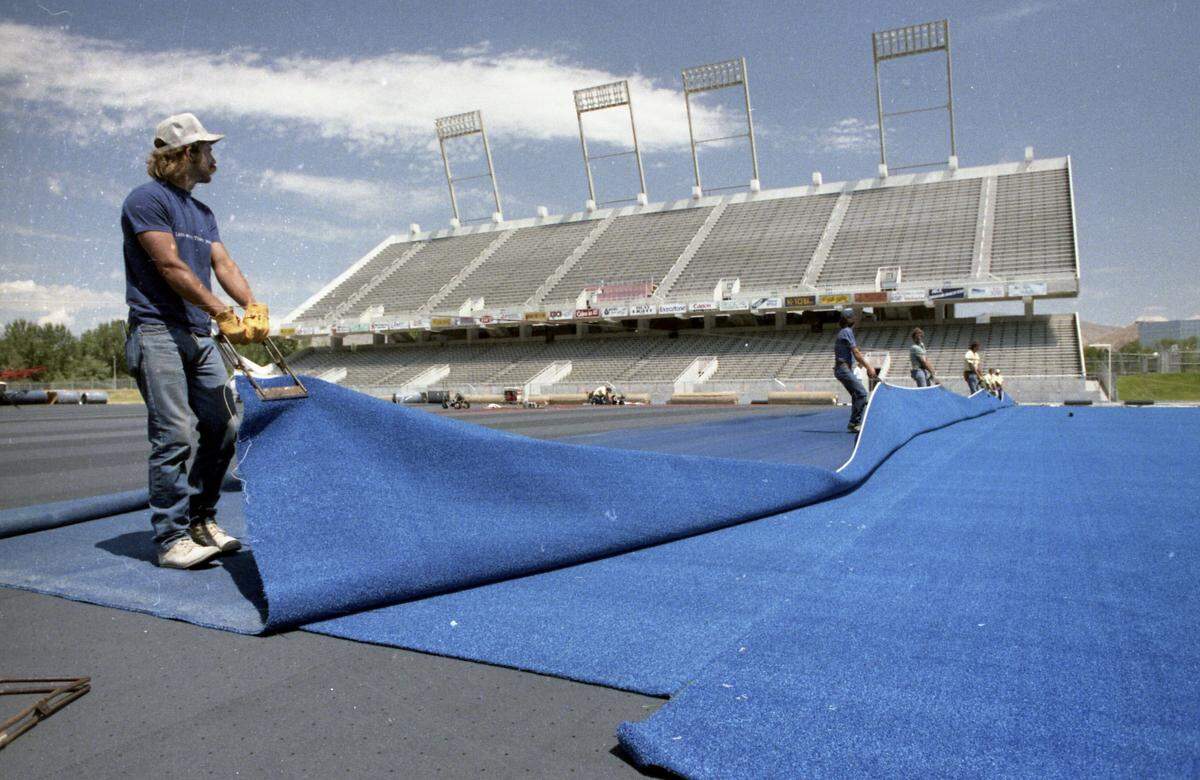
Bleymaier left Boise State in 2011, and he spent six years leading the San Jose State athletic department. But 40 years and six turf replacements later, the blue field remains one of Bleymaier’s most impactful and lasting legacies.
“For years, when I travel and go someplace and be introduced, even to friends and people who have nothing to do with athletics ... they’d say, ‘Where are you from?’” Bleymaier said. “When I’d say I’m from Boise — ‘Oh, Boise, you guys have the blue turf!’ Not even knowing that I was the athletic director.
“That was always fun to hear people comment about it — That they’ve heard about Boise State and that they knew that we were the ones with the blue turf.”
This story was originally published May 25, 2026 at 4:00 AM.
CORRECTION: John Keiser was the president of Boise State University from 1978 to 1991.