He played during Boise State’s golden era. Now this Hall of Famer is back on The Blue
Former Boise State offensive lineman Nate Potter used to joke about returning to his alma mater as a graduate assistant long before his playing career ended.
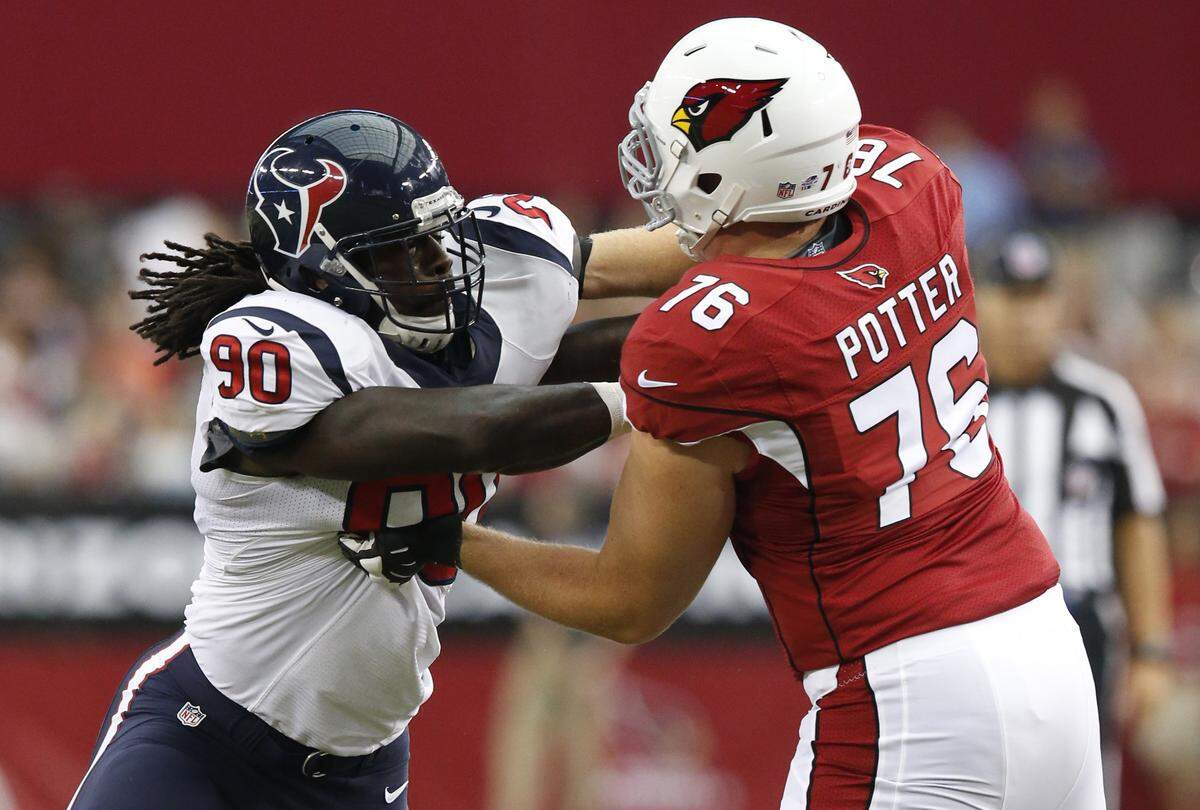
But he said he didn’t get serious about coaching until he made it to the NFL, where the seventh-round draft pick spent the 2012 and 2013 seasons with the Arizona Cardinals. He started six games as a rookie, but served mainly as a backup the following year, and he was released with an injury settlement in 2014.
“I found myself doing a lot more coaching of other guys than playing,” Potter said. “I knew my playing career was coming to an end, and I kind of caught the coaching bug.”
As soon as his playing career ended, Potter “contacted anyone and everyone and just tried to get my foot in the door.”
It didn’t take long for his coaching career to become reality. He started as an offensive quality control coach at Boise State in 2014, and spent the three years that followed as a graduate assistant on the same field where he earned three All-Mountain West selections and became the first consensus All-American in Boise State history.
Now Potter is back on The Blue, having joined Andy Avalos’ staff as tight ends coach and run game coordinator in January.
“It is home for me,” said Potter, who spent his high school career at Timberline before suiting up for the Broncos from 2008 to 2011, Boise State football’s heyday. “This program is in my blood, so it’s like coming back to family.”
The 33-year-old spent the past three seasons in the same coaching role at Montana State. He was hired there by former Boise State assistant Jeff Choate, who was the Bobcats’ head coach for five seasons before leaving last year to join Steve Sarkisian’s staff at Texas.
Choate coached running backs and special teams at Boise State during Potter’s freshman year. He coached linebackers and special teams during the rest of Potter’s playing career, and he kept tabs on the Broncos’ former left tackle, who got his first full-time assistant coaching job at College of Idaho in 2018.
Choate’s older brother, Jon — who has spent the past six years coaching the defensive line, linebackers and special teams at C of I — gave Potter a glowing review.
“I already knew what type of person he was,” Jeff Choate said. “I knew what kind of work ethic he had, and I knew what kind of passion and football IQ he was going to bring to the job.”
Potter not only has the resume to command respect from players, Choate said, but he has the mentality to be a great coach.
“He’s your classic low-maintenance, high-output individual,” Choate said. “He’s super organized and really, really smart, and I’m excited to see him leading and owning his room after he worked so hard to transition from coaching offensive line (at C of I) to learning the passing game.”
Learning how to teach
Potter spent his playing career on the offensive line, but he coached that position only for one season at College of Idaho under head coach Mike Moroski.
Moroski said Potter was given one of the most glowing endorsements he has ever received from former Boise State head coach Chris Petersen, which carried a lot of weight. Moroski also said mentoring a different position than the one he played is one of the best things a coach can do in their career.
It’s something Moroski experienced early in his career. The former quarterback at UC Davis coached quarterbacks, running backs, tight ends and offensive line for the Aggies before taking over at College of Idaho in 2013. Moroski said mastering the nuances of a new position expanded his horizons as a coach in ways that it took him years to fully comprehend.
“Good teachers learn how to teach,” Moroski said. “Breaking down the necessary skills, studying those and putting it all back together for the players calls for creativity, and makes you study and get better yourself.”
Tight end is no easy position to master, Choate said.
“Coaching tight ends is a pretty complex spot because so much is involved,” he said. “You’ve got to know protections, you’ve got to know run schemes and you’ve got to know the passing tree.”
Running game guru
Potter’s official title at Montana State was the same as his title at Boise State: tight ends coach and run game coordinator. Unofficially, Choate said he was the Bobcats’ guru when it came to the rushing attack.
“Nate brought ideas from the NFL, Boise State and the plus-one (option) run game at College of Idaho,” Choate said. “His role was to work closely with the offensive line coach and be that running game guru, and I suspect that will be his role at Boise State.”
Potter helped produce record-breaking rushing attacks for the Bobcats. Montana State set program records with 3,871 net rushing yards and 258.1 yards on the ground per game in 2019. Running back Isaiah Ifanse broke the team’s single-season rushing record with 1,623 yards last season.
Boise State is in need of fresh ideas in the running game. George Holani burst on the scene as a freshman in 2019, racking up 1,014 yards and extending the Broncos’ streak of seasons with a 1,000-yard rusher to 11. That streak was snapped in 2020 — a season that was shortened to seven games because of COVID-19.
Holani — who missed all but one game in 2020 because of injuries — was limited by a hamstring injury last season and finished with just 569 yards on the ground. The Broncos have produced one of the worst rushing attacks in the Mountain West the past two years, and they’ve turned to one of their own to help fix it.
“I think my strength as a coach is being a sponge, being flexible and adapting, whether it’s a new scheme or a new way to handle a situation,” Potter said. “I’m not set in my ways, and I’m always trying to get better.”
The golden era
Potter played at Boise State during one of the most successful eras in program history. Between 2008 and 2011, the Broncos went 50-3, and won three Western Athletic Conference championships and four bowl games, including the 2009 Fiesta Bowl to cap an undefeated season.
Potter took over at left tackle midway through the 2009 season and protected former Boise State quarterback Kellen Moore’s blind side in 2010 and 2011. They were inducted into the Boise State Hall of Fame together in 2018, and Potter said his history with the program will help him connect with players currently on the roster and when he’s on the road visiting recruits.
“They know how much I care about this place,” Potter said. “I ran those decks. I’m not going to be running much of them anymore, but I know how important that is, and how it builds a mentality in a team.”
Potter’s teammates remember him as always being one of the smartest players on the field. Those who had to go up against him in practice also remember trying to navigate a way around his freakishly long arms, which measured 34.63 inches long at the 2012 NFL Combine.
“He used to lock me up all the time in practice,” said former Boise State defensive lineman Shea McClellin, who went on to play for the Bears and Patriots and is now the head coach at Marsing High. “He is such a tall dude with such long arms that once he got a hold of you, it was hard to get him off.”
Former Boise State defensive lineman Byron Hout played and coached with Potter. Hout also remembers trying to finagle a way around Potter’s wingspan in practice. They also worked together as graduate assistant coaches at Boise State and were reunited at Montana State in 2019, which was the last of Hout’s five seasons on the Bobcats’ staff.
Potter lived with Hout when he first moved to Bozeman, Montana, and Hout said it was then that he noticed just how much Potter had grown as a coach in a short amount of time.
“With his knowledge of the game, you just knew he was going to be an all-star coach,” Hout said. “With some guys, you can just tell.”
Potter will be on the field with the players in an official capacity when spring practice begins on March 4.