A soccer fan and Japan native, Boise State official has hands-on World Cup role
Bringing down a bouncing ball in front of 74,000 fans, Roberto Baggio’s tight-fitting blue Italian jersey was a blur as he spun off his defender in Bulgaria white and green, skipped over a sliding tackle, and curled an inch-perfect shot into the bottom right corner to give Italy a 1-0 lead in the 21st minute of the 1994 World Cup semifinals.
Just four minutes later, Baggio doubled the Italians’ lead with a swift half-volley, sending the capacity crowd inside of New Jersey’s Giants Stadium into raptures.
The 27-year-old Baggio — one of the best players in the world at the time, and nicknamed the “Divine Ponytail” because of his flowing hair, talent and deep devotion to Buddhism — was a hero for the Italian diaspora across the globe as Gli Azzuri beat Bulgaria 2-1 and advanced to their first World Cup final in 12 years.
Just a handful of miles away from Giants Stadium, in New York City, a 9-year-old Japanese boy was cheering just as passionately as any Italian as he watched Baggio’s goals on the small, boxy television in his parents’ living room.
“I really remember watching a lot on TV live without the time difference, and really falling in love with Roberto Baggio,” Keita Shimada, now 41 and a longtime Boise State Athletics employee, recently told the Idaho Statesman.
“My brother was a Brazil fan. I wanted to do what my brother was doing, but I was competitive,” he continued with a laugh. “I wanted Italy to win, because they were starting to do well, and then Baggio with the ponytail and everyone’s talking about how good he is, and so I’m going to root for him.”
Shimada, born in Tokyo before moving to New York City at age 5, would have supported his country of birth if Japan had qualified for its first-ever FIFA World Cup. However, nine months earlier, the Samarai Blue suffered a devastating 2-2 tie in World Cup qualifying — a game known as the “Agony in Doha,” in which Japan was seconds away from its first-ever World Cup berth before conceding a last-minute equalizer to Iraq. The goal sent South Korea to the World Cup rather than Japan.
Thirty-two years later, including a return stint in Japan as a teenager, Shimada is back in the United States. Having joined Boise State’s athletics department in 2008 as a graduate assistant, he is now an assistant athletic director focused on sports medicine for Olympic sports, and men’s and women’s golf.
And the World Cup is now back in the United States for the first time since 1994. This time, Japan qualified — the Samurai Blue will compete in Group F against the Netherlands, Tunisia and Sweden.
Shimada will be a very interested viewer again, too. But in a deviation from 1994, he won’t be watching from home.
He’ll be up close and personal, at the games, as part of the physical recovery team for the 26-man Japanese World Cup squad that will be aiming to bring home glory to The Land of the Rising Sun.
A fateful dinner
Over 1,200 professional soccer players — and millions of soccer fans — from 48 countries across the globe will descend upon North America this summer for the largest World Cup in tournament history.
The 23rd edition of the world’s paramount soccer tournament will kick off on Thursday, June 11, and feature games in 16 cities across the United States, Canada and Mexico. Four of those host cities are on the West Coast: Los Angeles, San Francisco, Seattle, and Vancouver.
However, the World Cup frenzy isn’t limited to just those 16 hubs. Smaller towns across the continent will act as base camps for all 48 teams in the tournament. It’s how Sandy, Utah, will play host to Bosnia and Herzegovina, or why Egypt and world superstar Mohamed Salah will be based in Spokane, Washington, for several weeks.
For a short while, Boise was in the running to be a host city. The City of Trees ultimately wasn’t selected, but Shimada was.
The Japanese Football Association pinpointed Boise as a potential camp, with Boise State’s Boas Soccer Complex at the center of the conversation. So when Nathan Burke, the BSU senior associate athletic director, called a senior staff meeting to discuss a Japanese visit in May 2025, and asked for help, all eyes in the room turned toward Shimada.
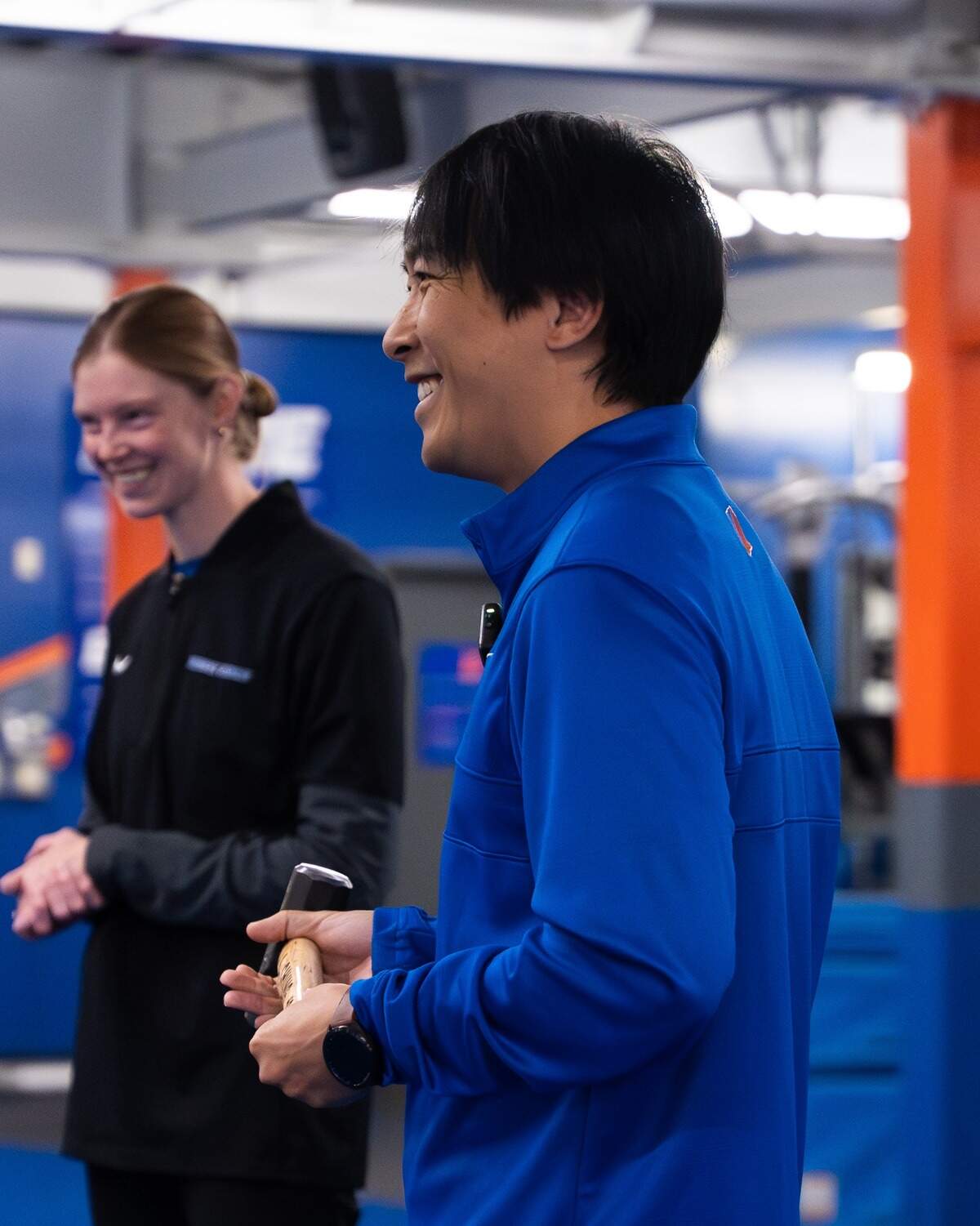
“I’m going, ‘Is he joking, or is he being serious?’” Shimada told the Statesman. The opportunity to assist his nation of birth seemed too good to be true.
Burke wasn’t joking, and quickly whisked Shimada up into a whirlwind of preparation on trying to sell Boise to the visiting entourage that included Japanese FA Director Naoki Tsumura.
Shimada’s first meeting with the group came at the Boas Soccer Complex, and he immediately noticed one thing: They arrived in an Uber.
In a move purely out of generosity, Shimada offered to drive the group back to their hotel near the Boise Airport at the end of the day — but not before a requested stop at Sakana’s Japanese Sushi on Vista Avenue, in which Shimada was offered a spot at the table to eat with the group.
It was there that Shimada learned that Japan likely wouldn’t choose Boise. He said the contingent was impressed with Boise State’s facilities, but they wanted more control over the kitchen in whichever hotel they picked, something the city couldn’t provide.
However, the group was still searching for something else, and Shimada was in the right place at the right time.
“We’re looking for someone with the local connections and network that can help us with recovery, facilitating contracts,” Shimada recalled Tsumura saying.
“The big modality that they love using is the cryo chamber,” Shimada explained. “They asked me about that, and I said I’ll be happy to help you, just let me know if that’s the way your medical staff wants to go.”
With decades of sports medicine and recovery experience under his belt, including a past appearance as a speaker at the USA Gymnastics National Congress on educating coaches on managing gymnastics injuries, Shimada figured he’d know the right people who could help the Japanese FA.
The twist that Shimada didn’t expect? They wanted him to be their primary contact in the United States for organizing cryochambers and other recovery tools throughout the whole tournament.
Putting it all together
The Japanese FA ultimately chose Nashville, Tennessee, as its base camp, a location much closer to the team’s three group stage games — two in Arlington, Texas, on either side of a trip to Guadalupe, Mexico.
With that information in place, Shimada quickly went to work to ensure cryochambers would be available not only in Nashville, but also at each of Japan’s match locations before the squad even arrived.
This all might beg the question: What is cryochamber therapy?
“A cryochamber is this giant capsule where your head is just sticking out ... and with liquid nitrogen, they blast your body with really, really cold air or cold gas, and they cool your body down. So, in a way, it’s a very similar concept to a cold plunge,” Shimada explained. “There’s a dopamine release, so there’s a little bit of relaxation and a feel-good release, a hormone being released, so I find that to be very helpful, especially in a tough schedule like the World Cup.”
Shimada partnered with the cryotherapy company Cool Factor, which runs a fleet of mobile units that can transport pods by road.
The company will have one of its units stationed at the team hotel in Nashville for the duration of Japan’s stay in Music City. There will also be a unit at the team hotel in Arlington, where Japan plays the Netherlands on June 14 and Sweden on June 25, and at the team hotel in Guadalupe, where Japan will play Tunisia on June 20.
Cool Factor’s ability not only to have several cryotherapy capsules already in place, but also to cross the border and operate in Mexico, was a major requirement for Shimada.
However, the most complicated part of Shimada’s job doesn’t even begin until after Japan’s final group-stage game.
If the Samurai Blue qualify from their group, depending on their position, they could be sent to a long list of different cities — a first-place finish would see them back to Guadalupe, second place to Houston, or if they qualify as one of the eight best third-place teams, they could end up in Foxborough, Massachusetts; East Rutherford, New Jersey; Santa Clara, California; Mexico City; or Vancouver.
“Right now I’m playing the role of the consultant adviser, but I can see my role expanding very quickly in those tough situations,” Shimada said. “I think I’m gonna be the triage person. We have a situation, we just need you to get it done, which is exactly my day-to-day job as an athletic trainer in the U.S. sports world.”
Shimada also expects to be pulled into other aspects of helping with the team’s recovery as the tournament advances, such as organizing the production and shipment of protective gear if a player gets injured.
But despite the potential stresses ahead for Shimada over the coming weeks, he described it as an “honor” to work with the Japanese national team this summer. He may not have become the professional soccer player — like Baggio — he imagined as a young child, but he is excited to help those who did.
“I’m excited about to be able to support a group of men that are going to provide so much courage, joy, excitement,” Shimada said. “I wanted to be a superstar soccer player, and so there’s going to be more youth players, and how that inspires, how it affects the next generation, I think that’s what excites me.”