Ridge to Rivers considers trail schedules to ease overcrowding, destruction in Foothills
Ridge to Rivers, the agency that manages Boise’s expansive Foothills trail system, could soon implement a program on some trails that would schedule use days for different groups — like hikers and mountain bikers — in the hopes of curbing traffic on popular routes.
Ridge to Rivers director David Gordon announced potential plans for the program during a public Zoom meeting Tuesday evening in which agency officials discussed future plans for the trail system, as well as issues with winter use that are leading to the destruction of some trails. Gordon said Ridge to Rivers will debut a survey in the next week for trail users to respond to the proposal and suggest trails where they would prefer to see schedules implemented. If feedback is in favor of a schedule program, Ridge to Rivers will pilot it on select trails in April until about September, Gordon said.
“We have fairly consistently heard from people that the trails are really busy,” Gordon said in a phone interview Wednesday morning. “We really don’t want to go to the degree of actually closing a trail to a specific user group, so instead we’re looking at other options.”
Gordon said during the Zoom meeting that use on some trails has doubled or tripled in the last year, in part due to Boise’s growing population and the rush to the outdoors amid the coronavirus pandemic. Gordon said current use far outstrips projections laid out in the agency’s 10-year-plan established in 2016. At that time, trail users told Ridge to Rivers they didn’t want to see running-only or cycling-only schedules on the trails.
Gordon suggested Lower Hulls Gulch, Around the Mountain, Polecat Loop and Bucktail trails as potential routes for a scheduling pilot. Each of those trails is used by hikers and mountain bikers and has other traits Gordon said are ideal for trail schedules: They have poor visibility like blind corners, which can potentially prove dangerous when trails are busy; and they connect to few other trails to avoid confusion on scheduling days.
“These kinds of solutions never please everybody,” said Gordon, acknowledging the potential difficulty of implementing a schedule. “It’s really difficult when you’re enacting any kind of restriction on a trail that’s historically been used by all user groups.”
Some trails could also be designated “directional,” meaning traffic would move in a single direction.
Restrictions could also cut traffic that’s damaging trails
Another potential solution for traffic could include monthly or seasonal restrictions on certain trails, Gordon said. Those restrictions could be for certain user groups or for all trail users.
In addition to curbing traffic, such restrictions would give Ridge to Rivers crews time to repair damaged trails. Gordon said the heavy traffic in combination with irresponsible trail use — hiking or biking when trails are wet or muddy — has churned many of the Foothills routes and caused significant damage.
Officials on Tuesday shared photos of Kestrel Trail, which is in the Hulls Gulch area. The photos showed a soggy trail laden with footprints and bicycle ruts. Gordon said users trying to avoid the mud had walked over an adjacent recovery area meant to restore vegetation and prevent trail widening, ruining that project.
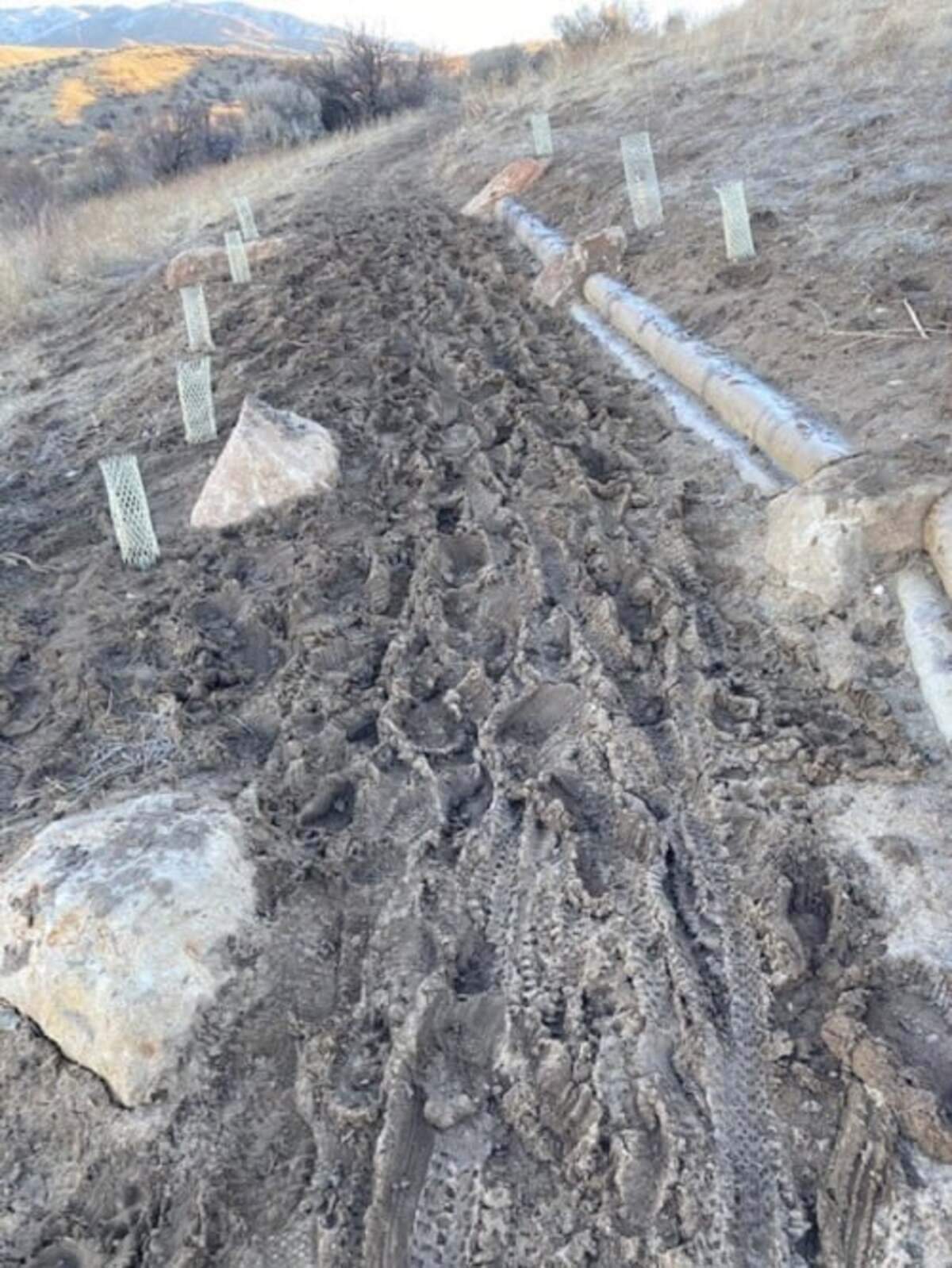
For years, Ridge to Rivers has pleaded with trail users to avoid trails after rain or when frozen routes are thawing, as Boise’s highly erosive soils can easily be damaged when wet. In December, the agency announced it would not be enforcing daily conditions-related closures at Table Rock, one of the most damage-susceptible trails due to its popularity and the high clay content of its soil. That decision was due, in part, to people disregarding the closures and using the trail anyway. That behavior has worsened this year, Gordon said Wednesday.
“People are not regulating themselves (on that trail) at all,” he said. “It’s awful.”
Gordon said Ridge to Rivers has been in talks with the city of Boise, one of its partners, about issuing citations to users who ignore trail closures. Since Ridge to Rivers lacks the authority to issue citations itself, it has relied on education in the past.
“We’ve been educating people for 20 years on this unsuccessfully, to a large extent,” Gordon said.
During the Tuesday meeting, Gordon said he hopes to have city employees issuing citations on the lower Foothills trails within about a year. The citations would be issued to individuals violating conditions-related trail closures, according to Gordon.
“Hopefully it raises the thought that it’s not worth (a ticket),” he said.
Boise trail system could see new designated-use trail
Gordon said the most straightforward way to combat heavy traffic on trails is to build more of them. However, with limited space and competing priorities in the Boise Foothills, that’s easier said than done.
In his presentation, Gordon said the Hawkins Trail, which will connect to Sweet Connie Trail, is moving forward, as is the Curlew Trail in the East Foothills near Watchman Trail.
Gordon also mentioned past efforts to create new trails have been stymied by a variety of issues: environmental concerns, lengthy reviews for trails on federal lands and private landowners rescinding agreements to easements on their properties.
A designated downhill trail for mountain bikers near Hulls Gulch has been in the works on Bureau of Land Management land since about 2019. It’s not clear when that trail is expected to open.