Boise High School’s iconic facade is getting a new look. Here’s the reason
AI-generated summary reviewed by our newsroom.
- Boise High removes white paint to restore historic sandstone facade, aiding preservation.
- Paint trapped moisture, causing basement wall damage and structural concerns.
- When the building was painted white and why remains a historical mystery.
Boise High students returning to school in the fall will notice a big change to the front of its iconic schoolhouse.
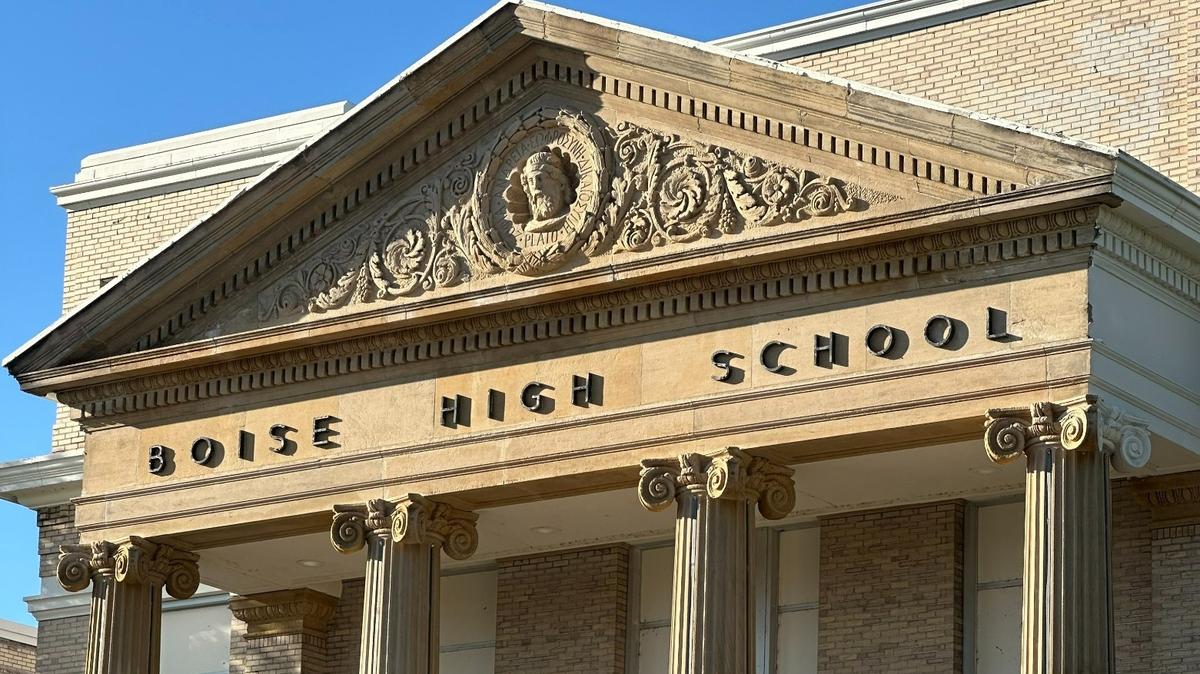
A brick and mortar remediation project, which started last summer and is continuing this summer, includes restoring deteriorating brick and mortar, repairing parapet caps — and removing white paint from the sandstone foundation and other masonry surfaces.
That includes the Boise High School facade, which is being restored to its original condition of unpainted sandstone.
“Imagine a lot of people’s surprise when they started stripping that white paint off, because there are truly generations of Boise High graduates that only know that facade as being a bright white, sort of a classical Greek white,” Boise High teacher Doug Stan told me in a phone interview.
Stan is also education director and treasurer for Preservation Idaho, and creator of the Idaho Architecture Project.
Stan said one of his favorite times of year is in the fall, “when the trees on either side of that nice shimmering white facade have that autumn fall yellow color.”
“What you get is this amazing scene when the sun is down in the fall, maybe 4 o’clock or 5 o’clock, of the sun coming in at an angle, just lighting up that white facade with the yellow trees on either side,” Stan said. “It’s a beautiful scene. And anybody who’s gone to school there knows what I’m talking about. And yet now it won’t shimmer like that.”
Masonry has its own ‘respiratory system’
The paint removal is for a good reason, though.
Dan Hollar, spokesman for the Boise School District, wrote in an email that the paint removal is critical for moisture control and structural preservation. The paint traps moisture against the building, which can cause it to seep indoors and damage the structure.
In some cases, the district has had to rehabilitate basement walls due to moisture problems caused by previously painted surfaces, according to Hollar.
“So the stone masonry has sort of its own respiratory system,” Dan Everhart, outreach historian for the State Historic Preservation Office, told me in a phone interview. “And moisture, whether it’s coming from the sky or coming from the ground, wicks up into or down through brick and stone, and then it naturally wants to make its way to the surface of that masonry and evaporate. And when you cover it with sealant, like paint, you trap that in, you cause moisture buildup.”
Boise High building history
The original Boise High School building at that site was built in 1902. It was a red-brick building in the federal and classical style, according to the Idaho Architecture Project.
But it was of such poor construction that it ended up being condemned in 1919 and torn down to make way for the new new central wing, which opened in 1921.
The east and west wings had been built in 1908 and 1912.
Interestingly, the east and west wings were built with light brick in the neoclassical style, a stark contrast to the original, red-brick federal school building. Perhaps school district leaders knew that the original school building wasn’t long for this world?
The new central wing was built using the same light brick to match the other two wings.
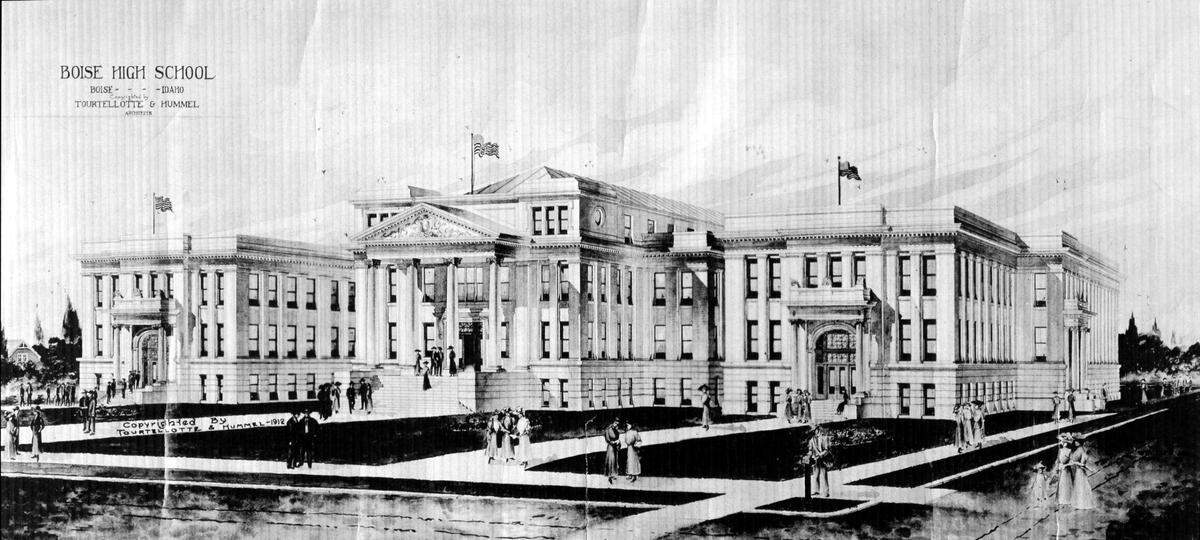
I found a rendering of the entire complex, designed by Tourtellotte and Hummel, and it was completely white.
It made me think that the building was intended to be white right from the start and that neoclassical architecture is based on Greek and Roman architecture, which is iconically white, constructed of white marble and limestone.
But Everhart points out that other buildings in Boise — notably the Idaho State Capitol and the Carnegie Library in Boise, also both designed by Tourtellotte and Hummel — are neoclassical and include columns, but remain in their original sandstone color.
So when was it painted white?
Hollar said the building has undergone various maintenance and restoration efforts over the years, but district officials weren’t able to find any records or confirm a specific timeline for when the white paint was applied to the sandstone.
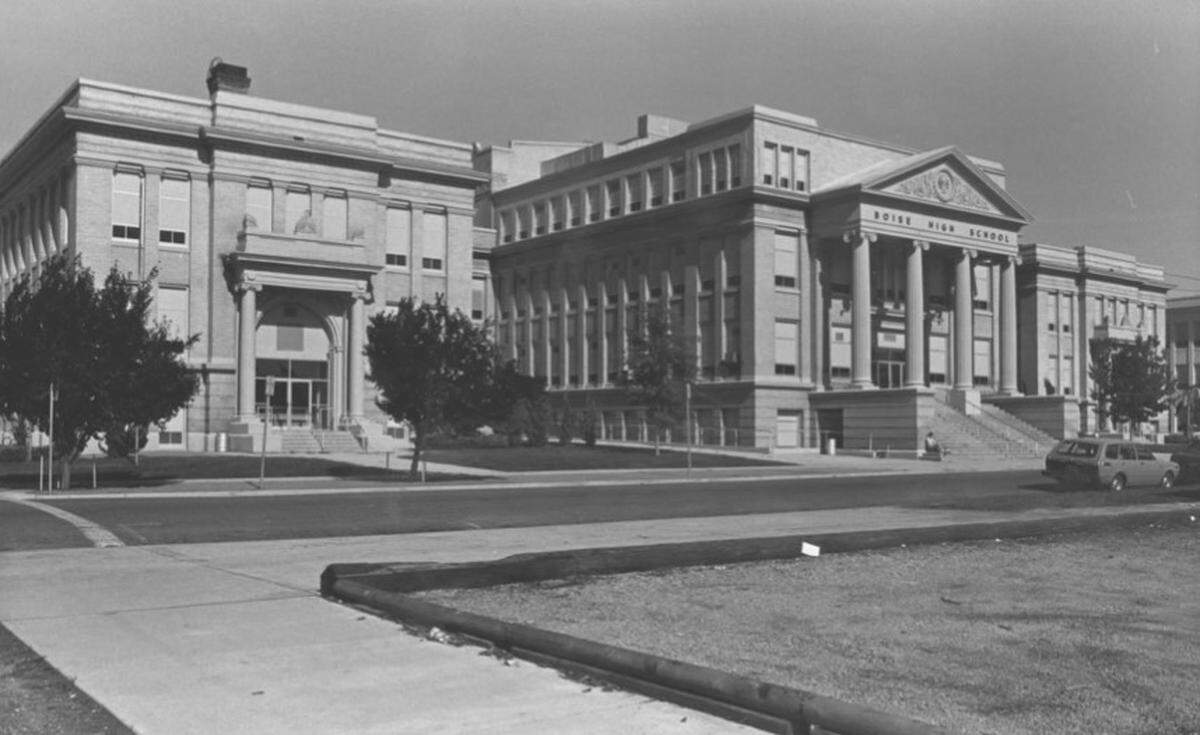
Stan said he has seen earlier photos of the building, pre-1930s, without paint. Everhart said other periods throughout the building’s history show it without paint from time to time. I found a photo of the building taken in 1980 as part of an application to be included in the National Register of Historic Places. The photo is black-and-white, so it’s kind of hard to tell, but it sure looks as if it’s unpainted.
Regardless of when it was painted, the next time you pass by the iconic school building facade, don’t be surprised if it looks a little different, and understand that it’s for the long-term health of the building, so that it may be around for another 100 years.
“I would love to encourage property owners, public and private, to leave their brick and stone unpainted,” Everhart said. “And you know, if there’s an aesthetic need to address something with color, that’s what windows and doors are for. They don’t do themselves or the building any favors by painting their unpainted brick and stone.”
Scott McIntosh is the opinion editor of the Idaho Statesman. You can email him at smcintosh@idahostatesman.com or call him at 208-377-6202. Sign up for the free weekly email newsletter The Idaho Way.