
Want to take the train to work in Boise? Get on board now | Opinion
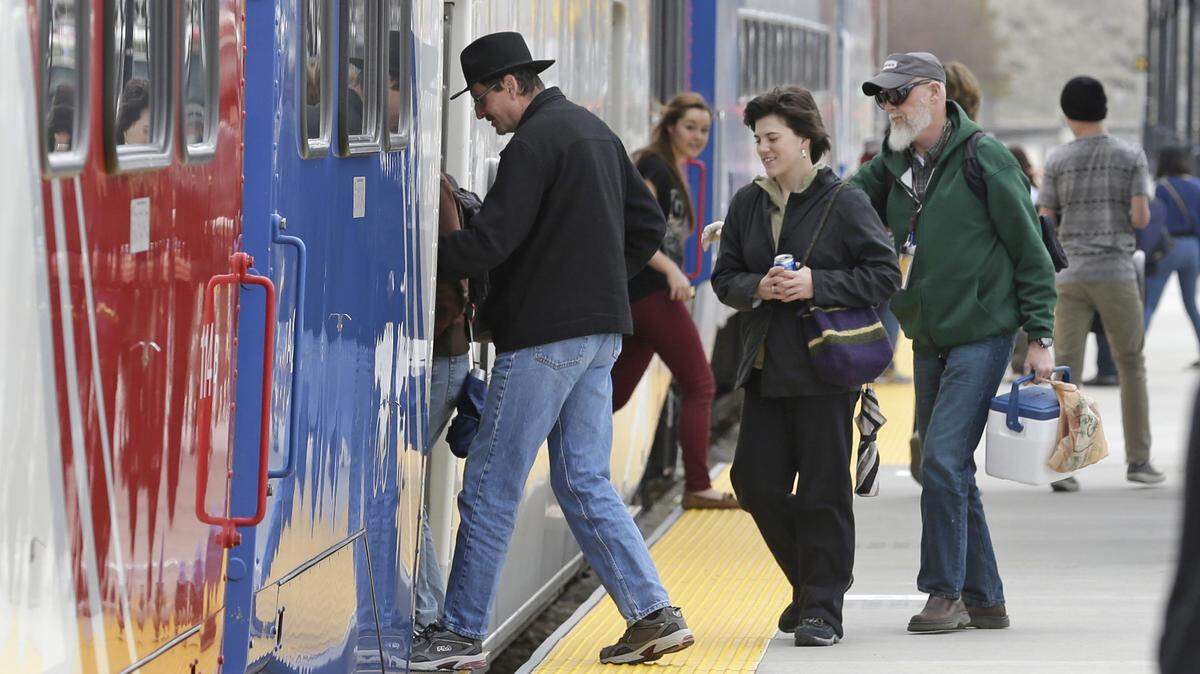
It’s time to get on board with the idea of a taking the train to work in Boise.
A commuter rail line connecting Boise, Meridian, Nampa and Caldwell is the “preliminary locally preferred alternative” for future high-capacity transit service in the Treasure Valley, the Community Planning Association of Southwest Idaho announced Wednesday.
We think Compass is on the right track.
The Boise metro area is not going to be able to ignore the need for some form of mass transit much longer.
Commuters who travel between Caldwell and Boise aren’t going to be able to enjoy the relative ease of traffic and cheap parking forever.
At some point (likely in the near future), Idaho and the Treasure Valley are going to have to face up to the fact that some form of mass transit is necessary.
And a commuter rail system would not be unheard-of. Dozens of cities across the country operate successful and highly popular commuter rail systems.
Idahoans need look no farther than our friends to the south in Utah and Salt Lake City, where the Utah Transit Authority runs, among other things, the FrontRunner commuter rail service.
FrontRunner is UTA’s commuter rail system that provides service from Ogden to Provo along an 83-mile corridor serving 15 stations in Weber, Davis, Salt Lake and Utah counties, according to UTA’s website.
“Nobody’s going to ride it”
We get it. Out here in the West, the car is king. People like their freedom, and being stuck to a train schedule is anathema to the West.
But consider this: FrontRunner’s ridership peaked at 5.19 million in 2019 before dropping during the pandemic, but has since rebounded to about 4.13 million in 2024 and has an average weekday ridership of roughly 15,000 passengers as of the first quarter of 2025, which puts it on pace for 4.35 million this year.
At some point, with growing traffic gridlock in the Treasure Valley, taking some form of mass transit will become a business decision for many commuters.
Traffic on Interstate 84 at the Meridian Road interchange to the Eagle Road interchange grew 10.6% from 132,000 vehicle trips per day in 2019 to 146,000 in 2024, according to the Idaho Transportation Department.
We’re not going to be able to keep building roads to keep up.
Commuters will choose mass transit when the decision becomes whether to get up earlier and earlier just to sit in traffic on Interstate 84 for longer and longer and pay more and more for parking or get on a train or bus, have your coffee, read the morning news, get work done or simply snooze while the train or bus gets you to work faster than driving your car.
“It costs too much”
FrontRunner’s operating cost for 2025 is budgeted at about $38 million. This figure covers all commuter rail expenses, including labor, maintenance and fuel.
FrontRunner, like the rest of UTA, is funded mainly by sales tax revenue. For all UTA operations in 2025, about 79% of revenue came from sales tax, 11% from federal funds and only around 6% from passenger fares (including both cash fares and contracted employer/school pass programs).
Commuters pay anywhere from $2.50 to $9.70 for a one-way ticket and $5 to $19.40 for a round-trip ticket, depending on distance traveled, with reduced rates for weekly passes and certain groups, such as students, Medicaid users and commuters with lower incomes.
We recognize that the idea of commuter rail is forward-thinking, not something Idaho’s legislators are known for.
One big hurdle is that the region will need to cultivate an ongoing, dedicated funding source for transit.
“Predictable funding for transit is something that Compass has advocated for over the past 20 years, and we’ll continue to work with the Idaho Legislature to secure a dedicated funding source,” Compass executive director Craig Rabon said in a press release. “Without funding, this project will not advance, and our region will miss out on a proven way to accommodate the growth we know is coming.”
UTA, formed in 1970, is a voter-approved special district that runs on a local-option sales tax. Idaho legislators have refused to even allow voters to decide for themselves whether they want a general local-option tax.
Starting small
FrontRunner commuter rail service started out small in 2008, initially running about 35 miles between Ogden and Salt Lake City. It’s now at 83 miles and goes all the way down to Provo.
The distance from Boise to Caldwell is 28 miles.
With the Olympics coming to Salt Lake City in 2034, there is active discussion about expanding the FrontRunner system even further.
FrontRunner proves that it’s easier to start small and build on it than wait and build a massive system from scratch.
“We don’t have enough population to support it”
Perhaps not right now.
Today, the combined population of Ada and Canyon counties in Idaho is about 847,840.
We still have a ways to go before we hit 2 million people. That was the population of the seven counties that make up the Utah Transit Authority at the time FrontRunner started in 2008.
It may seem like a long way off, but we’ll wish we had done something sooner. And now is the best time to start planning.
We’re still not completely sold on the idea of commuter rail. We recognize a more robust bus system might be a more financially feasible (cheaper) and practical option. But creating a high-occupancy, rapid bus system wouldn’t come cheap, either. It would require the creation of express, high-occupancy vehicle lanes dedicated just for buses. And we suspect commuters might be more willing to take a train to work than a bus.
Based on Salt Lake City’s experience, riders are willing to take the train.
What’s not an option is Option Three: Do nothing.
Some form of mass transit, whether it’s a commuter rail line or a bus system, is going to become a necessity.
And we’ll wish we had planned for it sooner.
When it comes to planning for mass transit, we are reminded of the saying, “The best time to plant a tree is 20 years ago. The next best time is now.”
The time to plan for Boise’s future transportation needs is now.
Statesman editorials are the opinion of the Idaho Statesman’s editorial board. Board members are opinion editor Scott McIntosh, opinion writer Bryan Clark, editor Chadd Cripe, newsroom editors Dana Oland and Jim Keyser and community members John Hess, Debbie McCormick and Julie Yamamoto.