Will the weather cooperate for this weekend’s solar eclipse in Idaho? Here’s the forecast
Bad news, Boise.
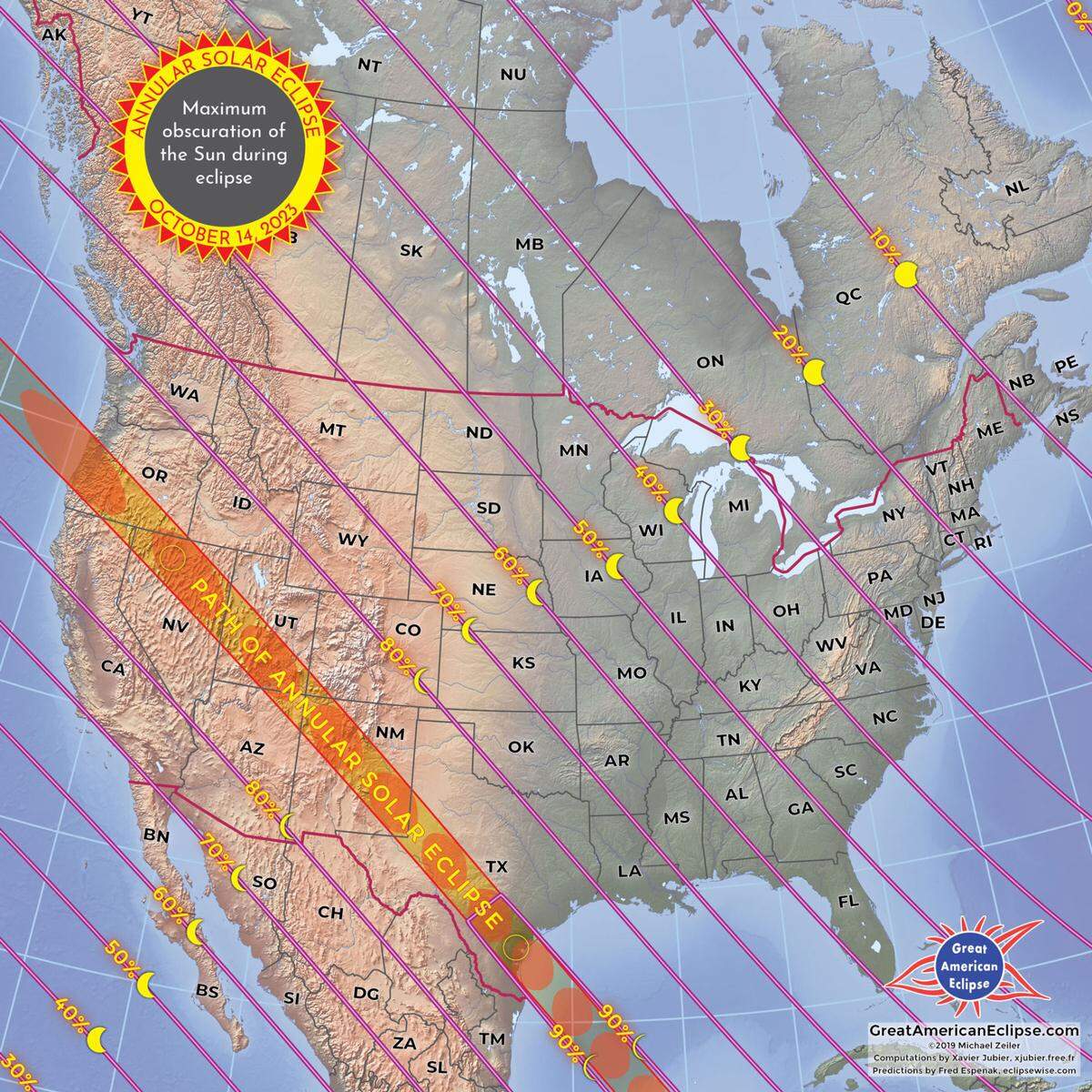
Millions of eyes will be looking toward the sky Saturday morning as a rare annular solar eclipse will be visible throughout most of North America. Boise is in a particularly good position, with the path of totality — where the eclipse is most impressive — passing just south of Idaho.
But we may not even get to see it clearly.
The National Weather Service in Boise forecasts “partly sunny” skies Saturday, but Weather Service meteorologist Korri Anderson told the Idaho Statesman that there’s a 60%-75% chance of clouds during the time of the eclipse.
“It’s going to be mostly cloudy to maybe overcast around our area,” Anderson said. “But there’s still some standard deviation in the models. So there is a chance that it could be more sunny on Saturday morning.”
There’s also not much luck for those hoping to get above the clouds.
While it’s too early to know the exact cloud ceiling — the elevation where the lowest clouds are — Anderson said that some clouds could be as high as 20,000 feet. For comparison, Boise sits at 2,700 feet, and the highest point in Idaho at Borah Peak is only 12,662 feet.
After a clear and sunny Friday, clouds are expected to move into the Boise area around 6 a.m., Anderson said. There’s a chance the clouds could break for a little in the late morning — the eclipse will peak in Boise at 10:24 a.m. — but there’s no guarantee that clouds will stop blocking the sun and moon.
What time is the eclipse in Boise?
Despite the chance for clouds, many Idahoans will still patiently await a glimpse of the solar event. It’s the first eclipse viewable in Boise since the total solar eclipse in 2017.
Even with clouds in the way, it’ll also get noticeably darker in Boise throughout the eclipse. From start to finish, when the sun is only slightly eclipsed as the moon moves in front of it, the eclipse will last about 2.5 hours.
The path of totality passes south of Idaho, through Nevada and Utah, where 91% of the sun will be blocked. The remaining 9% is the “ring of fire” still visible around the moon’s edges.
The eclipse will start at 9:07 a.m. and reach its max for Boise at 10:24 a.m. before decreasing again. It ends at 11:47 a.m.