
Newcomer may have ousted four-term Ada County Highway District incumbent by 2 votes
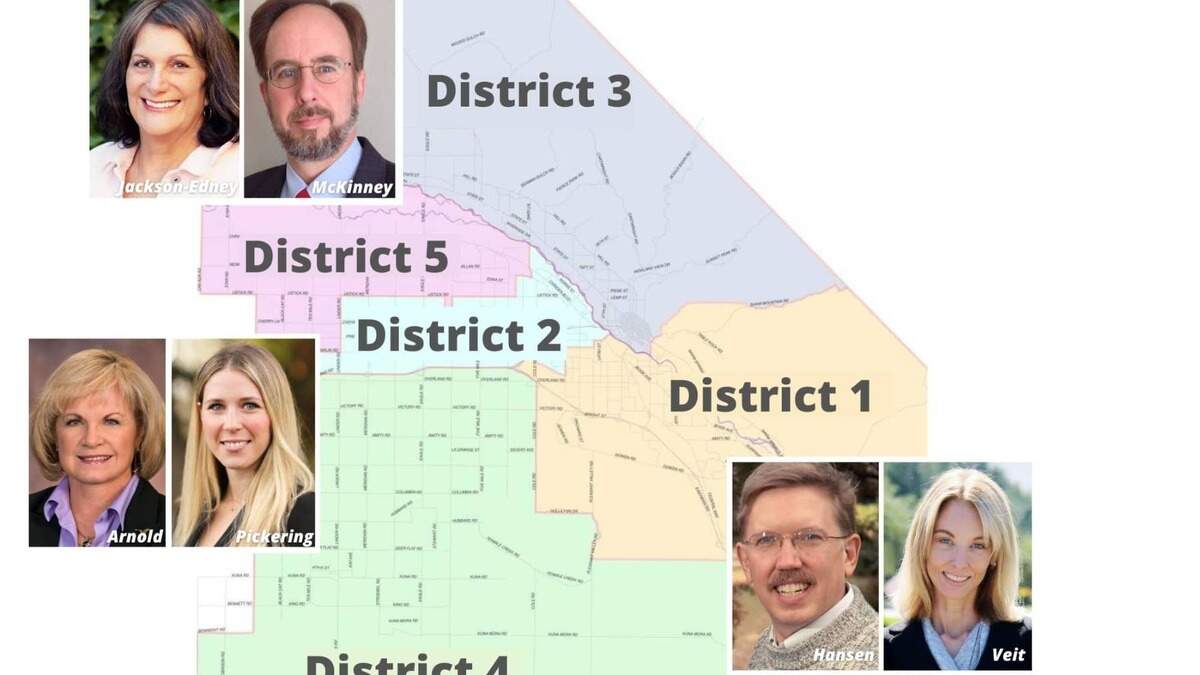
Voters opted to keep one incumbent on the Ada County Highway District commission but ousted another by just two votes, based on unofficial election results.
The winners of the nonpartisan election will spend the next four years helping to form the county’s policy and planning on roads, traffic, transportation, maintenance and operations, and pedestrian and bicycle safety.
Political newcomer Alexis Pickering beat four-term incumbent Rebecca Arnold, a Boise lawyer, by just two votes, 15,735 to Arnold’s 15,733. They ran in District 2, which generally extends from the Boise River west to Linder Road, south of Ustick Road and north of Interstate 84, including part of the Boise Bench.
Because the race was so close, Arnold is entitled by state law to a recount if she wants to request it after the official canvass of votes.
In a text message, Arnold said Wednesday afternoon that she “has been advised that a full recount request is very appropriate in this situation.”
“Still working through the details for that process,” she wrote.
Pickering, a community health strategist with Central District Health, was in a dead heat with Arnold for much of the night. Pickering said she was excited by Tuesday’s results and looks forward to results of the expected recount.
“I’ve been pounding the pavement, talking to hundreds of voters, thousands of voters,” she said early Wednesday. “To come this close and be just two votes over, as a millennial, as a first-time candidate against a 16-year incumbent, that speaks volumes to the change that people are asking for.”
Incumbent Jim Hansen won a third term representing District 1, which covers the eastern portion of the county, including much of Boise. Hansen won 54.2% of the vote, carrying him to victory over opponent Kara Veit.
Newcomer David McKinney, an attorney and former civil engineer, will replace retiring Commissioner Sara Baker to represent District 5, which covers part of western Boise and north Meridian. McKinney beat Emilie Jackson-Edney, a retired ACHD engineer, by garnering 60.5% of the vote.
Campaign finance
Hansen, of Boise, significantly outraised Veit, a former ACHD community engagement manager who works in marketing, taking in more than $26,500 to her more than $11,300. He, Pickering and Jackson-Edney were endorsed by left-leaning politicians, including members of the Boise City Council and local state-level officials.
Hansen took in money from developers — including a $250 donation from Clay Carley — but also got money from local Democrats, including $1,000 each from former gubernatorial candidate A.J. Balukoff and his wife, Susie, a $200 donation from the campaign of Idaho House Minority Leader Ilana Rubel, and $100 from the campaign of Boise Mayor Lauren McLean.
Pickering brought in more than 200 donations of varying amounts for a total of more than $42,000, including $1,000 from Susie Balukoff, $1,000 from developer David Wali, and $250 from Boise City Council Member Holli Woodings.
Jackson-Edney got money from local Democrats, including Woodings, state Sen. Cherie Buckner-Webb, the campaign of Rep. Melissa Wintrow, and Erik Berg, chair of the Ada County Democratic Party.
They ran against people considered to be more business-friendly candidates, who got money from right-leaning individuals and interests. Veit’s money came largely from big donations from construction companies, contractors and home builders.
Arnold brought in less money than Pickering — just over $30,000, including a $10,000 loan from herself — but her donations were higher-dollar. She got money from builders and development companies.
McKinney largely won over business interests in the race, taking in $1,000 from developer Brighton Corp., $1,000 from the Building Contractors Association of Southwest Idaho PAC, and $1,000 from Tall Timber Consulting, a development consulting firm.
The race in many ways was divided between what was needed in more urban Boise versus the less-dense suburbs. Public transit is desired in Boise but less so in the suburbs, and wider roads are wanted by some suburban developers but not by people who would prefer bike lanes and different modes of travel in the city.
Candidates were competing in Ada County’s largest election ever, with nearly 88% of the county’s nearly 300,000 registered voters casting ballots.
This story was originally published November 3, 2020 at 9:48 PM.
.jpg)