GOP vs. Dems. Suburban vs. city developers. How a local nonpartisan race got partisan
The race for the Ada County Highway District will be listed at the very bottom of the November ballot. A voter could easily ignore it. But those involved in Treasure Valley politics say it is perhaps the most consequential election this year.
While mayoral candidates in last year’s Ada County municipal elections may have made grand statements about how they would handle growth and transportation, the growth was all they can really control. Their control over transportation is limited. That power — over 2,400 miles of roads and a $136 million budget — rests in the hands of the Ada County Highway District and its five elected commissioners.
At stake is the transportation future for the Valley. Will new traffic be accommodated by a more robust public transportation system, or wider roads? Will ACHD emphasize new bike routes and pedestrian safety, or vehicle-traffic flow? Will developers pay more in impact fees to help shoulder the costs of growth?
The ACHD commission race is nonpartisan, but Republicans and Democrats are taking sides. The commissioners are elected to four-year terms and paid $26,000 annually.
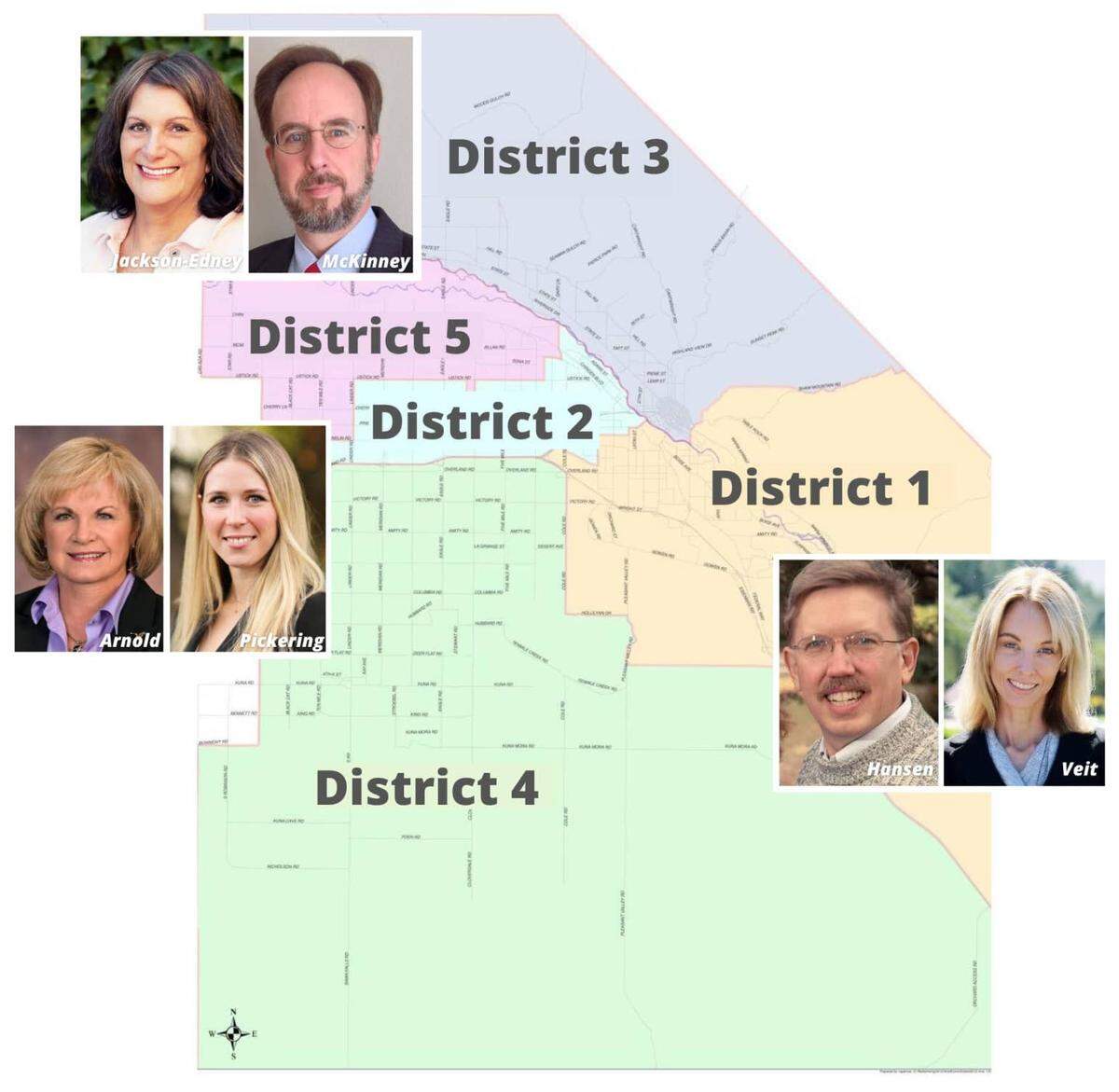
Democratic Boise City Hall-types and state representatives are lining up behind these candidates:
District 1: Jim Hansen, an incumbent holding his seat since 2013 who was a former state representative, as well as executive director of the Idaho Democratic Party.
District 2: Alexis Pickering, a political newcomer and public health strategist with the Central District Health Department.
District 5: Emilie Jackson-Edney, a former ACHD engineer who also has not run for public office.
They are winning financial support from the Conservation Voters of Idaho and some downtown developers who hope to see ACHD putting more money into alternative modes of transportation and safe pedestrian routes.
Ada County Republicans and their allies in the Legislature have put their support behind these candidates:
District 1: Kara Veit, a public relations manager and political newcomer who worked as a community relations manager at ACHD for a year.
District 2: Rebecca Arnold, an incumbent who has held her seat since 2005, who has worked as a lawyer for a real estate development company.
District 5: Dave McKinney, a lawyer and civil engineer who serves on Meridian’s Transportation Commission.
Funding their campaigns is a who’s-who list of homebuilders and suburban developers, including Brighton Corp., the Conger Group and Dave Evans Construction.
As of Sept. 30, Pickering had raised the most of any candidate: $34,546. Incumbent Hansen trailed her with $19,539.
Urban vs. suburban concerns
Boise City Hall has often found itself in a confrontational relationship with the highway district, as city leaders push for changes that ACHD has often resisted. Former Mayor David Bieter called ACHD a “failed model.”
Boise’s new mayor, Lauren McLean, could have a different relationship with ACHD — and the specifics of that relationship could depend on the outcome of the election. McLean declined to comment for this story. In a Wednesday news conference, though, she endorsed Hansen for District 1. She did not comment on the other races.
Among McLean’s top concerns are “making sure that we can meet the demands of growth, that we provide safe ways for people to move from home to work and throughout their neighborhoods that aren’t just in cars, and that we partner together on some of the larger plans such as State Street and, over time, transit,” she said Wednesday.
For too long, ACHD’s solutions to most problems has been to widen roads, said Erik Berg, chair of the Ada County Democrats. “But we can build flexibility, making it so corridors can work better for pedestrians, or bikes, or rapid transit. We should be looking at all our options. I know these options are expensive, but so are widening our roads.”
The Conservation Voters of Idaho — a nonpartisan group that backs candidates who favor environmentally sustainable policies — has backed candidates aligned with Democrats this year for similar reasons.
“With the Treasure Valley being one of the fastest-growing metropolitan areas and one of the fastest -growing states, the Ada County Highway District race is absolutely critical to ensuring we develop a more balanced transportation system,” said Rialin Flores, the group’s executive director.
The support from some downtown developers fits that philosophy.
“Downtown is very different from more suburban and rural areas, and we need to think of downtown differently,” said Scott Schoenherr, a partner at Rafanelli and Nahas, which is building a 10-story office tower at 11th and Idaho streets.
Schoenherr said he’s happy with decisions ACHD has made in the last several years — like converting some one-way downtown streets into two-lane streets. The agency has also included more bike lanes and widened sidewalks.
Still, much of that has come at the urging of the city of Boise and its urban renewal agency, the Capital City Development Corp.
Take, for example, construction on 8th Street north of Bannock Street that will widen the sidewalk, reduce traffic from three lanes to one, and include a southbound bicycle lane.
The project, proposed by the city of Boise, was met with some resistance from the ACHD commission.
Commissioner Sara Baker, who is vacating her seat this year, said ACHD funds shouldn’t go toward the project, because the urban renewal agency draws property-tax revenue away from ACHD and other taxing jurisdictions.
“It’s always been my belief that the CCDC should pay for these kinds of projects, because they have the money specifically collected to enhance these areas,” Baker said in a statement emailed by an ACHD spokesperson. “That would leave ACHD tax money available to do projects in other areas of the county where for example, gaps in sidewalks need to be filled or sidewalks created in older areas which now don’t have them.”
Commissioner Rebecca Arnold said the agency shouldn’t be giving priority to cyclists. “Boise is the seat of state government,” she said of the project in January. “It has to be vehicle-friendly.”
Funding for public transportation
Boise City Hall has also urged ACHD to think differently about public transportation. The city’s most ambitious public transit project is a bus-rapid transit system along State Street, which would involve building dedicated bus lanes so that the buses can move faster than the car traffic beside it.
ACHD hasn’t adopted Boise’s plan. Its current commission has argued that as a roads agency, it cannot use its fund to build a lane exclusively for bus travel. But Hansen, a lone voice in opposition, has said that ACHD does have the authority to build infrastructure for the bus system. Were he to get more allies on the commission, ACHD might shift its stance.
But transit is a polarizing issue. It’s expensive — and less important to suburban developers who aren’t building houses densely enough to accommodate an effective bus system.
“When you get into suburbs and semi-rural areas, the demand for alternative transportation modes slims a little bit,” said Bill Rauer, executive director of the Building Contractors Association of Southwest Idaho.
Funding for roads
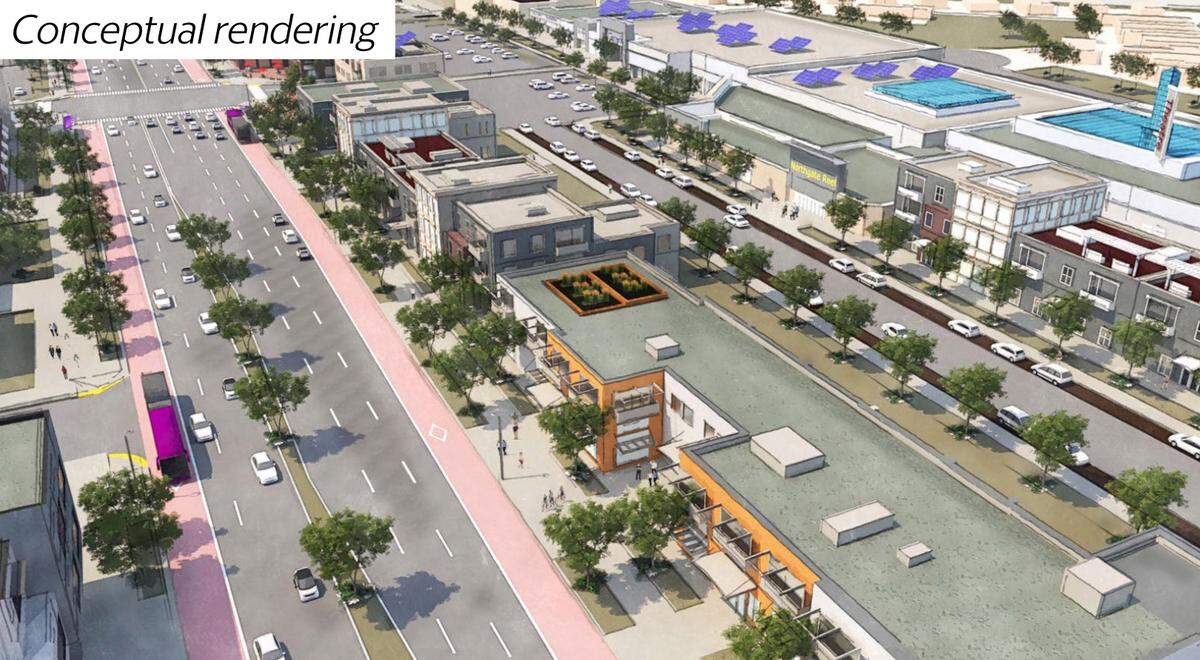
For developers and politicians in the suburbs beyond Boise, a focus on road-widening is exactly what they want to see.
“We as an association have been pretty satisfied with the direction that ACHD has taken on in terms of maintaining our roadways, and also addressing capacity issues to the extent they can,” Rauer said by phone.
Transportation is the largest issue on the minds of residents of Meridian, said Mayor Robert Simison. “We will support innovative ways to get roads built in Meridian,” he said in a phone interview.
But Simison also wants to make sure that ACHD has the money to build the roads.
“People who are willing to make sure ACHD has the funds needed to build the roads is the most important part,” he said.
This last year, the ACHD commission voted not to increase its property tax budget by the 3% it is allowed to each year. It also voted not to factor new construction into the tax roll, which would have provided an additional $1.6 million.
Consolidating the ticket
This year’s ballot will present voters a choice between two candidates for each seat— one backed by Democrats, the other by Republicans. That’s a contrast from past elections, when the fields sometimes have been crowded with candidates who split the vote.
Such was the case for the 2018 race in District 4, encompassing most of southern Ada County, which Kent Goldthorpe won with 38% of the vote. His three challengers included former Ada County commissioner and Republican Dave Case, as well as Gary Schaeffer and Boise Fire Captain Christopher Campbell.
It was also the case in the 2016 race in District 5, which includes parts of West Boise, North Meridian and Eagle. Rick Just and Mike Tracy split the vote and lost to Sara Baker, who garnered 44.8% of the vote.
Republicans have forced the ballot to narrow in some key past elections. In 2018, House Majority Leader Mike Moyle, a Star Republican, personally asked some of the candidates running against the candidate he backed, Mary May, to drop out to improve her odds against Democrat Paul Woods in District 3, which includes downtown Boise, Eagle and Star.
“Folks are recognizing the power of ACHD,” said Flores, the Conservation Voters director.
Victor Miller, chairman of the Ada County Republican Central Committee, did not respond to a request for comment.
Who’s in control
Even with a new commission, a great amount of power rests in two top staff members at ACHD — its executive director, Bruce Wong, and its general counsel, Steven Price.
The two are symbols of the existing philosophy at ACHD. As such, their relationship with city elected officials and planners who push for change has sometimes been strained.
In 2019, city and county planners sitting on an ACHD advisory group opposed some of Wong’s positions. He was later caught in a recording telling Arnold that he was “done” and that he had “had it with that group.”
In 2014, ACHD candidate Bob Bruce said that then-Mayor David Bieter asked him to fire Wong and Price if elected. Bieter later denied that. He did, though, criticize the contract ACHD’s commission gave to Wong just a month ahead of the 2014 election, which provided him with a 12-month compensation severance package if he were fired without cause.
The race against Arnold
Another representative of the existing thought at ACHD is Rebecca Arnold, a Republican who has served on the commission for 15 years representing District 2, which includes parts of Garden City, West Boise and North Meridian.
She was a candidate in the 2019 Boise mayoral race and came in third in the seven-way November election, with 13% of the vote.
Democrats around Boise have long vied to find the right candidate to knock Arnold out of her seat. Not all Republicans back her, either. In Meridian, Simison has so far chosen to endorse only McKinney, running for District 5.
But as a well-known Republican, Arnold has a strong base and deep coffers. Her campaign finance filings often contain donations from notables in the business and real estate development community.
One of her major supporters is her neighbor and employer, Winston H. Moore, owner of the commercial development firm W.H. Moore. Arnold is the firm’s general counsel. In 2016, Moore was the sole donor to a the newly created Idaho Association of Businesses PAC, which spent over $10,000 on Arnold’s campaign.
Separately, Arnold’s campaign spent $39,359 that year.
Her opponent in that election, David Eberle, a former Boise city councilman, spent $53,720 and received an endorsement from the Conservation Voters of Idaho. But Arnold defeated him, winning 55% of the vote to Eberle’s 45%.
“I don’t know how you beat an incumbent where there isn’t an issue,” Eberle told the Statesman by phone. “Without a compelling issue, I don’t know how you beat the name recognition and how she works her Republican friends.”
This article has been revised to delete an incorrect reference to the timing of some candidate endorsements and to correct the spelling of candidate Kara Veit’s last name in the the caption of the picture showing all six candidates.
This story was originally published October 1, 2020 at 4:00 AM.