Why have some Boiseans felt recent earthquakes and others haven’t? There’s no simple answer
‘Did you feel it?’ is probably the most asked question after an earthquake happens.
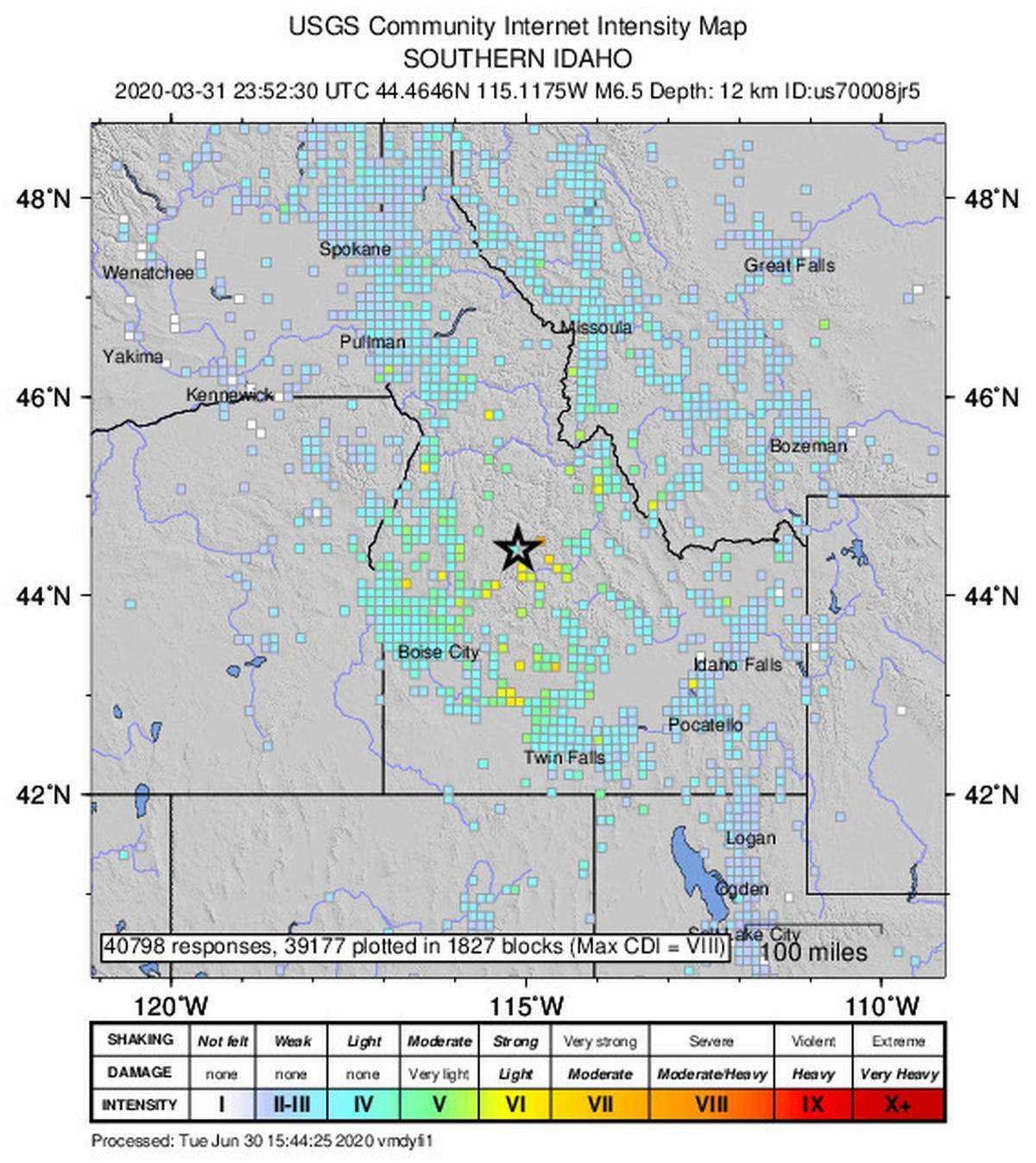
Bombarded with continuous shaking in Idaho since March, our brains are now conditioned to be aware of the slightest movements of the earth, prompting that question over and over again. And with good reason: As of July 7, the U.S. Geological Survey had registered 222 earthquakes of magnitude 3 or higher.
And often that question will lead us into a debate between those who definitely felt it and those who didn’t, especially when arguers had opposite experiences while being close to each other.
So, why do some people feel earthquakes here in the Treasure Valley while some others don’t? There is no simple answer, as feeling the earth shaking beneath you depends on many different factors: from the place you’re at, to what you are doing and even your biology.
Here is what experts have to say.
It depends on how strongly your area is shaking
When the earth shakes, waves of energy are released and transmitted to places relatively close to the epicenter. Much of the energy initially released is gradually lost as the energy moves away from that point.
But the type of movement you experience also changes with distance.
“If you’re very close to the earthquake, you get very sharp, jolting motions that are short in duration and have high frequency,” explained USGS seismologist David Wald. If you’re further away, you start getting rolling surface waves that are less frequent but last longer.
The material of the ground you are standing on also matters. Cities in flat areas, like Boise, sit in zones that may have a lot of soil heterogeneity — even when they seem uniform. This means that there could be different shaking levels from one neighborhood to the other.
If there’s a “building that’s on soil adjacent to a building that’s on rock, the soil building will shake stronger,” Wald said. Energy waves will travel faster through rocky soils, but they get slowed down in softer soils — think clay or muddy ground. As a result, the amplitude of the waves increases, and in some cases, the shaking motion could be felt for longer periods of time.
Even if you are in the same building as someone else, your experience of the earthquake could be quite different depending on how tall that building is.
The base of a tall structure moves slower than its top, because the base is attached to the ground and moves with it, while the top can move freely.
“It’s like an inverted pendulum,” Wald said. Thus, it is very common that “people in higher stories experience shaking when people in the lower stories don’t even notice it,” he added.
Furthermore, if the timing of the shaking of the ground matches the timing of vibration of a building — which depends on its height — shaking can be dramatically amplified and significant damage could happen in the structure.
For example, a combination of the effects of such earthquake-building vibration — called resonance — together with a soft soil were the culprits of the damage in an 8.0-magnitude earthquake that shook Mexico City in 1985. Although only a few buildings collapsed, they all had between 6 to 15 stories, the perfect height to resonate with the earth’s shaking.
It depends on what you are up to, too
Strong earthquakes are undoubtedly felt by most people, but whether you feel a mid-intensity earthquake — magnitude 3 or 4 — depends on what you were doing when it happened.
A 2014 study, led by Italian researcher Paola Sbarra, used 250,000 responses to a web questionnaire to analyze how people’s activity and location affected their perception of an earthquake.
Sbarra and her team found that people in motion — walking, driving, exercising — had the worst perception of mid-magnitude earthquakes, regardless of where they were. People at rest and with no distractions were able to perceive even weaker earthquakes.
If you are sleeping you probably won’t feel a soft trembling, unless you are in a tall building and the motion is amplified.
Even while at rest, if you are distracted — especially around loud sounds such as a blender in the kitchen or watching a movie — it is likely that you will miss the trembling because you are not paying attention to other signs of the earthquake, such as moving objects or creaking sounds in the building that you’re at.
Something similar happens when you are outside — you could think that objects move because of the wind and there are no squeaking building sounds around you.
It may also depend on your biology
Where you are and what you were doing may explain why some people feel earthquakes and others don’t in a general area. But what happens when one person feels it when sitting right next to another that doesn’t?
It is possible that the answer might involve differences in our bodies and the way we perceive movement around us.
Our body has multiple ways for detecting when we are moving or when something is moving around us. For that, our brains combine information about what we see and hear with the senses that determine our body position and balance.
Part of that balance system is located all over our bodies, composed of a network of neurons that sense the movements and position of our muscles and inner organs. This is called the proprioceptive system. But the structure that contributes the most to our balance and spatial orientation lies in our inner ear.
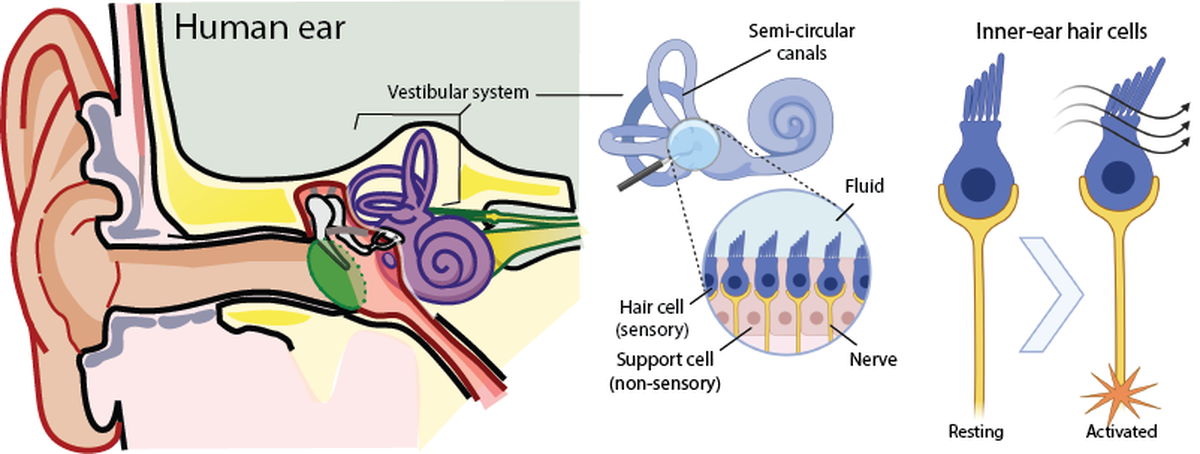
Apart from housing the organ that allows us to hear sounds, the inner ear contains our balance organs — the vestibular system. It tells us which direction we’re moving and how fast, explained Dana Gladd, doctor of audiology at St. Luke’s Hearing and Balance Center in Boise.
The vestibular system is formed by hollow bone structures filled with a jelly-like fluid, called semicircular canals. At their base, lots of tiny hair cells wait for any movement in the fluid to start firing electrical signals to the brain.
When an earthquake happens, the first information received by the brain from all these different balance-sensing systems in our body might be contradicting.
“It’s like being on board a ship,” said Dr. Neil Todd, a specialist in the neurobiology of hearing and balance and honorary lecturer at University of Manchester.
“When you’re experiencing an earthquake with long, slow waves, everything is moving with you as well. So your vestibular system will detect it, and probably the propioceptors in your body would detect it, but your visual system wouldn’t,” Todd said. That could make you feel dizzy.
Differences in our innate ability to feel motion could come from differences in any of the balance senses that detect it, especially from our vestibular system.
For example, Todd explained that “it is well established that there are very considerable differences in the sensitivity of the vestibular system, and that generally declines with age over 40.”
Another possibility is that “people who have a weakness or a deficit in their inner-ear balance system … are less likely to be sensitive to certain types of motion,” Gladd said, “ and that could absolutely play a role in why somebody is feeling something that somebody else isn’t.”
And even when no inner-ear deficiencies are involved, it is possible that the bodies of observers with different experiences are positioned in ways that make them more or less likely to feel the earthquake.
“If you’re just standing and you have (fewer) reference points, I think it’s harder to detect” than being in another position that allows you to have more information from the rest of your balance systems, Gladd said.