Driver made U-turn on flashing yellow arrow in Eagle, injuring 3. Blame him? Or arrow?
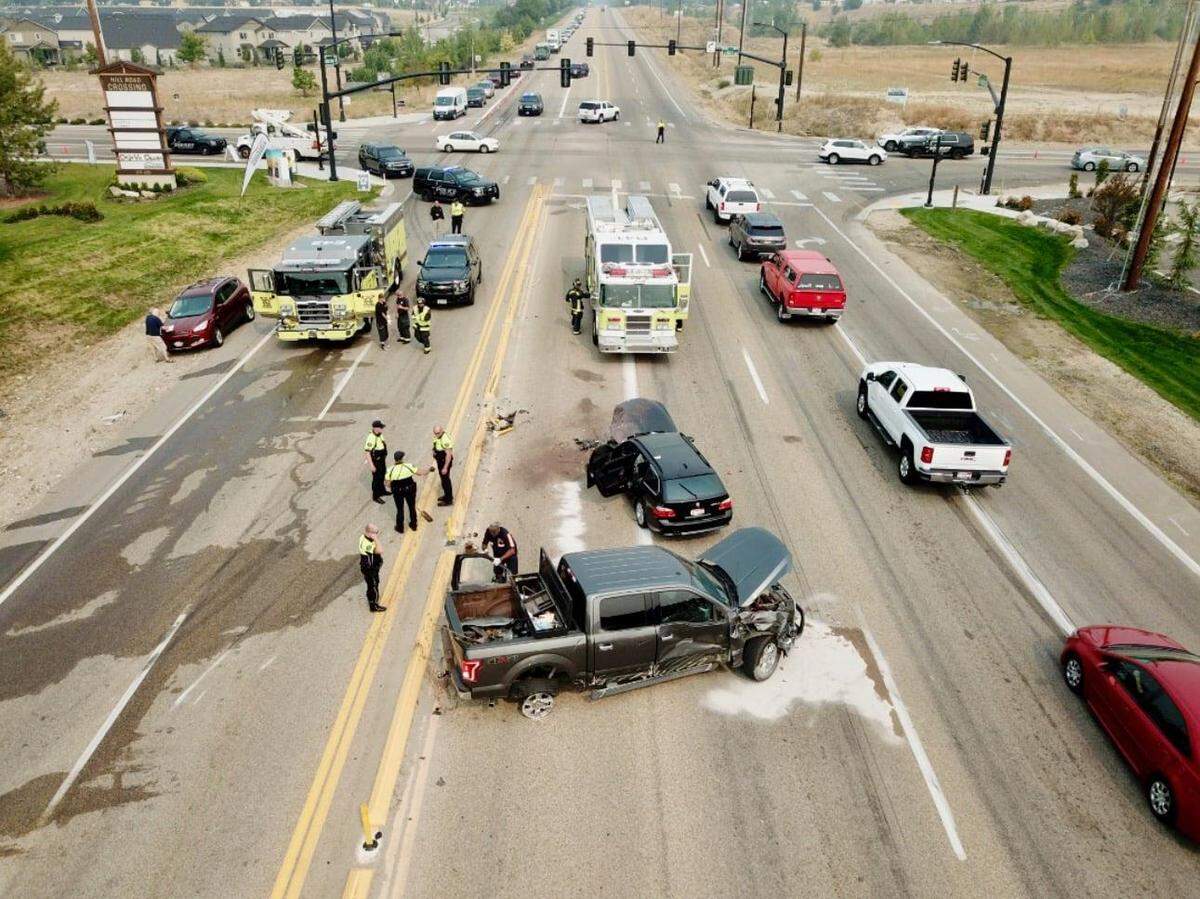
On Sept. 16, the driver of a Ford SUV tried to do a U-turn on a flashing yellow arrow on Idaho 55 at Hill Road in Eagle. He pulled into the path of a semitrailer driving south on the highway.
The semitrailer braked, trying to slow down, but couldn’t, according to the Eagle Police. The semi hit the SUV, and then a pickup truck. The pickup truck hit another car.
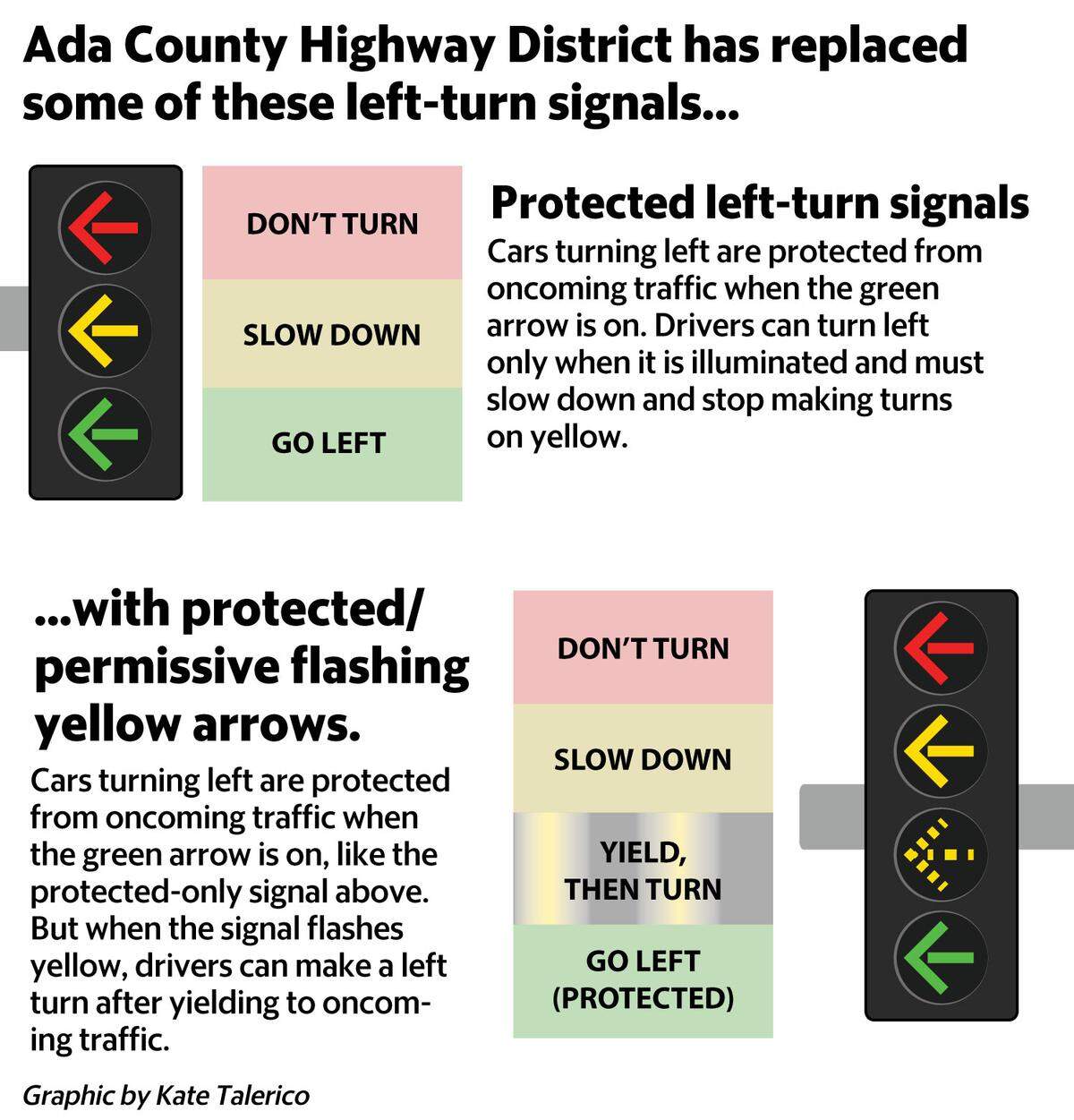
The flashing yellow arrows have long been hot spots for crashes. Last year, after a man was killed by an SUV turning left at a similar intersection, the Statesman reported that Eagle Police had expressed concern about the flashing yellow arrows since the Ada County Highway District and the Idaho Transportation Department began using them more widely in 2016.
Three people in the Idaho 55 crash were taken to hospitals for treatment for injuries, according to Eagle police.
In a Facebook post, Eagle police asked drivers to be more cautious when turning during a flashing yellow light. But seven commenters said this intersection, and others like it, should change, either with the removal of the flashing yellow arrow on the high-speed roads, or by lowering the speed limit along the increasingly busy suburban roads.
“It’s too much for drivers to comprehend in trying to judge approaching traffic speeds and gaps in traffic,” wrote Don Kostelec, a Boise transportation consultant and activist who previously worked at ACHD. “Expecting human behavior to be perfect is one of the biggest failed theories of traffic safety.”
“The speeds are too high ... to have flashing yellow lights,” wrote Robin Cabrini, who said her daughter had totaled her car making a left turn on one of them.
Road agencies respond
While crashes are often blamed on human error, heightened incident rates at certain intersections can point to a problem in the system — that indeed, the design of intersections lead drivers to make riskier driving decisions.
In June 2019, ACHD Executive Director Bruce Wong and ITD agreed to turn off the flashing yellow arrow at the intersection of Idaho 55 and Idaho 44 where the man, Steven V. Hatcher, was killed.
Wong also drafted a list of intersections where ACHD would study and consider turning off the flashing yellow arrows when traffic volumes are high and drivers have few opportunities to turn anyway.
Of the 63 intersections listed, 41 were on state highways, such as Idaho 44/State Street, which fall under ITD’s jurisdiction.
Since summer 2019, ITD and ACHD staff met with law enforcement to look at intersections that saw an unusually high amount of crashes.
Of the 63 originally listed, ITD and ACHD have removed the flashing yellow arrow completely at one other intersection beyond Idaho 44 and Idaho 55: Chinden Boulevard and Linder Road.
“The direction wasn’t necessarily to turn off all the (flashing yellow arrows),” wrote Natalie Shaver, public information officer for ACHD, in an email to the Statesman. “The direction was to continue assess these areas and make adjustments as needed.”
The agencies also removed the flashing yellow arrow during peak hours at Chinden Boulevard and Maple Grove Road and at Meridian and Overland roads. (In 2016, they also shut off the flashing yellow arrow at Idaho 44 and Edgewood Lane after a motorcyclist was killed there by a car turning left.)
“Addressing (flashing yellow arrows) on roads with higher speeds is just one part of this effort. Improving safety at (flashing yellow arrows) on all roads has been a top priority at ACHD,” wrote Shaver.
%20(1).jpg "Untitled design (4) (1).jpg")
State Highway 55 and Hill Road, where the Ford SUV turned into the path of the semitrailer, was one of the roads that ITD and ACHD considered, but where the flashing arrow was not removed.
Of the 22 roads ACHD looked at under its sole jurisdiction, half had a very low number of crashes associated with the flashing yellow arrows, she wrote. At other intersections, the flashing yellow arrow had been installed too recently to evaluate. The agency is still considering whether to make changes to the yellow arrow at Franklin and Five Mile roads.
“This is an ongoing evaluation process, and we do continue to check these facilities,” Shaver wrote.
Even the Federal Highway Administration encourages local road agencies to install protected left-turn signals in most places where the speed is greater than 45 miles per hour, though some traffic experts say they can be installed safely on roads with clear sight lines and lower traffic volumes.
Still, others argue that the lights, and the traffic-moving benefit they provide, should not be taken away because some people fail to yield.
“So because a few people are too stupid to drive, we should back up traffic?” one commenter responded to the Eagle Police’s Facebook post.
Pedestrian improvements
Beyond looking at roads with higher speeds, ACHD has also been looking at how it can better protect pedestrians at intersections with the flashing yellow arrow.
When stopped at flashing yellow arrows, drivers can sometimes be so focused on when they can turn between oncoming cars that they fail to look for pedestrians.
In February 2019, Boise residents Robert and Florence Goar, 89 and 87, were in a crosswalk when they were hit by a car turning left from Northview Street onto Milwaukee Street. The intersection has a flashing yellow arrow. The death sparked calls from activists to make the intersections safer for pedestrians.
In the year since, ACHD has rolled out new software to deactivate the flashing yellow arrow when a pedestrian push button is activated, Shaver said. So far, the agency has updated 85 traffic signals with the software, including the one where the Goars were killed.