
What are threats to Idaho’s Snake River? New report combs data, offers ideas
A superhighway for fish, a refuge for birds of prey, a leader in the agricultural industry and an epicenter for outdoor recreation — Idaho wouldn’t be all of these things without the Snake River.
The Idaho Conservation League released its first State of the Snake report last week, combing water quality data along the entire river to highlight what could be the biggest problems and outline possible solutions. The report outlines how water quality declines as it flows from snowmelt-fed headwaters through the agricultural heartland of Idaho.
“While progress has been made in certain areas ... the river is not as healthy as it could or should be,” the report says.
“There isn’t anything like this out there or any other group doing this sort of thing for the Snake River in Idaho, even though it’s arguably our most important waterway here in the state,” said Josh Johnson, Central Idaho director for the Idaho Conservation League and author of the report.
The report lays out the three biggest threats seen for the Snake River, but also relays optimism about the winding waterway’s future and posits next steps that should be taken to protect it.
Unchecked agricultural pollution
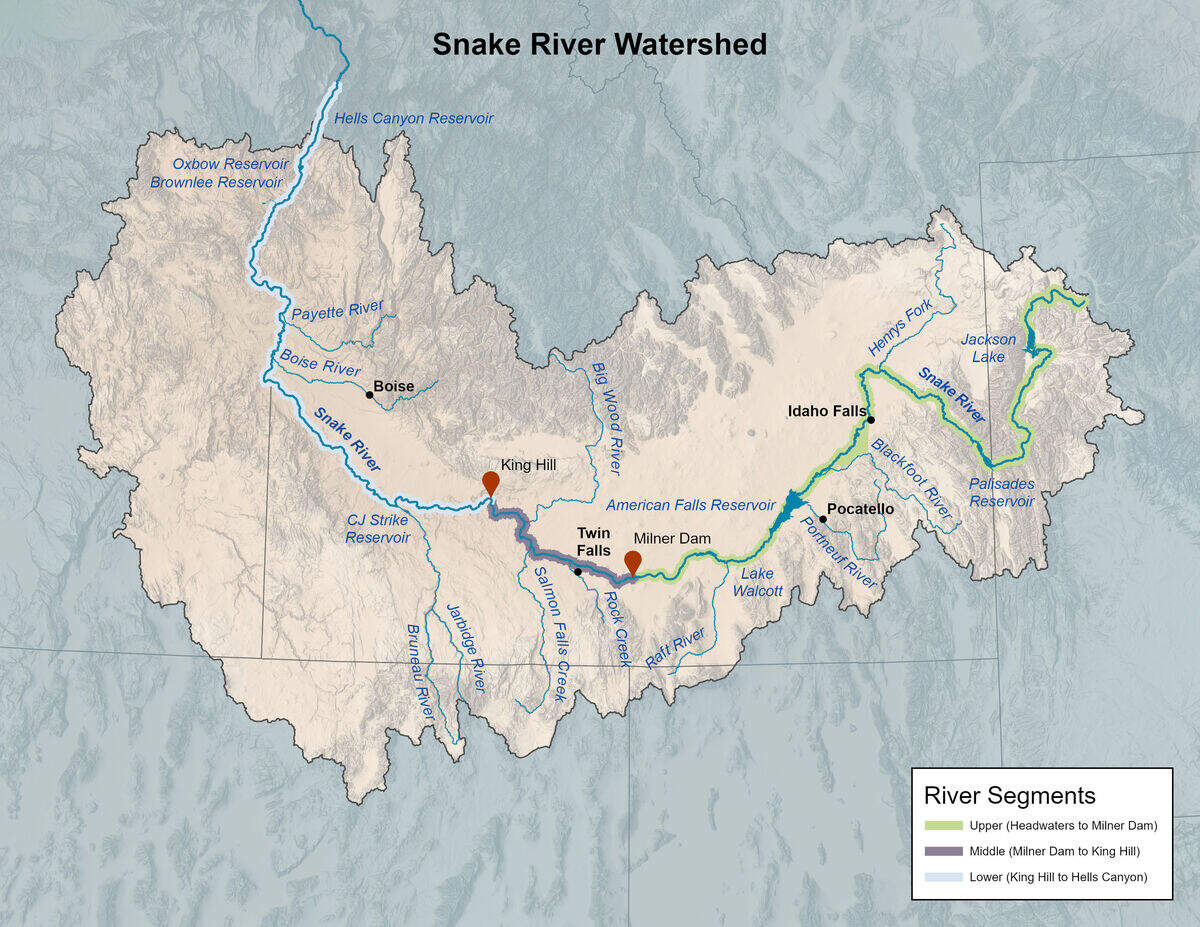
As is true for other agriculturally dominated regions, the major pollutants of concern for the Snake River are nitrogen and phosphorus. This problem is most pressing in the region near the Magic Valley agricultural scene in south-central Idaho.
“For reference, the (1.7 million) cows in the Magic Valley cumulatively produce a comparable amount of waste, nitrogen, and phosphorus as a city of roughly 80 million people,” according to the report.
But unlike human waste, which is treated, excess manure from concentrated animal feeding operations (CAFOs) is stored in unlined lagoons or spread on fields in excess of what the crops can use.
Excessive amounts of nitrogen and phosphorus from synthetic fertilizers and cow manure are then carried into the river by water and sediment runoff. This nutrient overload, known as eutrophication, can have a domino effect on the river ecosystem. The extra nutrients drive growth of algae and plants, which in turn deplete the water of oxygen, causing dead zones that can kill fish and lead to toxic algae blooms, according to the U.S. Geological Survey.
Planting cover crops, no-till farming and constructing artificial wetlands can help reduce agricultural pollution, but there is currently no regulatory pressure to implement these practices, according to Johnson. The federal Clean Water Act primarily regulates point source pollution and does not regulate “more dispersed agricultural runoff, non-point pollution, or explicitly often does not regulate CAFOs,” explained Johnson.
As part of the Middle Snake Watershed Advisory Group, the Idaho Conservation League is advising the state Department of Environmental Quality to revise limits on phosphorus pollution in the middle portion of the Snake River.
“The regulatory picture may not change,” said Johnson, “so I do think there’s value in focusing in on the incentive portion.”
The State of the Snake report stresses that in addition to developing regulation to hold CAFOs accountable, allocating state funding to incentivize pollution management could be a quick and effective solution.
As for where to start, Johnson said he’d like to employ tools such as BasinScout, developed by the Freshwater Trust. It compiles data from the individual fields in the watershed to identify the top contributors of agricultural pollution into the Snake River.
“The goal is not to villainize those farmers, but to understand where we can get the most bang for our buck with the limited funding we have,” Johnson said.
Invasive mussels and toxic algae
Invasive quagga mussels were first spotted in the Snake River in 2023, and drastic measures were taken to stop their spread.
These mussels filter large volumes of water as they feed, concentrating pollutants and increasing the chance of toxic algae blooms by eating only non-toxic algae species. They cling to hard surfaces, and in many cases that means clogging pipes that deliver water for drinking or irrigation.
The Idaho State Department of Agriculture treated the river multiple times with large amounts of a copper-based poison to kill the mussels. The copper shock devastated native invertebrate species, but Johnson pointed to studies on mine-impacted areas of the river that were once polluted with copper as evidence that, in time, the ecosystem will recover.
“It might take a decade, but it will come back. If we have quagga mussels in the Snake River, it won’t come back to what it was, it will be a new normal and be very different,” he said.
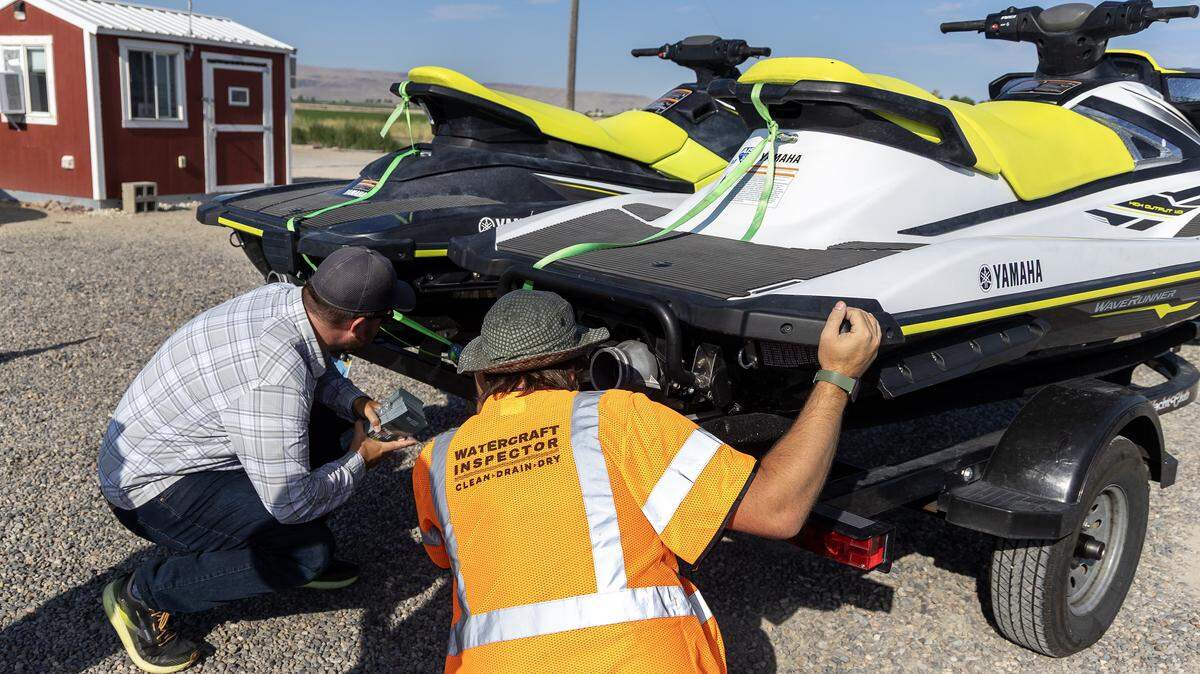
In the meantime, ISDA has monitoring systems in place, including watercraft inspection points, to eliminate the introduction of mussels from outside of Idaho — a problem officials have worried about for many years.
Toxic algae, on the other hand, is a public health risk that isn’t proactively monitored. “Right now I would characterize the toxic algae program at DEQ as reactive,” Johnson said.
Toxic algae is more likely to develop during the summer months in warm, slow-moving water, and the reservoirs along the Snake River fit that bill. “Brownlee Reservoir and Hells Canyon Reservoir have had confirmed toxic algae outbreaks each of the last three summers, with health advisories often persisting for months,” according to the report.
DEQ relies on people to call in and report potential toxic algae blooms, and then it may take days or even weeks to get test results back and issue a public health advisory. All the while, people and their dogs are recreating in the water and at risk.
“It’s just not an efficient way to do it, and it’s not a way that prioritizes public health,” Johnson said.
Johnson said the best solution would be to regularly test “the 20 or so water bodies that are repeat offenders.” But this idea, which he thinks would cost $200,000 annually, is looking less likely after budget cuts last year from the Republican-dominated Idaho Legislature reduced DEQ’s water quality and algae monitoring efforts.
“Unfortunately, we’re actually going backwards,” Johnson said.
‘A more optimistic picture than I thought’
Johnson has worked on the Snake River for a long time, and after compiling the report and seeing the whole picture, he said he wasn’t displeased overall.
“It actually painted a more optimistic picture than I thought,” he said.
Phosphorus levels still exceed DEQ limits in some areas, but overall levels have declined over the years, according to the report.
Past projects aimed at reducing Snake River pollution serve as proof of the concept that water quality can be improved, Johnson said. The report detailed examples of efforts “making a positive difference for water quality in the Snake,” including fish farms switching to fish food with less phosphorus; artificial wetlands constructed by the Twin Falls Canal Company to capture agricultural runoff; and projects by Idaho Power to reduce runoff in collaboration with The Freshwater Trust.
“We can improve the river, and we’ve done some of that, but I think the fallacy is thinking that we’re done,” Johnson said.