Eagle could grow to 100K, with 40% of its population in the Foothills. It’s trying to reverse course.
Drive far enough past the grapevine-covered slopes and the multimillion-dollar homes, and the Eagle Foothills start to empty. Nearly half that barren land belongs to the McLeods, an long-time Scottish ranching family that immigrated to Idaho in 1916.
For the past 15 years, the McLeods have planned to cover their old rangeland with houses. In 2004, they partnered with a developer to turn their 23,000 acres into a massive planned community called Avimor, with 10,000 houses to be built over 40 years.
Eagle has been planning for these homes, too. In 2007, as ranchers like the McLeods began to consider selling their land to developers, the City Council approved a plan that set the stage for thousands of new homes on 49,000 acres of Foothills, including the McLeods’ property. The plan would also allow Foothills landowners to annexed into Eagle and receive city services.
At the time, housing was booming. Growth in the Foothills seemed inevitable. Ada County had already given the McLeods approval to develop 919 acres of their 23,000. Planning for that growth to become part of Eagle was seen as wise.
The Great Recession changed all that.
Without builders breathing down its neck, Eagle began to rethink its plans. This year, under pressure from residents concerned about the costs of growth, the City Council began to consider whether it could limit the number of houses in the Foothills and keep development within Eagle’s current city limits.
The timing was good. Ada County, with leaders no longer amenable to approving planned communities like Avimor, wasn’t threatening to allow large-scale residential developments outside cities’ control, as it had before. And in the decade since the recession, many of the developers who had been eager to steer bulldozers toward the Foothills never returned. Some went bankrupt.
But not the McLeods.
This year, they approached the the city again through Avimor’s managing partner, Dan Richter, and said the time has come to develop their remaining land. Avimor has already built about 550 homes and plans to build 300 more under county jurisdiction. The city asked Avimor to determine how it would help pay for city services without costing current residents.
City officials presented Avimor with a list of demands aimed at protecting city taxpayers. Avimor addressed only some of them. They reached an impasse.
Seeing no way forward, the City Council began a process to repeal its 2007 plan for the Foothills. That would prevent urban-style growth there and thwart Avimor’s plans.
The effort prompted Avimor to push — successfully — for the election of friendlier leaders in the Nov. 5 election. And it brought into focus two sharply different visions for the future of the Treasure Valley’s wealthiest city.
Imagine Eagle in 2059 as a city of nearly 100,000, with nearly 40,000 in the Foothills. Of those, about 24,000 people, or 10,000 houses, would be located in Avimor. The city would spread across three counties: Ada, Boise, and Gem.
That’s the McLeods’ vision. It’s an expensive one for city taxpayers, the current mayor and council say, because the council won’t be able to provide police protection and sewer connections without raising taxes.
Now imagine Eagle in 2059 as a city of 70,000, with a maximum of 7,400 homes in the Foothills, housing about 16,000 people. That’s the alternative vision that Eagle City Council President Miranda Gold and Ada County Commissioner Diana Lachiondo are advocating.
Eagle wouldn’t have to extend city services into Boise and Gem Counties, nor would it have to pay for additional police to bring the level of service in its Foothills on par with that of the lowlands. That’s because nearly 70% of the land currently envisioned to be brought into the city would remain in unincorporated Ada County. The rest includes Foothills land that was annexed into Eagle in 2009, and some of the remaining county land between Beacon Light and Homer roads.
The county would let the McLeod land be developed with one house for every 10 or 40 acres. Perhaps Avimor could build closer to 1,000 houses — not 10,000.
For Avimor, such a change would be an immense loss. At a profit margin of $10,000 a home, that’s the different between making $100 million and $10 million.
And the remaining 7,400 or so homes that would still be built in the Foothills as part of Eagle? About 2,000 houses could go in between Beacon Light and Homer roads on lots between 1 and 5 acres apiece. But most would go up on mostly smaller lots in a 6,000-acre community called Spring Valley, which the city annexed in 2009, when it approved between 3,000 and 7,000 homes. The developer gave up on the project years ago, but it could sell the land to someone new who would acquire the right to build there.
The McLeods are frustrated with the city’s change of heart. So is Richter, the developer they hired to carry out the project.
“I worked for a year and a half with Eagle to get the 2007 plan,” he said in an interview. “At that time, everyone said, ‘We don’t want the county to have control of our doorstep.’”
The council is pushing for a change, fast, but time is running out. The city has less than a month to roll back its 2007 Foothills plan before an Avimor-friendly government takes the helm.

Avimor fights back
Avimor residents and employees have come out strongly against the city’s proposal. They’re proud of the way the community is planned.
For one, its homes are more affordable than those in Eagle — ranging in price from $260,000 for a 1,400-square-foot house to $1 million for a large estate on the ridge.
Richter says his homes use half the water and 70% of the energy of a typical subdivision in Ada County. Avimor households take fewer car trips each day than a typical Treasure Valley household. And although the homes are at a greater risk for wildfires than those in the lowlands, Richter said he has set strict landscape requirements for homeowners to prevent fire from spreading.
Richter loves talking about Avimor’s preservation efforts. Many people move there for the promise of open space. Avimor plans to build on just 7,000 of its 23,000 acres, clustering homes into dense “villages” connected by paths. The remaining 16,000 acres would be preserved as open space, with miles of trails for hikers and mountain bikers — all open to the public.
To hear Richter put it, if Eagle hands control of the Foothills over to the county, all of that will go away. He’s had his engineers draw up a map of what the Foothills would look like if carved up into 40-acre lots, all surrounded by fences.
“One of the things that they say is to preserve the Foothills for wildlife,” he said. “But 40 acre parcels don’t do that with fences. That’s just the worst thing you can do.”
County and city planners say that Richter’s prediction is off-base.
What would the Foothills look like in Ada County’s control?
If the city succeeds in forcing the McLeods to develop as part of Ada County, Avimor would look much different.
First, the McLeods could opt not to develop the rest of their Avimor land at all.
Few landowners in the Foothills have chosen to develop their land into 10 or 40-acre lots. Ten acres is the minimum allowable size.
Cost is a major reason. It’s expensive to build paved roads and install utility lines to serve widely spaced homes.
City planners don’t expect that will change. “You can’t just go out and run driveways there,” said Eagle city planner Nichoel Baird Spencer said.
Even Richter says he would never choose to divide up the McLeods’ land into 40-acre lots.
“That’s on no one’s horizon in this organization,” he said. “That’s just destruction of the land.”
But imagine for a moment that the McLeods did want to develop their land as densely as they could across the three counties they occupy. Zoning across all three counties would allow only between 600 to 2,000 homes.
The McLeods would need to the subdivide their land into smaller tracts. Subdividing would require county approval. And Ada County can add conditions to ensure that a subdivision include parks and open space, said Mitra Mehta-Cooper, the county’s strategic planning manager.
For example, Ada County has planned to build a park in Rocky Canyon, an area west of Idaho 55 currently owned by the McLeods. Ada County could agree to a subdivision only if the McLeods donate that land as a park. Because the McLeods’ land is also within a wildlife management area, the county might also force them to prohibit future landowners from putting up fences.
The county could require that the McLeods add easements for trails, which would ensure access to the public.
Even though Avimor lets the public on its trails, they remain Avimor’s private property — along with the parking lots at trailheads.
Richter previously planned to place public easements on the trails, but more recently he threatened to close them to the public if Eagle amends its comprehensive plan.
“We can’t afford to keep them open if we’re not welcome in the city anymore,” Richter told Eagle’s Planning and Zoning Commission at a public hearing in November.
“Development is what’s paying for us to be so generous,” he told the Statesman. “If there’s a roadblock to that… we would make them unavailable for most of the public.”
If control goes to the county, who could afford the Foothills?
Those who have developed in the Foothills pass the costs to buyers, raising the price of houses there. Ada County has in the last five years approved two subdivisions of 10-acre tracts just east of Highway 16. There, lots alone sell for close to $300,000 each. Since there are no water and sewer services in the county, buyers have to install their own wells and septic systems increasing costs.
“When you are restricted to a minimum of 10 acres to 40 acres, you simply do not have affordability like in a tract housing development,” said David Bensinger, a financial consultant in Eagle who is developing one of these subdivisions.“The only way we could develop our maximum allowable 14 lots was to put in a literal mile of roads and utilities. That naturally raises the price per lot.”
That stands in contrast to Richter’s vision for Avimor.
“I do have one-acre lots that I’m selling for $300,000, and they’ll have million dollar homes on them,” he said. “But they’ll all go to tap dancing lessons at our community center with the same guy that has the $250,000 house.”
Richter estimates that he has a higher ratio of teachers, police and firefighters living in Avimor than other communities in the Treasure Valley. Richter said he has plans to build townhouses and condos that might go for even less than $250,000. He’s also working with another developer who wants to build a senior living center there.
“We want it to be a small town,” Richter said.
A higher cost to taxpayers?
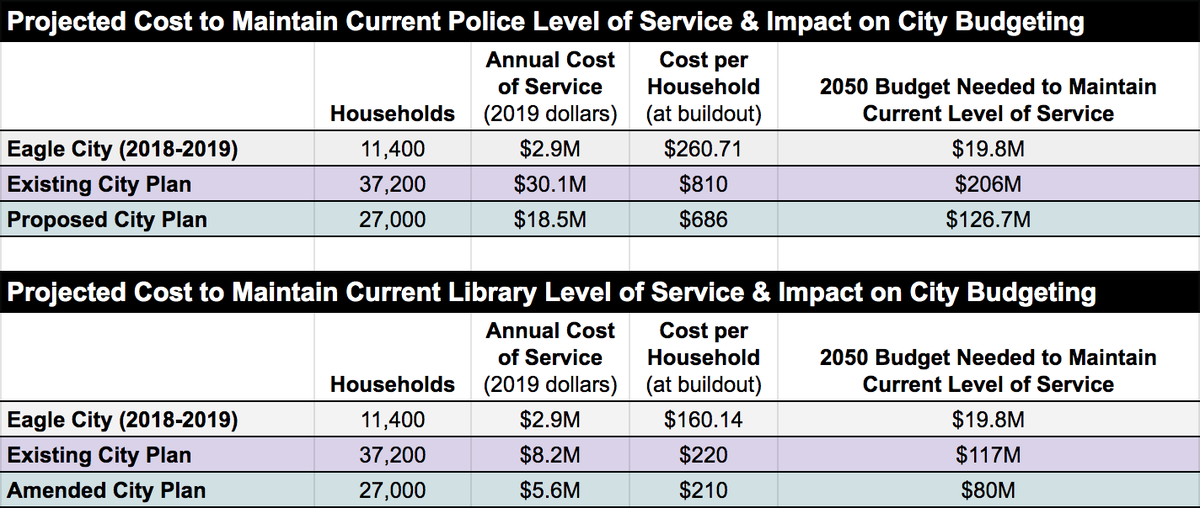
While Avimor markets its affordability, Eagle planners say annexation isn’t a smart financial move for current taxpayers. Baird Spencer, the planner, estimates that Eagle would be required to raise property taxes to maintain its current level of service throughout the city, or would need to reduce its level of service entirely.
Take police. In Eagle, police typically respond to an emergency within 3 minutes and 24 seconds. Meanwhile, the Ada County sheriff responds to emergency calls in Avimor in 15 minutes and 53 seconds (although the sheriff’s office receives fewer calls overall).
Why the faster response in the city? Because Eagle residents pay city property taxes to fund a larger police force. Were it to annex Avimor, Eagle would need to hire additional officers to provide that same level of service there.
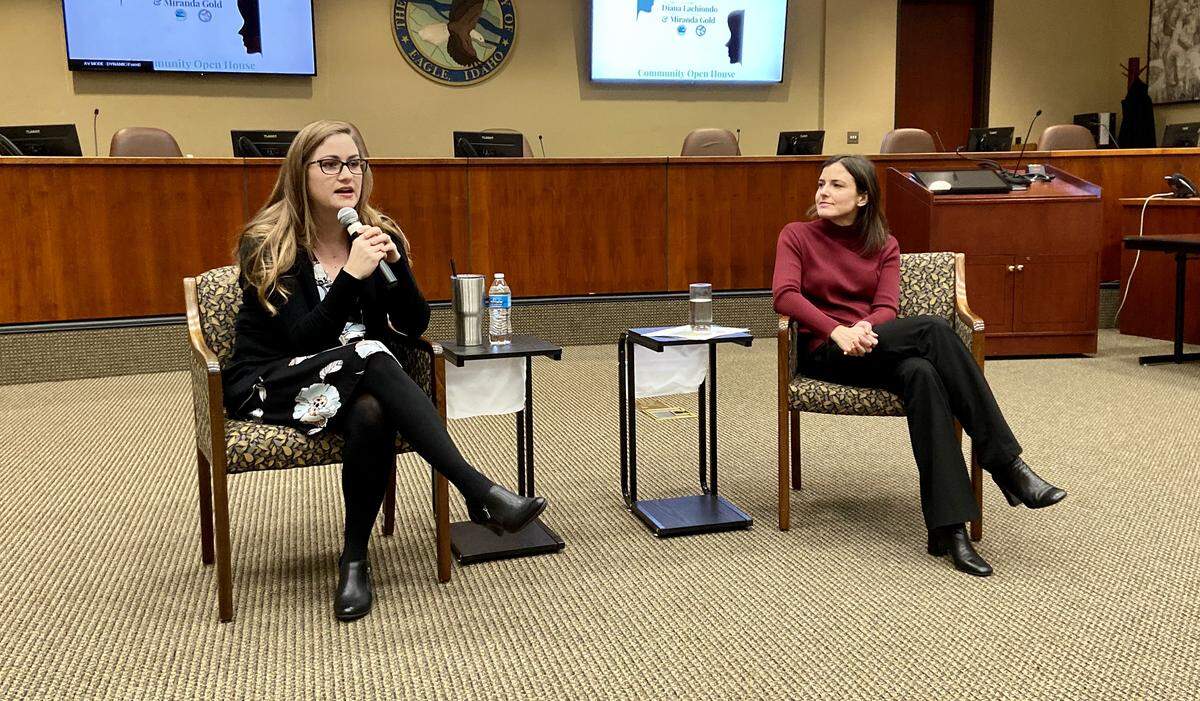
At a recent town hall on growth, County Commissioner Diana Lachiondo summarized Eagle’s dilemma.
“If you bring somebody into your city and they’re paying city taxes, do they deserve the same level of service?” she asked rhetorically.
Richter argues that the property taxes Avimor generates will be enough to pay for any additional police or services needed. He has also previously said Avimor would help fund a new police station.
But Baird Spencer points to a deeper problem in Eagle’s finances: For years, the city has used one-time revenues from new development to cover the cost of its operations.
Typically, these one-time fees go toward capital expenses, like a new police station, rather than the cost of the officers themselves. Property taxes are meant to cover operations. Such budgeting ensures that in the case of a recession — when development slows down — the city can put off investments in new buildings, but won’t struggle to finance its day-to-day needs.
Right now in Eagle, though, property taxes cover just 65% of the city’s operating expenses. Baird Spencer estimates that if the city lets growth happen in its Foothills, property taxes would cover less than 50% by 2040.
“This was one of the concerns expressed by the council,” Baird Spencer said at a planning meeting in November. “Fiscally, the city [is] not putting itself in a viable position to be continuing to develop forward.”
High stakes for Avimor
On a Monday afternoon in November, Dan Richter strolled through the Avimor community center. It’s the first building constructed in the community’s “village center,” the commercial area you see upon first turning into the community.
The village center has taken longer to develop than Richter hoped. In part, that’s because the recession slowed construction, and Richter hasn’t built houses as fast as planned. Any real estate investor knows you need rooftops before retail can go in.
But Richter still wants Avimor to have that Main Street feel. On Avimor’s dime, he started building a new brewery, which will be run by one of the first homeowners in Avimor. Richter imagines that in the summer, mountain bikers from across the Valley will stop by for a drink before continuing their downhill rides.
“When I come down to the community center, I want to see all kinds of bikes and no cars,” he said.
But to keep building the community center, Richter needs Avimor to keep growing.
“We spent $40 million on infrastructure to build the first house,” Richter said. That money went to extend Suez’s water lines up to Avimor, build a wastewater treatment station and pave the roads.
Avimor also has bonds to pay back.
Through what’s called a community infrastructure district, Avimor was allowed to sell bonds to pay for roadway improvements and sewer construction and levy a tax on homeowners to pay it back. The more homes built, the faster Avimor can pay off its debt.
Richter’s not worrying about that yet. He says that the bonds he took out are “small compared to value of the improvements.”
At the community center, Richter stopped in front of a photo of Colin “Sandy” McLeod, who died in 2013, midway through Avimor’s development. Everything Richter is working on came from “Sandy’s vision,” he said.
“We believed in the 2007 plan,” he said. “It was exactly what we wanted to build as well. ... It was a partnership. And we’re going to keep our agreement.”
This story was originally published December 11, 2019 at 5:00 AM.