
Boise can’t afford to build a ‘critical’ new road. Now, federal money promises help
AI-generated summary reviewed by our newsroom.
- The U.S. Department of Transportation awarded Boise $5.6 million for a Lake Hazel study.
- Local partners and city will provide a $1.4 million local match for the $7M study.
- The study must make the Lake Hazel extension implementation ready by Sept. 30, 2030.
The federal government will help Boise address a missing piece of its transit map — and develop a key link toward unlocking open land on the city’s southern flank.
The U.S. Department of Transportation on Thursday awarded Boise $5.6 million to plan the east-west extension of Lake Hazel Road, which would span a stretch of sagebrush steppe between Eisenman Road and Orchard Street. The city, public partners and private landowners with stakes in the area will cover the rest of the estimated $7 million study, according to a March application filed by Boise staff.
“This funding provides an incredible step forward for our community and region,” Boise Mayor Lauren McLean said in a press release announcing the award. “Once completed, the Lake Hazel extension will connect southwest Boiseans to future jobs and provide a critical roadway for industrial expansion.”
Road limitations hinder industry in south Boise
Both a Lake Hazel extension and a realigned Orchard Street are key to Boise’s evolving vision for the area city planners call South Airport. With its quick access to I-84 and proximity to Micron’s ever-growing campus, the area has rapidly reshaped itself into an industrial hub since the COVID-19 pandemic. Eisenman, which runs parallel to Interstate 84, has been a particular hotspot for industrial development as national firms look to take advantage of Micron’s investment and gain a toehold in the burgeoning Northwest.
But now easily accessible land is filling up, and developers are eying space farther from the highway. The problem is that there’s no road to get there. That’s why the city wants a new artery parallel to Gowen Road connecting to Lake Hazel at Orchard.
“South Boise is undergoing a structural transition from largely undeveloped land to a major industrial and employment district anchored by advanced manufacturing, airport-related industry, and logistics activity,” the city’s grant application states. “Decisions made in the next several years regarding corridor alignment, access management, and utility sequencing will determine whether this area develops as a coordinated, high-performing employment center or as a fragmented network of disconnected roadway segments.”
Ideally, the new Lake Hazel would be paired with a realigned Orchard Street. As built, Orchard loops around a one-time landfill before running into Gowen Road. It then jogs 500 yards west before continuing south. That won’t work for trucks accessing an area that McLean in January called “perfect for industrial development.”
Both ideas are penciled into the Ada County Highway District’s 2024 Master Street Map. The problem has always been money, according to Boise Council Member Jimmy Hallyburton. Each project on its own would have eaten up a year’s worth of the city’s ACHD funding allocation, Hallyburton said in a January council work session.
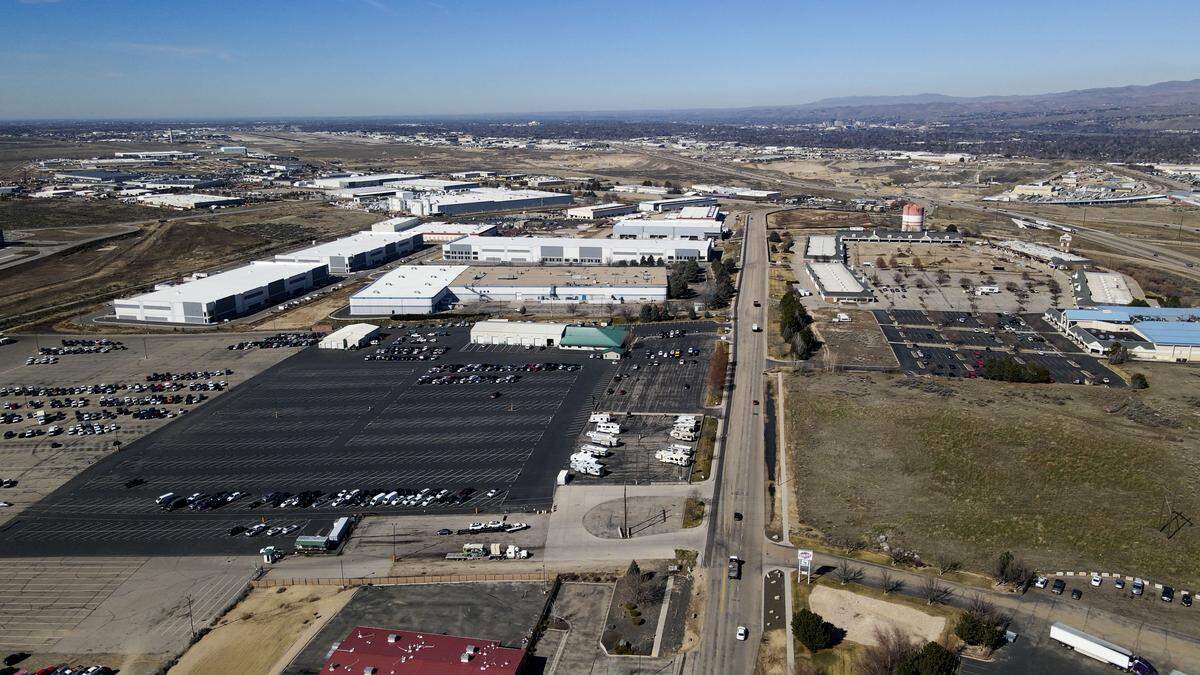
The Better Utilizing Investments to Leverage Development — or BUILD — grant will determine the exact route and design of the new Lake Hazel roadway, “bringing the project to shovel ready,” the city stated. The study includes a screening for environmental impacts, studying railroad crossings and “outlining a phased implementation plan” to ready the project for financing.
Timing here is key, as developers line up to take advantage of open land near the city’s growing industrial hub.
ACHD has $255 million in infrastructure projects earmarked for South and Southeast Boise, according to the application. About $212 million is tied to new growth, making them impact fee eligible. That means developers will pay to cover the costs of new infrastructure as they build.
Boise wants to determine where the larger roads will go before smaller ones come in one piece at a time, introducing “permanent inefficiencies” as “one of the Boise metropolitan region’s last major employment growth areas develops over the next 20-30 years,” according to the application.
Lake Hazel plan ‘critical’ to Micron’s growth
The city isn’t the only one eyeing a new Lake Hazel Road. Landowners, developers and employers — namely, Micron itself — are eager to see it built.
The Community Planning Association of Southwest Idaho projects between 15,000 and 19,000 new jobs to spring up in and around Micron by 2055. In that time, the planning agency predicts 4,690 households will move into the area, filling a cluster of large subdivisions either already approved or in the pipeline for development.
“This project is critical to supporting Micron’s growing workforce in the Treasure Valley and to ensuring the region’s transportation and housing infrastructure keeps pace with significant economic investment and job creation,” Heather Baldwin, Micron’s corporate vice president of procurement, wrote in a letter to Transportation Secretary Sean Duffy supporting Boise’s application.
“As Micron continues to expand operations in Southeast Boise, access to affordable and attainable housing located closer to our campus has become an increasingly important workforce consideration,” Baldwin continued. “The Lake Hazel Road Extension would unlock new residential development opportunities in South and Southeast Boise, allowing more Micron team members to live closer to their place of work and reduce long distance commuting pressures.”
Micron didn’t commit money to the planning study but two other companies with “direct economic interests in the corridor” are pitching in to the $1.4 million local match, according to the city. Scott Nicholson and Larry Williams each pledged $175,000 through their companies, Meridian’s Black Creek Limited Partnership and Boise-based B&L Co., respectively. ACHD has committed $400,000, and the Capitol City Development Corp., Boise’s urban renewal agency, promised $250,000.
The remaining $400,000 will come from city coffers.
“By providing access to stranded industrial land, the Lake Hazel extension is critical to supporting the 130% growth in households and 102% increase in jobs projected for this area,” CCDC Executive Director John Brunelle wrote in a letter supporting the application. “For residents, this road is a primary conduit to high-quality employment hubs; for businesses, it ensures reliable access to the regional talent pool.”
Per the terms of the grant, the study must be completed and the project “implementation ready” by Sept. 30, 2030. That means ready for environmental review, final design and financing and capitalization.
“As Boise grows and our roadway funding remains constrained, we are grateful for our federal partners who have helped quickly move this vital community project forward,” McLean said. “Thank you to Idaho’s congressional delegation for their support in bringing these federal tax dollars back home to Boise so we can invest in our city’s growth.”