Trump has big plans about homelessness. How could they affect Boise?
AI-generated summary reviewed by our newsroom.
- Trump's 2025 order opposes housing first, redirects funding to housing readiness.
- Boise policies, including new camping bans, may align with federal funding shifts.
- Civil commitment provisions raise concerns about rights and implementation fairness.
On one night in January this year, almost 800 people in Boise were homeless, according to the most recent Point-in-Time count, an annual tally of homelessness.
Idaho’s housing prices have skyrocketed in recent years, stretching budgets and contributing to the Treasure Valley’s increase in homelessness. The challenges have also stirred strong emotions, as advocates take two different approaches to solving what can seem like an intractable problem.
There’s “housing readiness”, which focuses on getting people treatment for mental health and drug problems so they are prepared to have a home. And there’s “housing first”, which aims to get people off the streets and then provide treatment.
President Donald Trump recently signed an executive order urging the federal government to end support for housing first. The order could ultimately affect Boise, and how much federal funding is available for local programs.
Some studies show that people tend to respond better to treatment when they already have shelter, a.k.a. housing first. However, homelessness still persists even as advocates use both approaches.
The diverging paths reflect a long, ongoing conversation about what the root causes of homelessness are, according to Lantz McGinnis-Brown, research scholar at Boise State University’s Idaho Policy Institute.
“Under one philosophy or one perspective … homelessness is often seen as a moral failing. Somebody did something morally wrong to end up in the situation of homelessness,” McGinnis-Brown said by phone. “Another perspective, coming from a more economic bent, is that homelessness is essentially an economic pitfall that can happen, especially to somebody who is working poor.”
Homelessness in Boise
Homelessness is a dangerous and difficult situation, marked by stress, danger and exposure to crime and drug use, according to McGinnis-Brown.
But the way society has attempted to end homelessness has changed drastically with the times.
For example, Trump’s executive order calls on governments to bring back civil commitment, forcing some people to get treatment against their will. That’s an approach reminiscent of the 1950s and 1960s, McGinnis-Brown said.
Ultimately those practices ended for three reasons: public outcry over inmate treatment, a revolution in medications and treating mental illness, and the high cost of keeping the institutions open, he said. In 1975, the U.S. Supreme Court ruled that people can’t be kept in confinement if they are not dangerous and can live independently.
In Boise, the city’s homeless policies ended up at the U.S. Supreme Court.
Six homeless Boiseans sued in 2009 after they were cited by Boise police for sleeping outside even though they had nowhere else to go. The 9th U.S. Circuit Court of Appeals ruled in 2018 that if people can’t sleep inside, then they can’t be punished for having no choice in the matter. Human beings have to rest, the court said.
The U.S. Supreme Court in 2019 declined to hear the case, leaving in place a decision that police couldn’t continue citing people if no shelter beds were available. Beds were considered unavailable if homeless people couldn’t comply with religious requirements, like mandatory praying or service attendance.
An Oregon district court and a 9th Circuit appellate court later said, in Grants Pass v. Johnson, that cities couldn’t fine homeless people for camping outside if they had nowhere else to go. The city of Grants Pass, Oregon, had punished people using camping paraphernalia like blankets or pillows while sleeping outside.
But that ruling was overturned in 2024 by the U.S. Supreme Court. Some West Coast political leaders, notably California Gov. Gavin Newsom, welcomed the decision. Newsom said the 9th Circuit’s decisions in the Boise and Grants Pass cases had overly restricted what governments could do about homeless encampments.
Since then, unsheltered homelessness has continued to go down in Los Angeles County, according to the Los Angeles Times. But, Grants Pass is still dealing with homeless encampments and settled another lawsuit over its approach to homelessness in August.
In recent years, Boise’s Interfaith Sanctuary homeless shelter has tried to expand its services to the former Salvation Army building on State Street. But those efforts have prompted strong feelings, heated public meetings and a January Idaho Supreme Court decision that overturned Boise’s approval of Interfaith’s original permit for the State Street shelter. The City Council changed its rules around permits and Interfaith Sanctuary applied again.
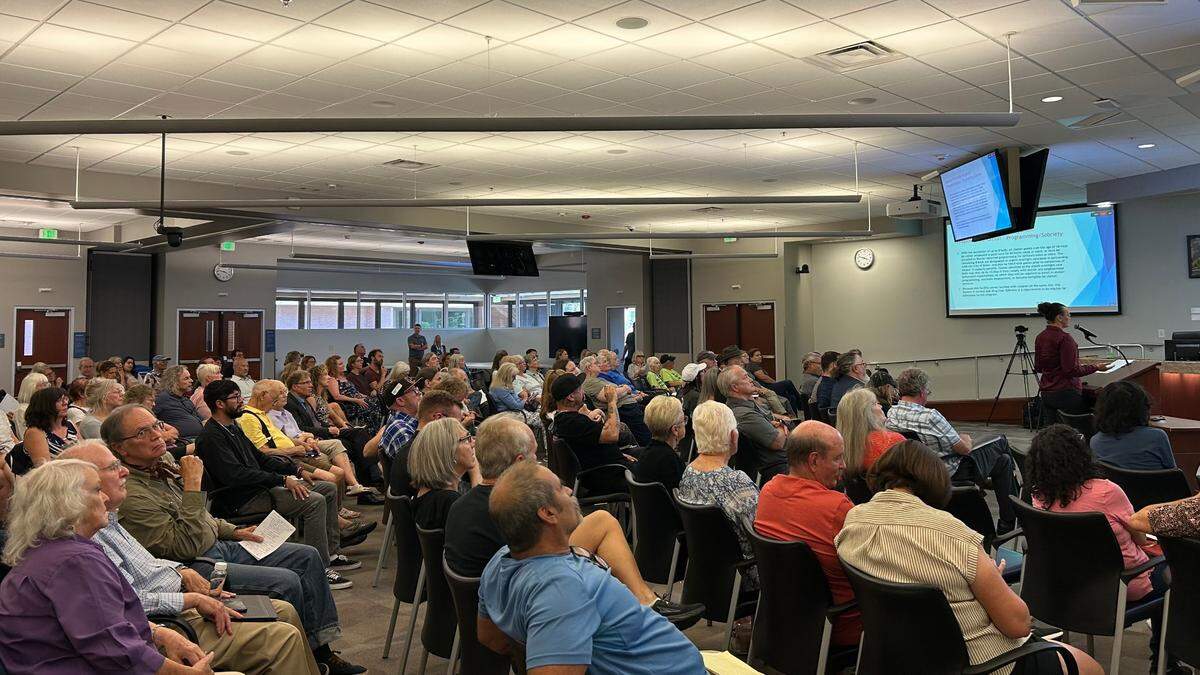
The council is expected to hold a hearing on Interfaith’s application on Sept. 30.
What’s the solution in Idaho?
Both schools of thought end at the same goal: Helping people live better lives, in places they can call their own. The main difference is the order in which people get housing and treatment. But the differences have inspired emotional rhetoric about which method is better.
“Housing first is atrocious,” Commissioner Rod Beck said during a July 31 Ada County meeting on homelessness. The county commissioners, including Beck, said they believed homelessness stems from drug and alcohol use and mental illness, rather than economic factors like high housing prices and low wages.
Trump’s executive order, signed on July 24, decried “endemic vagrancy” and “disorderly behavior.” He said most homeless people were addicted to drugs, suffering from mental illness or both. Trump also argued that the solution wasn’t “housing first” and directed federal agencies to send money to cities taking the housing-readiness route.
Jodi Peterson-Stigers, the executive director of Interfaith Sanctuary, said she doesn’t know how people would determine who needs to be institutionalized or who just needs stability and a meal. There hasn’t been enough housing in Boise to show whether housing first works locally or not, she said.
New Path Community Housing, a 40-unit housing first model, has served 100 people since its 2018 launch, according to Boise State University’s 2024 program evaluation.
Residents show a decrease in emergency room visits and hospital stays after they enter New Path, the report said. Four residents reported sobriety as a success for the year, but that data isn’t tracked for every resident, according to McGinnis-Brown. That’s in part because of the program’s philosophy, which is getting people off the streets and saving money. Requiring sobriety would block some people from entering and staying in the program.
“New Path is designed to get people into housing in order to avoid the dangerous (and expensive) symptoms of homelessness,” he said via email. “Encouraging sobriety isn’t a 100% overlap with solving homelessness.”
Of the nine people who left New Path in 2024, about 80% left for other housing, whether for a stable situation (55%) or something less stable, like staying with a friend or family (22%), he said. The vast majority of residents are disabled, he said, but those who work and can afford rent pay 30% of their income. Working, going to school or volunteering is not required to be in the program.
“Having a variety of programs available is good, because it gives individuals the freedom to engage with the services that work best for them,” he said.
At the Boise Rescue Mission, an average of 15 people graduate from the drug and alcohol recovery program per year, according to Bill Roscoe, president and CEO of the Boise Rescue Mission. Of those, 80% remain sober the year after completing the program, but it’s hard to track beyond that, he said.
People have to live at the Rescue Mission during the program, which in some ways echoes a housing-first principle. But Roscoe said unlike housing first, his programs require treatment, counseling and working toward sobriety. His way is successful, he said, because there’s accountability.
The drug and alcohol recovery program is Bible-based, Roscoe said. Participants must go to religious services once per week. Those who live in the mission’s transitional apartments must attend church regularly.
The mission hosted over 2,700 guests in 2024, Roscoe said. He estimated 15% of those who go through the mission’s programs return to homelessness. Between 250 and 500 people leave the mission each year to independent living, Roscoe said.
Part of the problem is that anyone who is struggling must decide whether to get help. That rings true for those who are homeless and those who are not. “We have to persuade them that there is a way out,” Roscoe said.
He said he’s happy but not surprised to see Trump’s executive order. Roscoe’s goals, like the executive order, are for people to “recover from homelessness, not just live on in a subsidized apartment for the rest of their lives in dysfunction.”
But someone who is struggling with the trauma of homelessness could show improvements if they had someplace safe to stabilize, said Peterson-Stigers, with Interfaith Sanctuary.
“It’s so concerning,” Peterson-Stigers said by phone. “Where’s the infrastructure to ensure the humane treatment of people currently experiencing homelessness?”
How will Trump’s order affect Boise?
Some local proponents of housing readiness told the Statesman that Boise will be in a good place to receive federal funds. That’s in part because of a new law passed in the 2025 Idaho legislative session, against Boise’s wishes, that bans public camping. Sen. Codi Galloway, R-Boise, sponsored the bill, though she did not disclose that her husband owns a business near Interfaith Sanctuary.
But advocates around the country and in Idaho still don’t know what to expect.
Boise spokesperson Maria Ortega said it was unclear yet how the new executive order would affect the city. City officials declined an interview request from the Statesman.
“We recognize that there is no one fix-all solution, and that this is an issue that local jurisdictions, the state, and federal agencies must look at together,” said Nicki Hellenkamp, Boise’s director of housing and homelessness policy, in a statement sent via email. “We are committed to leaving no stone unturned in creating a safe and welcoming city for everyone.”
It’s also unclear if or how the order could affect federal homelessness funding administered by the Idaho Housing and Finance Association, according to spokesperson Benjamin Cushman. The association, an arm of state government, annually awards to developers Idaho’s share of the federal tax credits that provided much of the money to build the New Path apartments in 2018 and an expansion now under construction. It also administers federal housing-choice vouchers across much of the state to help low-income tenants pay rent.
“Ultimately, it depends on how the federal agencies implement the order and how Congress makes its funding decisions,” Cushman wrote in an email.
Under the order, people who are living on the streets and cannot care for themselves could be subject to civil commitment. That language could cast a “wide net,” depending on what it means to not be able to care for yourself, according to McGinnis-Brown. Around half of homeless people work, according to a 2021 study, and could be swept up in the order’s provisions.
Galloway, who sponsored the public camping bill, said by email that her law will help Idaho’s eligibility for federal dollars. Trump’s executive order was “common sense leadership,” she said. In Idaho, she indicated that more legislation could be coming.
“At this point, we are still watching and gathering data to see how the Galloway Law performs in creating a clean, safe, and accessible Boise,” Galloway said. “Getting a hole-in-one would be amazing, and no new legislation would be needed. However, if we see public camping problems, we will come back and tighten it up.”
This story was originally published September 11, 2025 at 4:00 AM.
CORRECTION: This story has been updated to reflect the year with the most recent point-in-time count data available, 2025.