Interfaith Sanctuary shelter approved, again, after 9-hour public hearing. Why?
AI-generated summary reviewed by our newsroom.
- Boise planners unanimously approved Interfaith's 205-bed shelter on State Street.
- Opponents cited safety and property concerns; an appeal to City Council is expected.
- Shelter added security plans after January court ruling voided earlier project approval.
After a public hearing that lasted nearly nine hours, the contentious Interfaith Sanctuary homeless shelter on State Street is moving forward for a second time.
Boise’s Planning and Zoning Commission unanimously approved a permit for the construction of the shelter — which would be the only low-barrier shelter in the city — on Monday in front of what had started as a packed crowd that dwindled as the hearing dragged deep into the night.
Opponents and proponents argued over public safety concerns versus the need for the shelter amid growing homelessness and lack of affordable housing. At times, the testimony skidded toward animosity, exasperation and anger over the 205-bed shelter at 4306 W. State St., at a former Salvation Army location that abuts homes in the Veterans Park neighborhood.
Commission Chair Chris Danley pushed Veterans Park Neighborhood Association President Katy Decker, Interfaith Sanctuary Executive Director Jodi Peterson-Stigers and its attorney, Geoff Wardle of Boise’s Clark Wardle law firm, to work together more and find common ground.
“Don’t make me make you hug,” Danley remarked at one point.
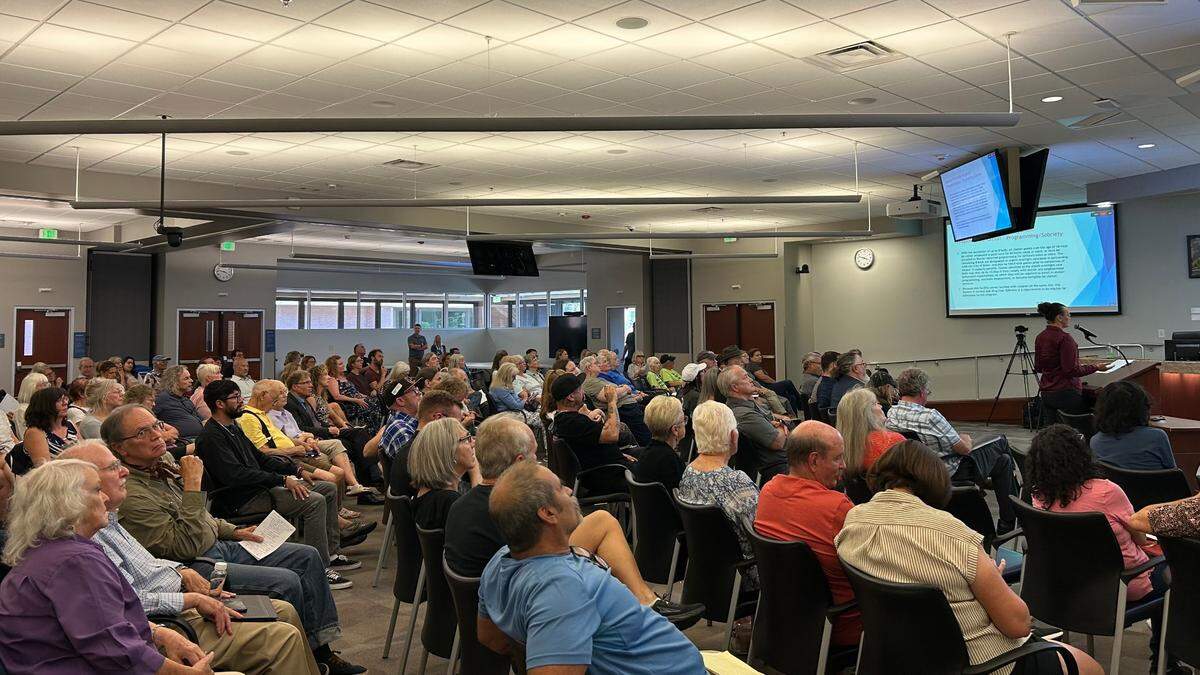
The commissioners’ approval sets the stage for a likely appeal to the Boise City Council from the Veterans Park Neighborhood Association, which has opposed the project since it was first announced and approved in 2022. The association has argued that the shelter could put nearby residents at risk and decrease property values.
The approval is the second time it has gone through the permitting process. The Idaho Supreme Court ruled against its first approval in January. While most of the plan stayed the same, Interfaith added several additions, including operation and security plans developed with the city police and fire departments.
Opponents said the added security measures didn’t go far enough. The recommendations included paying for neighborhood patrols, reimbursing losses in property values, and prohibiting the shelter from providing services to people not registered with the shelter.
The commission rejected those but added a requirement that Interfaith work with the Police Department, the Veterans Park Neighborhood Association and other city officials to strengthen public safety efforts.
“Between right here and right now and when anybody can enter the building officially, there’s still time and opportunity for these things to get figured out,” Danley said.
Fears and hope for State Street
Residents said people in the shelter could stash weapons in the neighborhood since they’re prohibited on the shelter property. They said there wasn’t enough pedestrian safety along State Street, and said the concentration of people experiencing homelessness could affect the nearby Willow Lane Park.
Some 90 people signed up to testify during the hearing, with over 300 people submitting written comments split almost evenly between opponents and supporters.
Bobbie Aitchison, who lives about 2 miles southeast of the site, said she operated a transitional housing program for 25 years, but she too had safety concerns.
“I’m well aware of the burning desire to help folks reintegrate, but I’m also well aware of the effects that need to mitigate it when there’s a concentration of folks who are living with these challenges,” Aitchison said. “I propose that there is much more that can be done.”
Aitchison asked that the city ensure the measures are functioning well over time.
“It may not be cheap or easy, but it can be done,” Aitchison said. “I know, because I have done it.”
Representatives of the police and fire departments said there could be an increase in calls for service. But they said they expect an increase with any high-occupancy development.
“With any sort of high-density housing, if you’re putting many people in one area, it is very reasonable to expect an increase in health care services,” said Ed Fritz, crime-prevention supervisor for the Police Department. “A lot of that does depend also on the actions by the sanctuary, how they execute their plants and policies.”
According to Mike Bisagno, division chief for the Boise Fire Department, “it’s the same as if you put apartments somewhere around town. We’re going to have a few more calls there.”
Bisagno added that the operations at the shelter — which is not an emergency shelter like the River Street location — could also result in better outcomes for the surrounding area.
According to Peterson-Stigers, the executive director of Interfaith, the new shelter would differ from the River Street location in several ways. Most notably, the shelter would operate using a pre-approved guest list, with reservations and background checks required for intake and a waiting list for potential residents.
The shelter would provide beds and services 24 hours per day, seven days a week with a curfew for residents, according to Josh Wilson, design review manager for the city. Residents would be able to leave the shelter for jobs and outside obligations, provided they return within the prescribed hours each evening.
This differs from an emergency shelter, where guests often wait in lines to find a bed on a first-come, first-served basis and must leave in the morning.
According to Wardle, the River Street property has already been sold, and many of the family and medical services the organization has provided with the city of Boise would disappear if the new State Street location doesn’t become a reality.
A contentious history over Boise shelter
The proposed shelter has faced resistance since Interfaith announced its plan to move from its River Street location near Rhodes Skate Park to State Street.
The Planning and Zoning Commission deniedthe original application, which the Boise City Council then overturned in 2022. Opponents then petitioned the Idaho Supreme Court, which threw out the City Council’s approval, calling it “arbitrary and capricious and based on unlawful procedure.”
The court said city code didn’t allow the City Council to overturn a Planning and Zoning Commission decision unless it found the commission had made a mistake. “A mere difference of opinion, like the one in this case, (does) not suffice,” according to the court’s summary of its ruling.
Construction had already begun on the project when the court ruled in January, and it has continued since. According to city staff, some approvals by the city’s Design Review Commission that weren’t affected by the ruling allowed Interfaith Sanctuary to continue building parts of the site.
“Interfaith is our only low-barrier shelter in the city,” Boise City Council Member Colin Nash said at a town hall in January. “If we do not have a low-barrier shelter in this city, we are going to have serious problems.”
Interfaith is considered a low-barrier shelter, meaning it has few qualifications. As long as guests do not steal, act violently or damage property, they can stay at Interfaith.
The Rescue Mission is considered a high-barrier shelter. As Boise Rescue Mission Ministries President Bill Roscoe told the Idaho Statesman in 2022, there are more rules at his shelters, including “no drugs (or) alcohol, no foul language, no threats.” Guests must remain drug-free and sober during their stays or they may be told to leave. Guests also must follow habits laid out by the shelter, such as eating meals with the organization, changing clothes at night and turning the lights out at a certain time.
In May, the City Council amended its code to allow it to reverse P&Z Commission decisions, even if it hasn’t found mistakes in the decisions.
Supporters of the change, such as Nash, said that would ensure transparency and accountability. Unlike City Council members, Planning and Zoning Commission members are unelected appointees.
Katy Decker, the president of the Veterans Park Neighborhood Association, said the change was troubling and would allow the City Council to retry cases from scratch.
Statesman reporter Sally Krutzig wrote the low- and high-barrier descriptions used in this story in 2022.
This story was originally published July 8, 2025 at 5:52 PM.